Invest1 publisher2 min readPublished
Dilution alone cuts a 0.25% startup grant to 0.153% by Series C
Of Dollars And Data walks a quarter-point grant through vesting, dilution, preferences and exercise costs. Vesting ends years before a typical exit, and most of the markdown comes from events beyond the employee's control.
The Investor · Invest desk
What happened
- Of Dollars And Data works a standard case: employee number ten takes 0.25% of a company on a below-market salary and calculates $250,000 on a $100 million sale. The site puts the figure at $97,500.
- Grants typically vest over four years with a one-year cliff, 25% at the anniversary and 1/48th a month after. An employee who leaves at two years is entitled to 0.125% of the company.
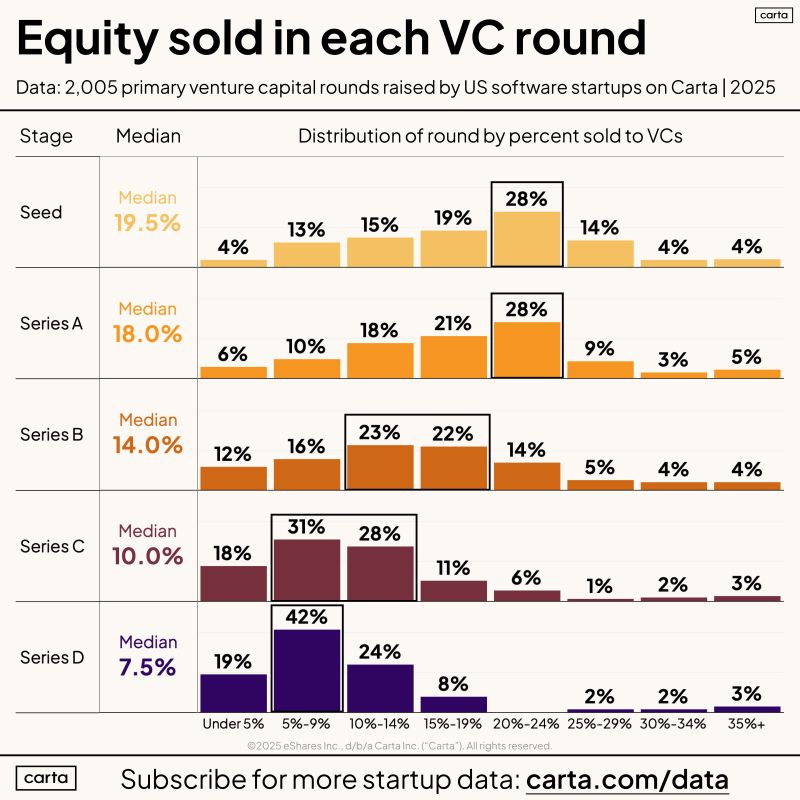
- Typical dilution runs 20% at Series A, 15% at Series B and about 10% a round after that, taking the same 0.25% stake to roughly 0.15% by the end of a Series C.
Compiled by The InvestorSomething wrong?How this is made
Why it matters
- cost Anyone who cannot write the five-figure cheque inside 90 days forfeits equity they already earned.
- constraint The end of the vesting schedule leaves two options: stay employed until an exit, or pay to keep what vested.
- exposure The employees whose companies exit early are the ones sitting behind preference stacks on small sale prices.
- decision With the pay cut stated only qualitatively, the one number a candidate can verify at signing is the salary, and the grant's value depends on financing terms other people set later.
Take the dilution schedule on its own. Of Dollars And Data runs a 0.25% grant through a Series A at 20%, a Series B at 15% and a Series C at 10%, and the product is 0.153% [5][15]. On a $100 million sale that is $153,000, so three financings by themselves remove $97,000 of the $250,000 the new hire worked out in their head [2][16][17]. The piece lands on $97,500 [3]. The text we have breaks off mid-sentence in the section on taxes, before itemising the remaining $55,500 [18][14].
Timing does more damage than any single financing term. "Arguably the biggest issue that prevents employees from realizing their equity isn't related to financing mechanics, but timing," Of Dollars And Data wrote [11]. Equity vests over four years with a one-year cliff [4]. PitchBook put the median time to IPO for tech companies at 11.5 years [8]. Someone who vests in full and then leaves sits about seven and a half years short of that median. Then comes a 90-day window to decide whether to buy the options at a strike price fixed by the valuation on their hire date [19][10][12]. For later hires the site says that cheque often runs to five figures, due in cash, locked up for years and earning nothing [12].
Jared Heyman's analysis of Y Combinator companies found the ones exiting above $1 billion took about nine years and the ones below $100 million about three [9]. A liquidation preference takes the first dollars at that end of the range. In the article's own example, a fund paid $10 million for half a company at a $20 million valuation with a 1x preference, and it collects that $10 million from a $15 million sale, leaving $5 million for the founders and employees [7]. Holders of 50% of the equity get 33% of the price [20].
I'd treat the grant as a claim on an event somebody else schedules, bought with a salary the article describes only as "a bit below what the market pays for your role" [1]. Whether $97,500 is cheap or expensive depends on that discount being stated in dollars. The counter-case is in the same numbers: the same diluted 0.153% is worth about $1.53 million if the company exits at $1 billion, a size that took about nine years in Heyman's data [21][9]. Refresher grants can offset the pool refreshes that dilute early employees further, though the article notes they do not always arrive [6]. Some companies now give departing employees five to ten years to exercise rather than 90 days [13].
What to watch
- Any revision to PitchBook's 11.5-year median time to IPO moves the seven-and-a-half-year wait one for one.
- Whether more venture-backed exits land under $100 million inside three years, where a 1x preference absorbs the first dollars.
- Offer letters that state the salary discount in dollars alongside the percentage would let a candidate price the trade at signing.