Build1 publisher3 min readPublished
C4ADS traces $4.6bn of Nvidia hardware to one Southeast Asian importer with unresolved ownership
A C4ADS investigation maps three routes for restricted accelerators into China, and almost all of the value it counted sits with a single importer whose ownership is still unresolved.
The Engineer · Build desk
What happened
- The monitoring nonprofit C4ADS published a report naming three routes by which export-restricted Nvidia accelerators reach China: research-institution purchases, Southeast Asian drop-shipping, and nested shell companies.
- Drop-shipping through Vietnam, India and Malaysia, which is technically legal, moved $13.4 million of A100, H100/GH100 and AD102-series GPUs between 2022 and 2025.
- Two Hong Kong firms dominate the receiving end, and one of them, Profit New Limited, traded $8.7 million of silicon in a single day in March 2025, before April's tightened controls.
Compiled by The EngineerSomething wrong?How this is made
Why it matters
- constraint Screening shipment routes reaches the $13.4 million channel. The $4.6 billion one turns on corporate registries in three countries, and customs data does not answer it.
- exposure A reseller or broker transacting with the region's largest Nvidia importer is dealing with a counterparty whose ownership the investigators could not establish.
- precedent With almost all of the traced value sitting behind one unresolved entity, beneficial-ownership checks on importers become the obvious next enforcement target ahead of route analysis.
- contradiction Washington bars the sales and Beijing formally discourages the purchases, yet the report says exceptions went to ByteDance, Alibaba and Tencent in 2026 and gray-market imports are tolerated, so neither rulebook describes the actual flow.
Divide the research-institution total by the chip count and you get roughly $30,400 a unit: 56 chips, $1.7 million, July 2025 to January 2026 [11][22]. C4ADS, which is funded mostly by the U.S. government, says those GPUs sat inside "sprawling multi-vendor contracts" routed through small Chinese regional integrators [1][9]. Some of the buying institutions have ties to the CCP and to China's defense and intelligence sectors, according to the report [10]. An earlier C4ADS investigation, covering multiple years of government records, put the same channel at $6.48 million [12].
The drop-ship route is harder to call, because its cover story is a real process. Most Nvidia silicon is made and packaged at TSMC in Taiwan, and a chip or the accelerator around it may go through several rounds of testing, sometimes more than one trip, before it reaches a customer's data center [5]. Vietnam has chip testing facilities, so a Taiwan-to-Vietnam leg has an ordinary explanation [14]. A portion of the purportedly tested chips then travelled on to Hong Kong [15]. The report leaned on the fields where that explanation runs out: high-value shipments recorded without cost, insurance, weight or freight values, and import values declared as zero [17].
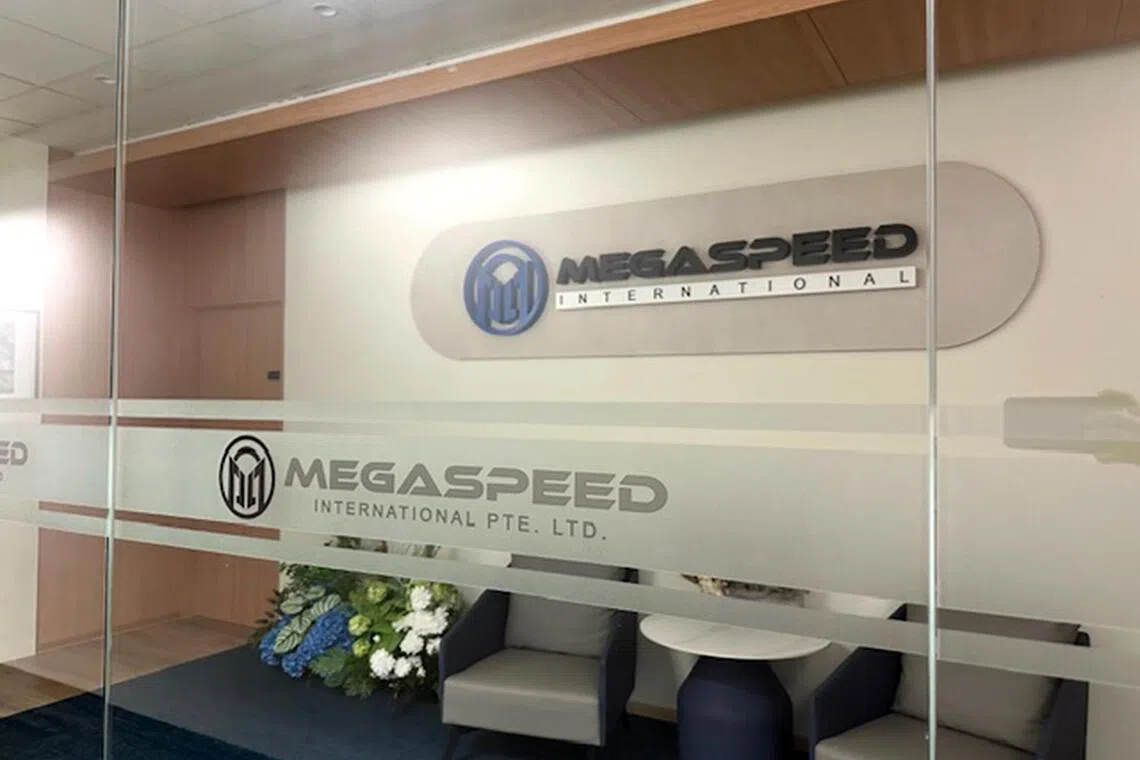
The largest category by value is opaque ownership. C4ADS puts $4.6 billion under it and books all of that to one entity, Megaspeed International, the biggest Southeast Asian importer of Nvidia hardware between 2023 and 2025 [18][19]. That is about 340 times the $13.4 million the report traced through drop-shipping [23]. Megaspeed operates companies in Singapore, Indonesia and Malaysia, was bought in 2023 by the Singaporean firm Swiftdata, and before that belonged to the Chinese gaming company 7Road Holdings [20]. During the handover its major shareholder was briefly Huang Le, a Chinese businesswoman who is also a director of a Hong Kong company [21].
Trade data records a shipment; the beneficial owner sits outside it. C4ADS followed Megaspeed through filings in three countries and still calls the ownership "unresolved" [19][20]. The report maps trade patterns and stops short of the liability of the intermediaries that handled the parts.
Which part number is in the box still decides the legality. H100, A100 and Blackwell-family chips cannot be sold to China, while the H20, the H200 and AMD's MI325X move case by case, with a 25% tariff on the latter [6]. Beijing's stated policy discourages and restricts purchases of American accelerators in favour of a domestic effort led by Huawei [7]. The report counted chips only where its records named them explicitly, so its totals are floors [3]. Epoch AI has estimated that around a third of China's AI compute, and possibly most of it, consists of smuggled GPUs [4].
What to watch
- Whether any registry filing or follow-up investigation resolves who owns Megaspeed above Swiftdata.
- Whether Beijing's 2026 exceptions for ByteDance, Alibaba and Tencent widen, changing what counts as a gray import.
- Whether U.S. enforcement action reaches the Hong Kong importers named in the report, Profit New Limited and ELB International Limited.