Science1 publisher3 min readPublished
Genetics and carrying-capacity models put Australia's pre-1788 Indigenous population at 2.22 million
Researchers writing in Nature Human Behaviour estimate a median pre-colonial Indigenous population of 2.22 million and 2.06 million excess deaths by 1861, built from genetics and environmental modelling instead of colonial head counts.
The Scientist · Science desk
What happened
- A study in Nature Human Behaviour puts the median pre-colonial Indigenous population of Australia at 2.22 million people, or 0.29 per square kilometre, against earlier historical figures of 250,000 to 1 million.
- The most-cited prior baseline is Alfred Radcliffe-Brown's 1930s calculation of 250,000 people, which he acknowledged did not account for lethal disease or frontier and structural violence.
- The 2021 census count sits at about 37% of the new median, and on current growth trends the researchers do not project parity with the 1788 population until around 2047.
Compiled by The ScientistSomething wrong?How this is made
Why it matters
- constraint Because the baseline deliberately avoids colonial-era observation, there is no rival head count to check it against. Disagreement about the 93% will be a fight over model assumptions.
- capability Groups working on other colonised regions now have a worked route to a pre-contact baseline that does not depend on counts taken after epidemics and violence had already reduced the population being counted.
- precedent A modelled median with an uncertainty range is being offered to processes that have treated documentary records as the standard of proof, and Bradshaw ties it directly to truth-telling and reconciliation.
- contradiction The write-up's "up to seven times" and its own median do not rest on the same prior figure, so which earlier estimate a citation leans on changes the claimed scale of the revision.
The estimate can move this far from the old one because it does not begin with anyone counting people. Alfred Radcliffe-Brown's figure of 250,000, calculated in the 1930s, still anchors many later estimates [4]. He worked from observations made after epidemics and frontier violence had already passed through, and he acknowledged that his values did not account for lethal disease or frontier and structural violence [5]. Any estimate built on post-1788 observation inherits that problem.
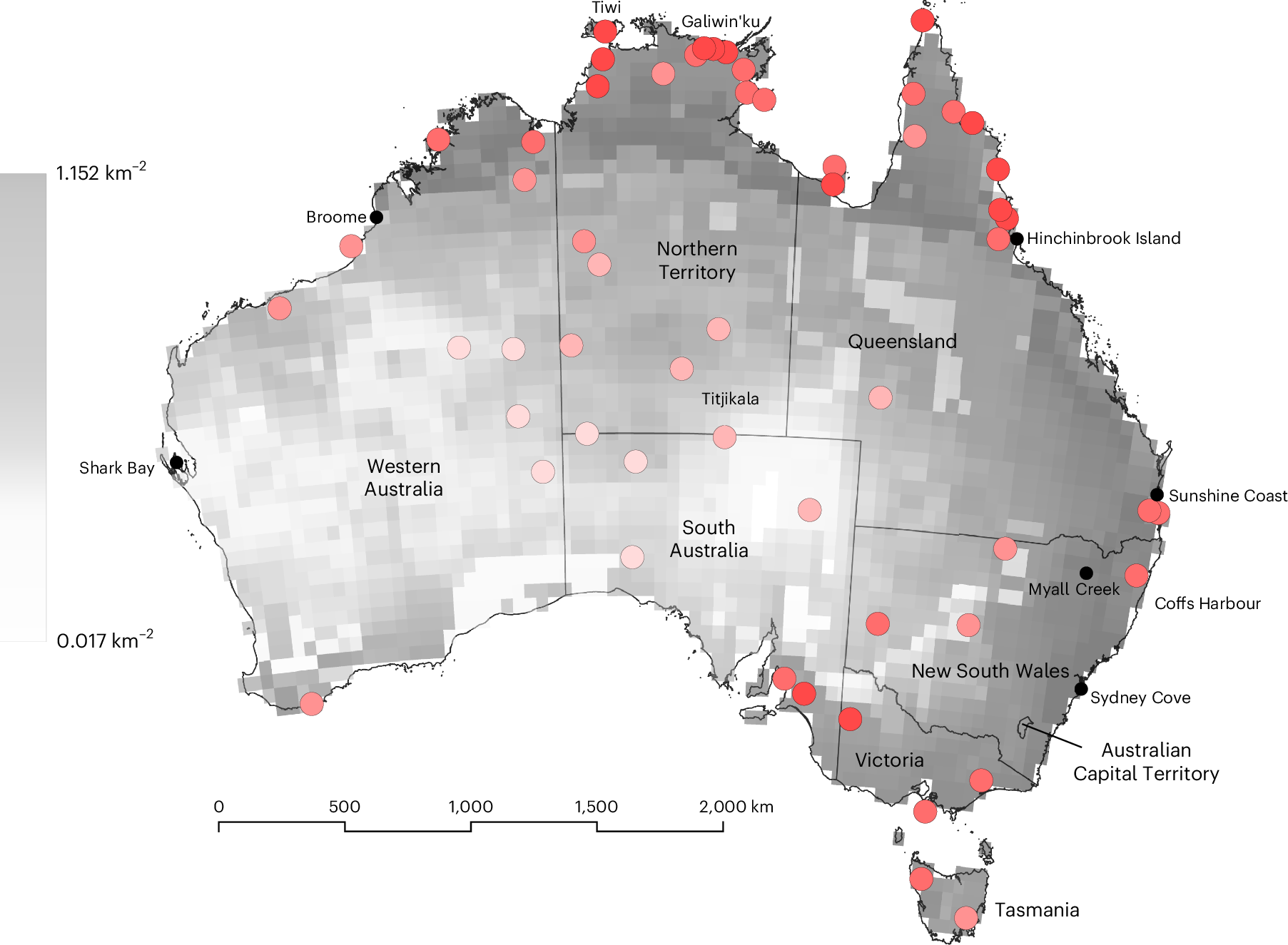
So the team built the baseline elsewhere. It used modelled and genetics-based estimates, with historical and ethnographic accounts supporting the result but not feeding into it [7], alongside archaeological reconstructions and a model of environmental carrying capacity across the continent [6]. The median comes out at 2.22 million people, 0.29 per square kilometre [2]. Those two figures imply about 7.7 million square kilometres of land, consistent with a model run continent-wide [25]. Earlier historical figures ran from 250,000 to 1 million [3].
The loss numbers sit downstream of that baseline. The model puts excess deaths between 1788 and 1861 at 2.06 million, an average of about 28,200 a year [9]. Multiply 28,200 by the 73 years and you are back at 2.06 million, so the annual figure is the total divided by the span, not a measured series [19]. Those deaths against the 2.22 million baseline give 92.8%, the 93% in the write-up [20][11]. Seven per cent of 2.22 million leaves roughly 155,000 people alive in 1861 [21], and aligning with early census records is what fixed that end point [9]. Hold the survivors there and swap the baseline back to 250,000, and the same 1861 count is a 38% decline [22].
The summary also says the modelled population is up to seven times previous estimates [8]. Against Radcliffe-Brown's 250,000, a median of 2.22 million is 8.9 times; against 1 million it is 2.2 times [23]. Which of those figures the seven-fold multiple starts from goes unnamed in the release, so a citation should rest on the paper's stated range.
The Indigenous population has grown since the 1950s, and the 2021 census count is about 37% of the median pre-colonial estimate [13][12], roughly 821,000 people [26]. On current growth trends the researchers project parity with the 1788 population around 2047 [14]. Getting from 37% to 100% in 26 years takes about 3.9% compound growth a year [24]. That is quick for births and deaths alone, and the summary does not separate natural increase from changes in who is counted as Indigenous.
"Understanding the size of Indigenous populations in Australia before European invasion in 1788 is essential to truth-telling and reconciliation," said Corey Bradshaw of Flinders University, a chief investigator at the ARC Centre of Excellence for Indigenous and Environmental Histories and Futures [15]. Lead author Alan Williams said the results "demonstrate their remarkable survival, resilience and recovery over the past century" [16].
Co-author Lynette Russell, of the Monash University Indigenous Studies Centre, put the policy reading this way: "In addition to recognizing this intergenerational trauma and disadvantage, it is also time to recognize intergenerational privilege" [17]. The researchers also say the study shows why population histories need several independent approaches when the historical record is incomplete or biased [18].
What to watch
- The uncertainty band the paper reports around the 2.22 million median, and whether its lower bound reaches down toward the old 1 million figure.
- Whether Australian truth-telling, heritage and land processes cite the median, the full range, or the seven-fold multiple.
- Replication attempts that swap in different genetic reconstructions or carrying-capacity assumptions and see where the median lands.