Leadership1 distinct publisher3 min readPublished
Staff describe a two-minute Teams call with microphones off and Slack access ending the same morning. Roughly half of the announced 3,200 cuts are still to come, and July set the template they will be measured against.
The Board Room · Leadership desk

Compiled by The Board RoomSomething wrong?How this is made
Every element of the July template solved a problem for the employer. A statement read aloud keeps a studio head from improvising a commitment a lawyer would later have to unwind. Muted microphones prevent the clip that circulates. Ending Slack access on the morning of the call closes the window in which departing staff can copy files or write something into a channel a reporter reads by lunchtime [5]. Those are genuine risks, and the process priced them carefully. What it did not price is that the same shutdown removed the only channel a largely remote workforce had, which is why one ZeniMax Online employee describes the morning as goodbyes all through the day and then silence [7].
Two dates in the record carry more information than the headcount does. The email went out on 6 July [1], and affected staff at US studios are paid until 4 September [10], a span of exactly 60 days [19], which is the floor the WARN act sets for employers with 100 or more workers [9]. Severance itself was not resolved on the day and is still being bargained [12]. The reputational cost of the delivery was therefore incurred in full, weeks before any package existed that might have offset it.
The other date is 10 June, when staff say they read a Bloomberg report warning that cuts were coming [14]. That is 26 days before Sharma's email [20], and staff describe rumours running for several weeks beforehand [14]. For most of a month the most authoritative internal information available to employees came from the trade press.
Some in HR would call the muted call the humane version: nobody is made to break down with their camera on, and nobody's question gets answered wrongly in front of forty colleagues. But the format also removed any way to ask afterwards, and the meeting Barrett describes ran two minutes to end service that in some cases spanned decades [8]. Grief was going to be part of this regardless; one former employee describes textbook depression symptoms in the weeks after [16], and a single father in Montreal describes losing the health insurance the job carried [17]. The distress was unavoidable. The confusion on top of it was not.
Microsoft's own account of why the format was chosen is not on the record. The Guardian's reporting rests on named former staff at Bethesda Austin, ZeniMax Online and Bethesda Montreal [4], and characterises the muted call as the routine at least at studios in North America [6], which leaves open whether the same script ran elsewhere. On that, we do not know yet.
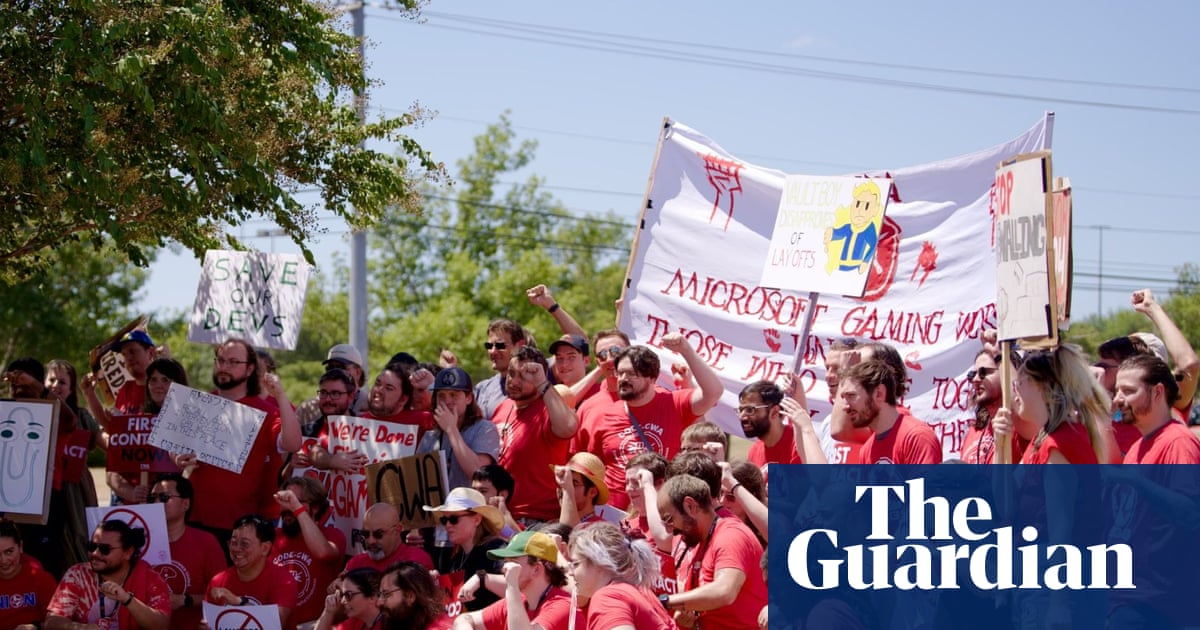
The part that binds the next two quarters is who is now on the other side of the table. Both Bethesda Game Studios and ZeniMax Online unionised in 2024, and the employees quoted describing the call sit on the bargaining committees negotiating with Microsoft [11]. Rallies are running outside studio buildings across North America, with the Bethesda union asking players for support [13]. A severance negotiation conducted with counterparties who also have a procedural grievance is a more expensive negotiation, and the moment to make the delivery defensible was before the first call, not during the second.
Ranked by verification strength, evidence, and original report placement.
On the morning of 6 July an email headed "Resetting Xbox" went from Asha Sharma, chief executive of Xbox, to all of the division's employees around the world.
The email announced the most significant restructuring in the history of Microsoft's console business: 3,200 staff would be laid off throughout the financial year to 2027, and 1,600 of those roles would be eliminated immediately.
An hour after the email, Teams meeting invites started arriving at studios throughout the company.
Anne Barrett, laid off from Bethesda Game Studios Austin, says the layoff was delivered on a virtual call with the studio manager in which all cameras and microphones were turned off, so staff were unable to say anything or react.
Barrett says staff were told on the call that they would lose access to their Slack channel, and a flurry of goodbye messages followed before it was shut off.
The Guardian reports that this was the routine, at least at studios in North America: a Teams call with a studio head, a prepared statement read, then a warning about Slack, with emails to be turned off a few days later.
Distinct publishers with included, body-backed reporting in this cluster.
1 article · September 1, 2026
Follow any of these and your For You feed starts watching them — no settings page required.
product
Meta owns the models and the data centres, and still pays Microsoft to rent someone else's1 distinct publisher
product
Agent-to-agent email is already here. The disclosure rule is not.1 distinct publisher
product
Nebius funds $4.5bn of AI capacity on terms that pay lenders mostly in stock2 distinct publishers
leadership
Gates's "no plan" essay calls for government action on AI workforce transition1 distinct publisher
Evidence-backed comparisons of source perspectives and observed adoption signals. Read the methodology
Which Builder, Operator, and Investor concerns the observed source mix emphasized—not a truth score.
Evidence, demonstrated adoption, hype gap, incentives, and confidence are assessed independently, each on its own current evidence. How these are measured.
Strong firsthand testimony, no corporate counterparty
Five named people, four of them laid off, describing the same two hours at three different studios — that is about as good as worker testimony gets, and the WARN framework behind the 4 September date is a statute anyone can look up. What is thinner: the 3,200 and 1,600 figures come from an internal email the Guardian characterises rather than reproduces, the id Software number and the "support studio size" line rest on one LinkedIn post, and Microsoft neither confirms nor disputes a word of it here.
First half executed, second half still a schedule
Half of this restructuring has already happened to real people: 1,600 gone on 6 July, id Software cut to a minority of its former workforce, US payroll stopping on 4 September, unions already at the table. The other half — roughly 1,600 roles through the end of FY2027 — exists so far as a line in an email, which is why July matters so much: it set the template the rest will be measured against.
The biggest number is the quietest one
Nothing here is inflated; if anything the reporting undersells its own scoop. The phrase most open to puffery — "the most significant restructuring in the history of Microsoft's console business" — passes by unquantified, while the fact with the longest reach, that about 1,600 cuts are still scheduled through FY2027, gets a single clause and no follow-through. The emotional material is dramatic because the people describing it are, not because the framing pushes it there.
Leverage on one side of the table, silence on the other
Two of the three central voices sit on bargaining committees negotiating severance with Microsoft while giving interviews to a national newspaper; public sympathy is part of that negotiation, and the union is explicitly courting gamers on social media. None of that makes their account of the morning wrong — the matching detail across studios argues otherwise. The asymmetry worth naming is the empty chair: no Xbox or Microsoft voice appears at any point, so the company's framing of the restructuring is absent rather than rebutted.
Solid on the morning, hazy on the plan
We would defend the how in detail — the call, the mics, the Slack cutoff, the sixty-day floor — because multiple named people at separate studios describe it the same way. We would hedge on the how much and what next: totals sourced to one email through one newsroom, no company confirmation, and a second tranche whose size we infer by subtraction.