Product1 publisher3 min readPublished
The $5.8 billion Ascension Parish plant is due to roll 2.7 million tonnes of sheet a year from 2029. The two automakers holding 30 percent of the joint venture are also the named buyers. That is the part that de-risks it.
The Product Desk · Product desk

Compiled by The Product DeskSomething wrong?How this is made
The cap table here matters more than the furnace. The two automakers inside the joint venture hold 30 percent of it between them [1], and both are named as customers for the coil, with the largest share going to Hyundai's own US vehicle plants according to Louisiana Economic Development [8]. Demand risk in that structure lives in a shareholder agreement, not a sales pipeline. New capacity is often built to win new buyers. This paperwork instead guarantees the buyers the group already has: automotive sheet accounts for about 67 percent of planned output [2].
The capital intensity is worth sitting with. Spread $5.8 billion across 2.7 million tonnes of annual capacity and you get roughly $2,150 per annual tonne [3]. Against the 1,300 direct positions the project carries [6], that is about $4.5 million of capital per direct job [4], which is the ratio you would expect from a materials-flow bet and not from an employment programme. Louisiana's $100 million performance-based grant [11] covers around 1.7 percent of the build [5].
Domestic output depends on imported inputs. Louisiana Economic Development puts annual iron ore imports at an estimated 3.6 million tons [9], which is roughly 1.3 tonnes of ore for every tonne of finished steel [6], arriving through a deep-water dock Hyundai Steel is building with the Port of South Louisiana [12]. Before the furnace, a direct reduction step burns natural gas to strip oxygen from that ore [14]. So the mill converts exposure on finished sheet into exposure on ore freight and gas.
The 70 percent emissions reduction attached to this project is Hyundai Steel's own comparison of electric arc furnace molten steel with blast furnace molten steel, quoted by BigGo Finance [15]. It describes furnace types, not a measured result for Donaldsonville, and nothing in the announcement material puts a number on the delivered cost per tonne. Tariffs go unmentioned too. The case made in public is Executive Chair Euisun Chung's line about contributing to the future of "Made in America" [16], plus the mill's billing as a cornerstone of a $26 billion US commitment through 2028 [13], of which $5.8 billion is about 22 percent [7].
The timeline is fixed, and it is not open to renegotiation. From the March 2025 announcement to commercial production in 2029 is roughly four years [8], longer than most product roadmaps survive intact, and Hyundai Steel has no North American production base to fall back on in the meantime [17].
The frame worth borrowing has two axes: whether your demand is captive or contested, and whether your critical input is domestic or imported. HYUNDAI-POSCO Louisiana Steel sits in the captive-demand, imported-input quadrant [7]. That combination takes price and availability risk off the thing you sell and concentrates it on the thing you buy. If your own build sits in the same quadrant, the test is not whether the facility opens. It is whether you can absorb a bad year on the input side, because the captive buyer will keep taking product either way.
Ranked by verification strength, evidence, and original report placement.
Hyundai Steel broke ground on a $5.8 billion Electric Arc Furnace-based integrated steel mill project in Louisiana, described as the first of its kind in North America.
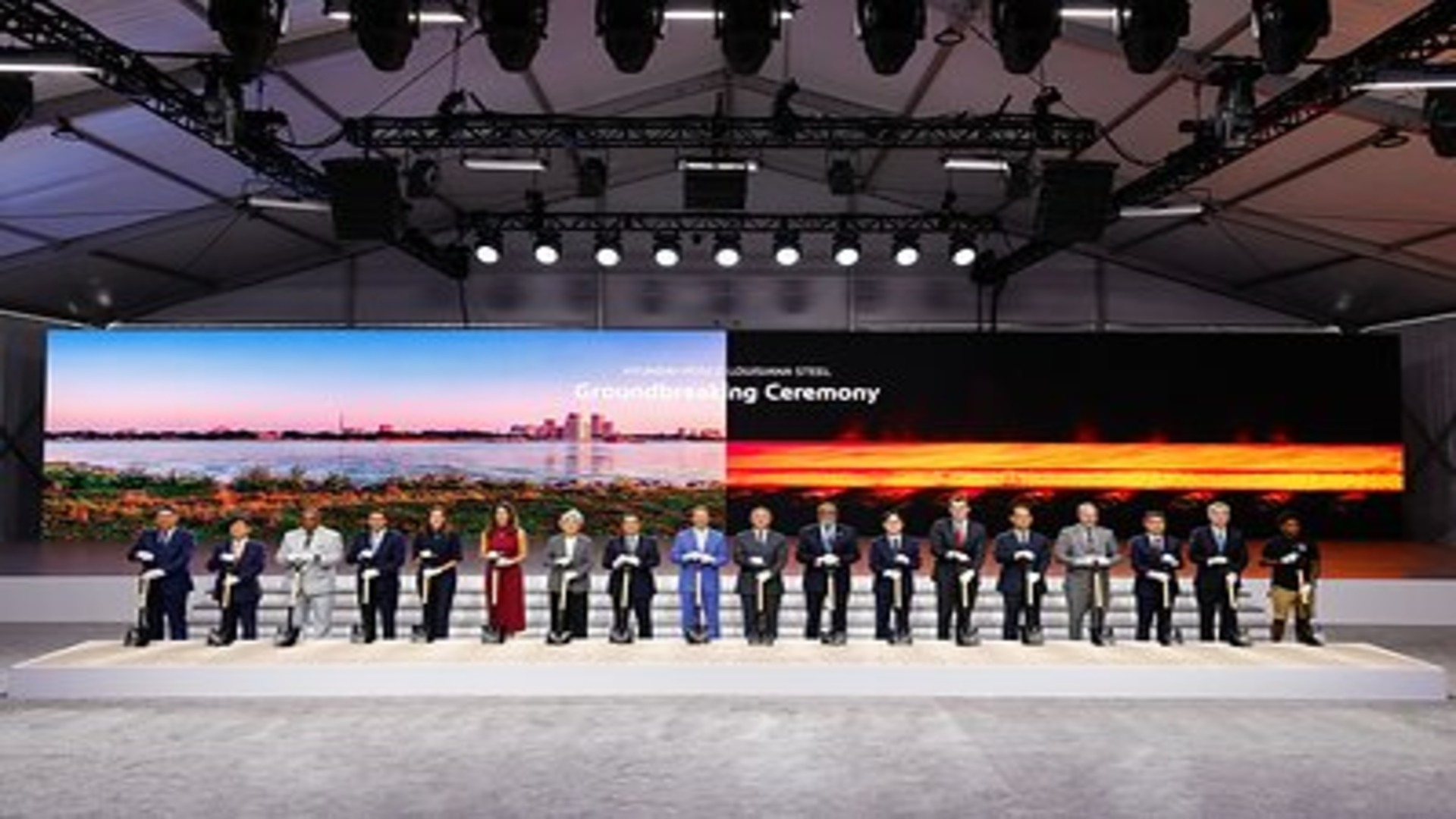
Hyundai Steel held a ceremonial groundbreaking event on September 4 at RiverPlex MegaPark in Ascension Parish, Louisiana, under the slogan "Building the Future of Steel, Together with Louisiana".
The mill is slated to begin commercial production in 2029.
The facility will be capable of producing 2.7 million metric tons of hot-rolled and cold-rolled steel sheets per year, primarily for automotive applications.
Of planned annual production, 1.8 million tons will be automotive steel sheet and another 900,000 tons will be for general applications.
The mill will be operated by HYUNDAI-POSCO Louisiana Steel (HPLS), a joint venture in which Hyundai Steel holds 50 percent, POSCO 20 percent, and Hyundai Motor and Kia 15 percent each.
Publishers with included, body-backed reporting in this cluster.
1 article · September 6, 2026
Follow any of these and your For You feed starts watching them — no settings page required.
invest
Hyundai and Kia near 10 million green cars, and 5.6 million of them are hybrids1 publisher
invest
Washington puts Chinese humanoids on the restricted list, and robot sourcing inherits car risk1 publisher
invest
NVIDIA banks $81.6B, authorises $118.5B of buybacks, and guides growth down by half2 publishers
product
Unitree gave back $30bn and still sits near five times its pre-float valuation1 publisher
Evidence-backed comparisons of source perspectives and observed adoption signals. Read the methodology
Which Builder, Operator, and Investor concerns the observed source mix emphasized—not a truth score.
Evidence, demonstrated adoption, hype gap, incentives, and confidence are assessed independently, each on its own current evidence. How these are measured.
Single outlet relaying the interested parties
Cost, tonnage, headcount, ore volumes, acreage and ownership all reach the reader through Interesting Engineering, which is in turn passing along Hyundai Steel's announcement, Louisiana Economic Development's project data and a BigGo Finance account of the furnace. The arithmetic holds up where it can be checked: 1.8 million plus 900,000 tonnes does equal the headline 2.7 million, and the four joint venture stakes sum to 100 percent. What is missing is any party without a stake in the outcome.
Ground broken, nothing rolled
There is a real site, a real ceremony and committed public money, which is more than a press release. There is also no steel: commercial production is dated 2029, and the demand side described is intra-group rather than any third-party contract shown here. At this stage the only adoption on the record is capital, acreage and a dock agreement.
Firm capital, soft superlatives
The 70 percent emissions cut is Hyundai Steel quoting itself with no baseline given, and 5,400 jobs from 1,300 direct roles is the familiar shape of an economic development estimate rather than a measured figure. Against that, the physical commitments are unusually concrete: $5.8 billion, 1,700 acres, a named joint venture with disclosed stakes, a dock being built with the port. The overshoot sits in the adjectives and the environmental arithmetic, not in the project itself.
Everyone quoted wants the ribbon cut
Hyundai Motor Group is placing the mill inside a $26 billion "Made in America" commitment, and Euisun Chung's remarks are about American industrial leadership rather than steel margins. Louisiana Economic Development supplies the jobs, acreage, ore and offtake figures while also putting $100 million of public money behind the site. The two carmakers named as buyers own 30 percent of the seller. That ownership stake de-risks the project, and it is also why nobody in the story has cause to question its demand assumptions.
Firm on the spine, thin on the promises
The ownership split, the tonnage split, the grant size and the acreage are stated precisely enough, and consistently enough, to work with. Anything dated 2029 or expressed as an emissions percentage rests on a single interested account with no second source in view, so those parts of the story deserve to be held loosely until a competitor, a regulator or a utility filing speaks to them.