Science1 publisher2 min readPublished
HyperBird catches grape mildew days before the leaf shows a spot
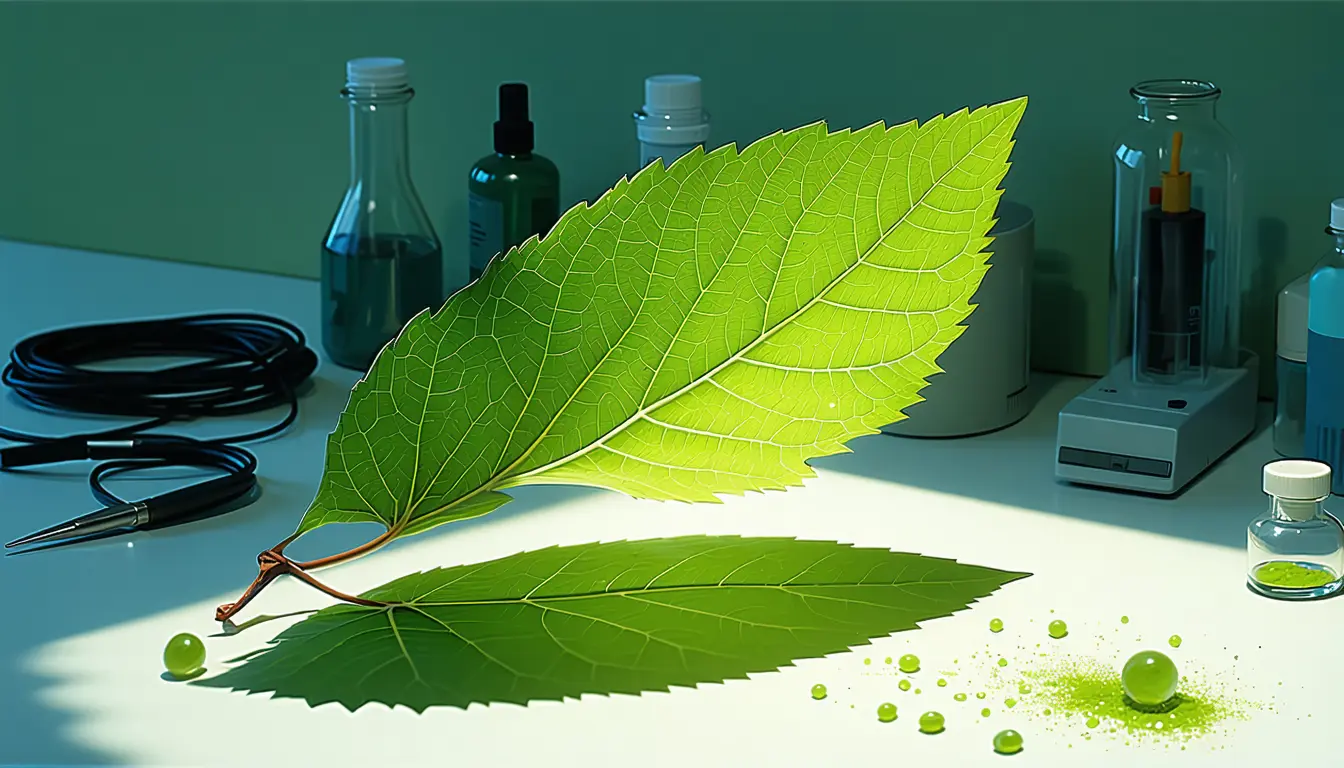
Cornell and USDA researchers built a hyperspectral microscope that reads hundreds of wavelength bands from a single leaf pixel, enough to find mildew growing inside grape tissue that still looks healthy from the outside.
The Scientist · Science desk
What happened
- HyperBird detects grape diseases including powdery and downy mildew days before physical symptoms become visible, according to the Cornell AgriTech and USDA scientists behind the platform.
- It builds on Blackbird, the robotic red-green-blue phenotyping camera the team released in 2021 to speed the scoring of thousands of grape leaf samples for infection in USDA mildew-resistance breeding work.
- The same imaging picked up fungicide residues on the leaves, letting the researchers tell which treatment had been used against mildew.
- Technicians still cut the dime-sized leaf discs the instrument reads by hand, the most time-consuming task in the analysis, and robotics students are trying to automate it.
Compiled by The ScientistSomething wrong?How this is made
Why it matters
- capability A breeding program can grade resistance in tissue that still looks clean, so scoring a seedling no longer waits for lesions to appear on the leaf surface.
- constraint Manual sample preparation, not the sensor, sets how many discs get through in a week, so the extra spectral detail buys resolution until the cutting is automated.
- cost Anyone adopting this is buying storage and processing at terabyte-per-day scale alongside the optics, and that cost recurs with every imaging run.
- decision A grower deciding spray timing cannot yet point this at a canopy; what exists is a laboratory instrument that reads cut discs. That ordering puts the fungicide-targeting use behind the breeding one.
The engineering problem is at the pixel. Yu Jiang, a systems engineer at Cornell AgriTech and one of the project's senior scientists, said the limit on hyperspectral imaging at microscope scale has been spatial resolution: distinguishing a tiny diseased spot from the surrounding pixels of healthy cells [9][10]. "Imagine trying to find a Coke can in a photograph of a large room," he said [11]. If the image is too coarse, "the light reflected by the can gets mixed with light from everything around it" [12].
Blackbird already had the spatial resolution of an optical microscope, and HyperBird keeps that while adding roughly 200 times more spectral resolution per pixel [15]. Measured against the three bands of a colour camera, 200 times implies on the order of 600 narrow wavelength bands per pixel, which sits inside the hundreds of bands phys.org describes [3][21]. The data volume follows from that. One day of imaging produced nine terabytes [18]; if a day's run is several hundred to a thousand dime-sized discs [4], that is somewhere between 9 and 18 gigabytes of raw data per disc [22].
Katie Gold, assistant professor of grape pathology at Cornell AgriTech and another of the senior scientists, said the gain is access. "It's harnessing the power of hyperspectral and high-throughput analysis in a much more accessible way for the scientist," she said [7][8]. phys.org lists faster breeding of resistant varieties and earlier fungicide targeting among the uses, and puts global vineyard losses from powdery and downy mildew in the billions of dollars a year [20][2].
The May 20 paper in Plant Disease, led by Saeed Hosseinzadeh, a former postdoctoral researcher in Gold's lab, is described as a first step in evaluating hyperspectral imaging for automated high-throughput phenotyping in plant pathology and breeding programs [17]. What it tested is detection: a change inside the leaf, ahead of anything on the surface [5][18]. The phys.org account does not report a detection accuracy or how many leaf samples went into the nine terabytes [23]. Whether an early signal in one disc predicts what that vine loses at harvest is a separate question [17].
What to watch
- Whether the robotics work on automating leaf-disc collection produces a working prototype, since that step sets the throughput ceiling.
- A published trial reporting detection accuracy and sample counts, ideally on intact vines.
- Whether the fungicide-residue signal is validated well enough to verify that a spray was actually applied.