Leadership1 publisher2 min readPublished
Google productivity advisor recommends zero-based calendaring to tackle rising workloads
Nearly two-thirds of professionals say they are covering more than one role, and half blame AI tools for part of the added load. The remedy on offer from Google's executive productivity advisor starts with a blank printed calendar.
The Board Room · Leadership desk
What happened
- A recent Korn Ferry survey found that nearly two-thirds of professionals say they are currently performing the responsibilities of more than one role.
- Half of the professionals in that survey say AI tools have contributed to an increasing workload.
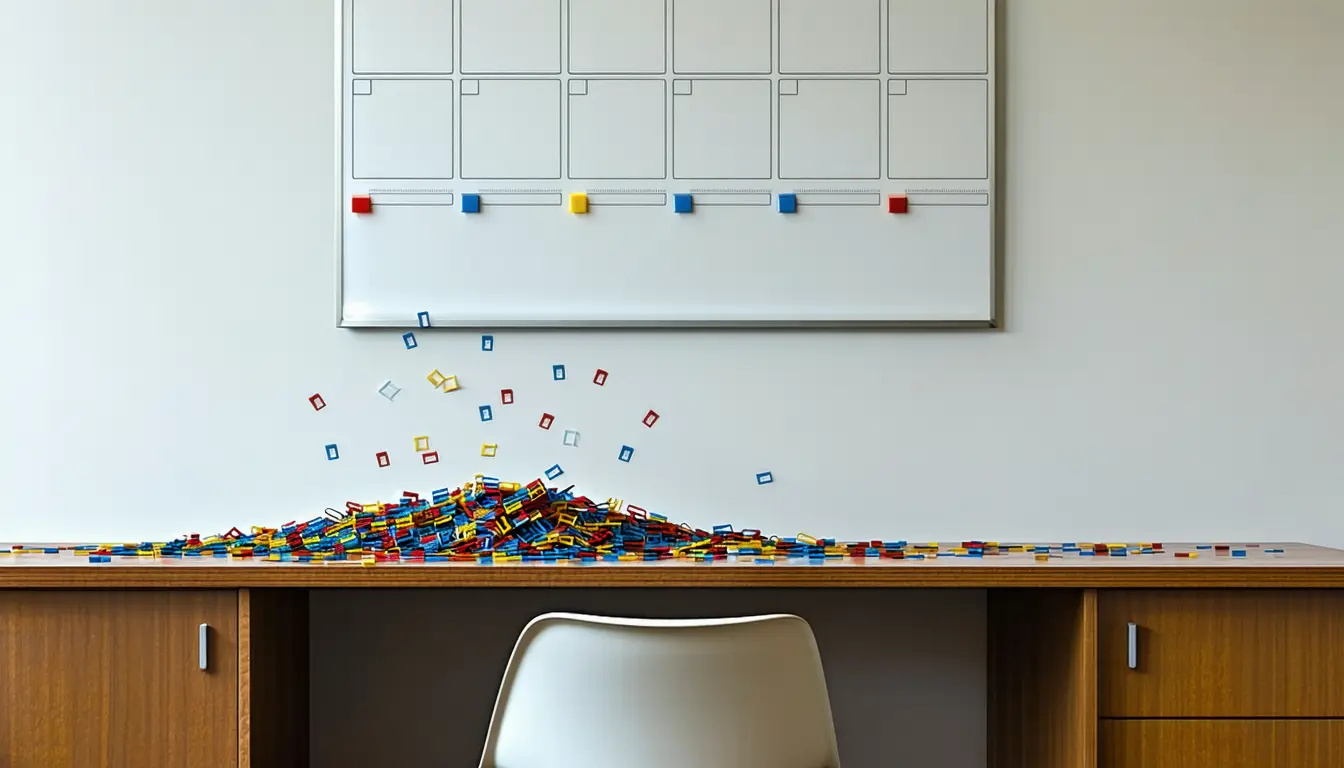
- Google's executive productivity advisor, Laura Mae Martin, coaches executives by handing them a blank calendar printed on paper and having them add back only what they would accept if invited today.
- Of knowledge workers polled by Dropbox, 74% say they manually move AI-generated work between apps at least three times on a typical workday.
- Martin says managers can also set themes for the whole team, putting all external client meetings on Wednesdays or all product meetings on Tuesdays, which also makes scheduling easier.
Compiled by The Board RoomSomething wrong?How this is made
Why it matters
- cost A standing weekly hour costs each attendee about 52 hours a year, and it renews unless somebody cancels it. One manager can recover that inside their own calendar without asking permission.
- constraint The audit repositions work. Handing back a role is beyond it. A week that is still full after the reset has told the manager the load is a staffing question.
- decision Charter's own caveat is that the team-wide reset usually is not realistic without participation. That leaves a leader choosing between the partial solo pass now and waiting for buy-in that may not come.
- capability Theme days are the one part of this a manager can impose within their own span of control, so scheduling gets simpler for everyone reporting to them without any org-wide policy.
The question Laura Mae Martin puts to executives is whether they would accept the meeting today. "If you had a new calendar tomorrow, would you still accept that weekly one-hour meeting if you were invited today?" she said. The exercise is offered to individuals because the group version is hard to convene. Charter reports that a full meeting reset usually is not realistic for a busy leader without team-wide support and participation, so it asked Martin how one person runs zero-based calendaring without the team.
Her version starts on paper. Martin has executives print a blank calendar, mark only the meetings that cannot move, such as external client meetings and important all-team meetings, then map where their energy runs high and low before placing protected focus time. She compares it to emptying a closet before deciding what goes back in: "Would you actually still pick that up and try it on?" she said. For hybrid workers she separates "home basers", who concentrate best at home, from "outfielders", who have "to be out, and you do your best work in your office."
The Dropbox numbers describe the AI part of the workload complaint. A majority of knowledge workers said an AI assistant is now their primary starting point for new work, and 11% said AI generates finished work. That leaves 89% whose assistant output still needs a person to finish it. Themes are aimed at a different cost, the switching between projects and teams that Charter says research links to eroded focus and performance: Monday for product, Tuesday for sales, Wednesday for customers. The manual moves between apps sit inside one piece of work, and a label on the day leaves them there.
The printed calendar has a ceiling, and Martin marks it herself. "There will always be fire drills, but the point is if it goes to even 60% to 70% of how you hoped it would go and planned, it's way better than 0%," she said.
The 90-day block is the part that produces evidence. Martin has executives add a 30-minute slot 90 days out to revisit the new flow, and she holds three-month check-ins with them; at that cadence the review costs about two hours a year. Charter attributes the workload figures to a recent Korn Ferry survey and the handoff figures to a Dropbox poll, and does not report sample sizes for either. A leader who runs the reset and keeps the record arrives at the check-in with a list of the work that would not fit any arrangement of the week.
What to watch
- Whether Korn Ferry publishes sample sizes and dates, and whether the two-thirds multi-role figure moves in its next reading.
- Whether AI tools begin writing output directly into destination apps and cut the manual handoffs Dropbox's respondents describe.
- Any published follow-up on whether executives who run the reset still hold the new schedule a quarter later.