Product1 publisher3 min readPublished
The 19% Gap: Why Developer Velocity Self-Reports Cannot Justify an AI Rollout
A devops.com argument that "implement AI everywhere" is the old "automate everything" push in new clothing rests on one number that should end survey-based adoption decisions.
The Product Desk · Product desk
Drafted by a language model from the sources cited here and checked against its claim ledger before publication. How we use AISend a correction
What happened
- DevOps teams risk repeating the mistakes of the "automate everything" era by trying to implement AI everywhere without a clear business need.
- In the automation era, along with faster software delivery, companies ended up with new dependencies, more complex infrastructure, and additional tools that also needed to be maintained.
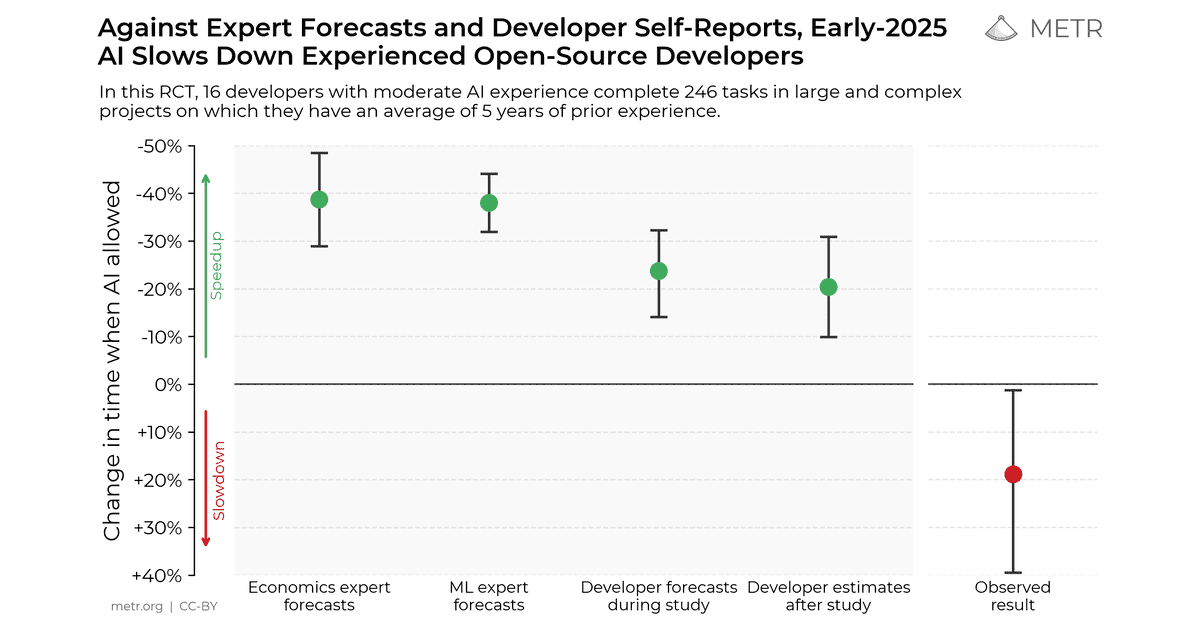
- A METR study showed developers expected a 24% increase in speed and subjectively estimated the effect of AI as a 20% productivity gain, whereas in reality task completion slowed by 19%.
- Research cited in the article found experienced developers were actually 19% slower despite expecting AI to make them faster.
- The gap between the developers' self-reported 20% productivity gain and the measured 19% slowdown is 39 percentage points.
Compiled by The Product DeskSomething wrong?How this is made
Why it matters
A piece published on devops.com argues that DevOps teams are on track to repeat the mistakes of the "automate everything" era, this time by installing AI wherever it will fit and without a clear business need [1]. The load-bearing evidence is a single cited result: in a METR study, developers expected AI to make them 24% faster, subjectively rated the effect as a 20% productivity gain, and actually completed tasks 19% slower [3], with the article noting the slowdown applied to experienced developers [4].
Look at the arithmetic rather than the headline. The distance between what the developers believed happened and what was measured is 39 percentage points [5]. The distance between what they expected going in and what they got is 43 points [6]. Any rollout decision built on "the team says it is faster" is therefore being made on an instrument with a known error bar wider than the effect it is trying to detect. This is the same failure the automation era produced in a different register: delivery did get faster, and companies also ended up with new dependencies, more complex infrastructure, and additional tools that themselves needed maintenance [2].
The pressure to skip the measurement step is structural. The article points to a weekly cadence of new AI tooling for DevOps, from Terraform generation assistants to GitHub Copilot, Cursor, Kubernetes optimization tools, and AI-powered incident analysis platforms [15], and to peer claims such as cutting development time by 30% [16]. It also cites Vention's State of AI 2026 report, in which 51% of respondents named increased efficiency and streamlined processes as the primary business benefit of AI [7]. The author's reading is that recognizing a technology's potential value is not the same as having a justified use case for it [8], and that fear rarely serves as a sound basis for engineering or architectural decisions [17].
Two responses are described. One is to ignore the change and treat AI as a fad, which risks missing tools that would cut routine work [12]. The other, which the article calls the more common one today, is to look for ways to apply AI to any task at all, so that it turns up in monitoring, CI/CD, infrastructure management and support not because it solves a specific problem but because that is what everyone else is doing [12][13]. The proposed filter is blunt: a team that cannot answer "what problem are we trying to solve?" is probably already in trouble [14].
The stated consequences of getting this wrong are not abstract slippage. According to the article, poorly planned AI adoption can increase architectural errors, infrastructure costs, inconsistent engineering practices and operational complexity [9] - four categories that all show up on someone else's budget line months later.
What to watch: whether teams put a measurement baseline in place before the tools arrive, since after the fact the only available signal is the one the METR result discredits [3]. The article's own sequence is to assess AI SDLC maturity, set objectives and success metrics, and build internal AI expertise before expanding adoption [10], then start small, measure results, and scale only the use cases that show real value [11]. The tell will be which organisations can name a use case they tried and shut off.