Science1 publisher2 min readPublished
Decelerating the body at gate release explains how a track sprinter crosses the line already moving
Some elite track cyclists cross the start line already moving, and a Royal Society Open Science model finds the speed comes from a timed body movement inside the few centimetres the starting gate allows.
The Scientist · Science desk
What happened
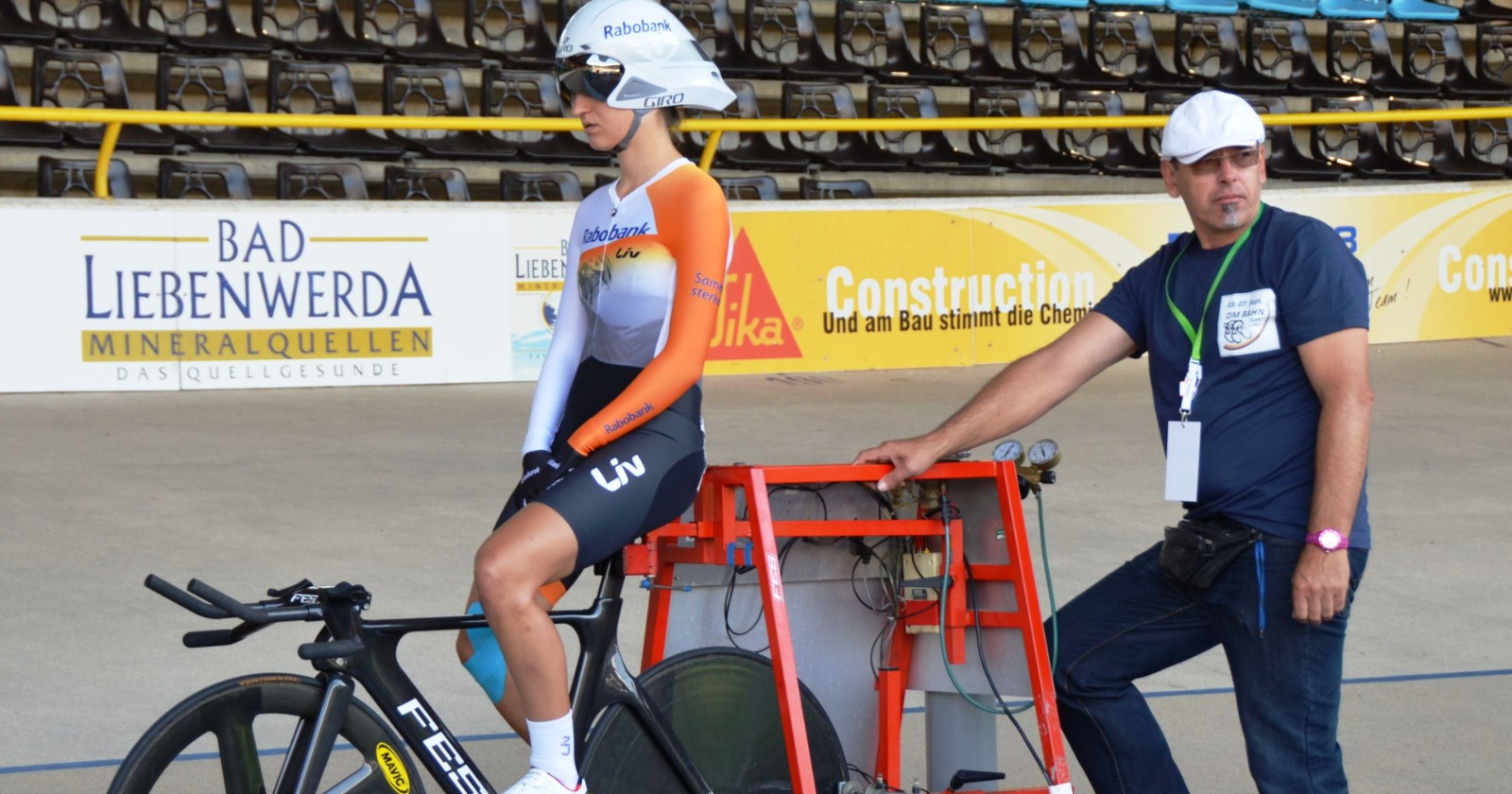
- Track events begin with rear wheels clamped in a gate, so riders technically start from rest, yet some elite sprinters already have forward speed on the bike at the moment the signal fires.
- Researchers filmed three elite French track cyclists at high speed, reconstructed each rider's centre of mass, measured gate braking force and pedal torque, and checked the model against real start-speed traces.
- The model attributes the head start to a brief whole-body movement, backward then rapidly forward around gate release, that transfers momentum to the bicycle as the rider's forward motion slows.
- Only one of the three riders produced a non-zero start in the experiment, crossing the start line at 0.4 metres per second.
- Run as an optimisation, the model says that same rider could have reached 1.3 metres per second without crossing the line before the official signal.
Compiled by The ScientistSomething wrong?How this is made
Why it matters
- capability A start can now be scored against a rider's own computed maximum, because the ceiling falls out of measurable inputs: offset length, crank torque, the two masses and gear ratio.
- constraint Since the offset depends on frame geometry, the legal ceiling differs rider by rider, and a bigger athlete on a bigger frame has less room to build speed before the line.
- decision Squads deciding where start training goes have a specific case for millisecond timing drills and video feedback on gate release, work that competes for hours with raw power development.
The legal room was six centimetres. That is the offset the one rider who left the gate already rolling had between the front wheel and the line, and the bike was doing 0.4 m/s when it crossed [11]. A bike cannot be moving faster inside the offset than it is at the line, so covering those six centimetres took at least 0.15 seconds [2]. The interval in which whole-body movement, and not the pedals, supplies most of the bike's acceleration is about 0.2 seconds [9].
Riders shift their mass backward, then rapidly forward, and it is the slowing of that forward motion that loads the bicycle [8]. The authors wrote: "It is this deceleration, when phased with gate release, that produces the largest positive inertial force on the bicycle. The peak velocity of the CoM is therefore not sufficient by itself; the relevant dynamical quantity is the relative acceleration of the CoM, together with its timing." [12] The rider's centre of mass peaked at 2.0 m/s, five times the speed the bike had at the line [11][3].
For that rider the computed ceiling is 1.3 m/s, which is 3.25 times the 0.4 m/s achieved and leaves 0.9 m/s of headroom [14][1]. The model derives it from offset length, crank torque, cyclist mass, bicycle mass and gear ratio [13]. It ends at the start line: whether an extra 0.9 m/s there shortens a race is untested, and the authors say further research could extend the model to predict effects on full sprint times [16].
The study filmed three elite French track cyclists, and one of them produced the moving start [7][10]. One instance shows the effect is achievable; it does not estimate how often riders manage it. Earlier models had taken speed at the signal as a starting assumption and left the split-second transition from gate hold to sustained pedalling unexplained [6], so an explanation plus one clean trace is real progress, and the authors say larger studies could test whether the same timing strategy works across more riders, gates and events [16].
The offset itself follows from where the gate holds the rear wheel and from frame geometry [4]. According to the authors, smaller riders on smaller frames end up with the front wheel farther behind the line and a larger offset, while larger frames tend to reduce it [5]. The 1.3 m/s figure therefore belongs to one rider on one bike.
On what to train, the authors wrote that "training should prioritize millisecond-level timing control, video-based feedback to align whole-body motion with gate release" [17]. Hitting the optimum, they note, requires precise movement in under a second [15].
What to watch
- An extension of the model to full sprint times, which would show whether headroom at the line converts into a finishing time.
- Replication across more riders, gates and events, which would turn one demonstrated case into a rate.
- Whether squads start selecting frames to enlarge the offset, given that offset length is one of the model's inputs.