Leadership1 distinct publisher3 min readPublished
Federal data show nearly 3 million fewer people covered through the exchanges after premiums rose about 30 percent on average. The bill for that arrives at firms that never wrote the policy. Nobody has sized it yet.
The Board Room · Leadership desk

Compiled by The Board RoomSomething wrong?How this is made
Follow any of these and your For You feed starts watching them — no settings page required.
leadership
Senator Merkley asks two childcare chains for the memos they wrote when they bought in1 distinct publisher
science
HIPAA Covers Less Than You Think, And "Anonymized" Is Not A Legal Shield1 distinct publisher
leadership
OpenAI writes the Pentagon's looser human-control standard into its own policy1 distinct publisher
invest
Before you shift another dollar of health costs to staff, audit the hospital's calendar1 distinct publisher
Federal enrollment data counts coverage, and the record supplied here stops at the total. The Vox excerpt of the Today, Explained interview does not break the nearly 3 million out by income band, employment status, or proximity to an employer plan [9]. That distinction is the entire employer question. A self-employed contractor who drops an exchange plan reaches her clients only if she reprices her work; a part-time employee's spouse who drops one arrives as a request at open enrollment. Until somebody publishes the composition, any board deck that puts a dollar figure on employer exposure is extrapolating from a headline.
The one piece of arithmetic worth showing is crude. Enhanced subsidies lapsed in January [2] and the federal data landed in June [1], an interval of about five months [7], which averages to roughly 600,000 net departures a month [8]. Treat that as a smoothed line rather than a run rate. Exchange coverage turns over at renewal, so most of the loss plausibly registered at the start of the plan year instead of accruing evenly, and the material here gives no monthly breakdown [9]. The average is useful only for scale.
The mechanism is the part that touches payroll. Julie Appleby of KFF Health News put it to Today, Explained this way: "It's the prices - people are dropping out" [5]. The subsidy works by capping what a household pays as a share of its income and covering the remainder [6], so withdrawing the enhancement converts a fixed income share back into a market price, and that price rose by an average of about 30 percent [3]. Merit budgets do not move 30 percent. The gap closes either because an employer absorbs part of it through eligibility or cash, or because the household absorbs it by going without [4].
One argument on the compensation committee holds that this is an individual-market story, since our people are on our plan. For this quarter that is mostly right, and it is worth saying plainly rather than manufacturing urgency. Over a longer horizon it weakens, because exchange coverage is the fallback that makes part-time and contract staffing viable at all, and its price is now an input to those arrangements rather than a background condition.
That leaves sequencing. That is where the decision actually sits. Affordability ranks among voters' top concerns heading into the midterms, and healthcare costs have become a central issue for candidates [10], so the subsidy question is live rather than settled. A benefits change made this quarter to hold people through a 30 percent premium rise is far easier to announce than to withdraw if Congress restores the enhancement later. A temporary stipend can be ended without a fight, while an eligibility expansion becomes an expectation the next comp cycle inherits. The reversible form of help is the cheaper one. This quarter is when its price is lowest.
Ranked by verification strength, evidence, and original report placement.
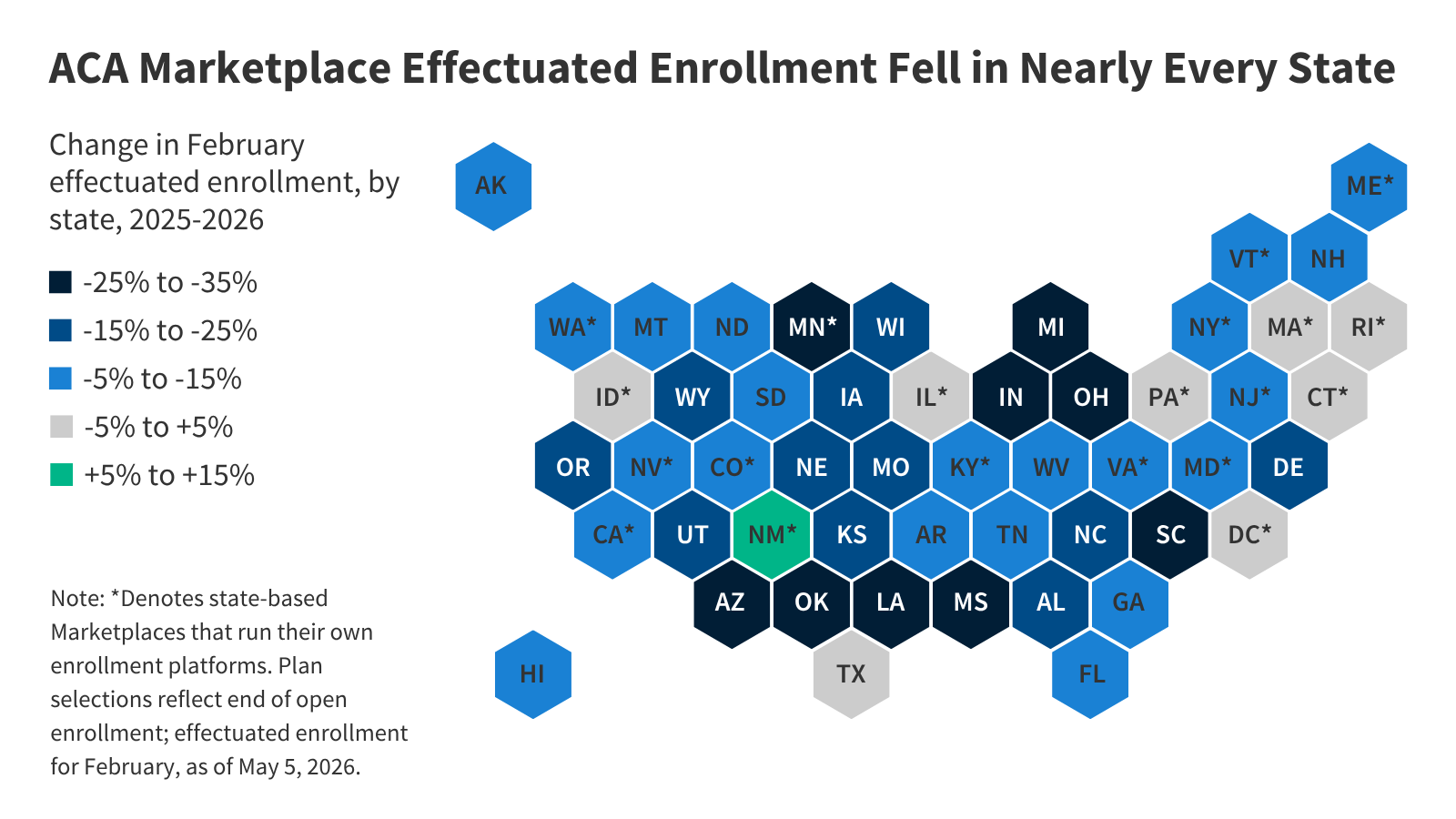
Nearly 3 million fewer Americans now have insurance through the Affordable Care Act compared to last year, according to federal data released in June.
After the enhanced subsidies expired, many Americans saw their health insurance premiums spike by an average of about 30 percent.
Congressional Republicans allowed the enhanced subsidies for the Affordable Care Act to expire in January.
The Affordable Care Act created subsidies that pay part of a household's premium on the individual market: after the household pays a certain percentage of its income, the subsidy picks up the rest, up to a certain income level.
The published excerpt of the Today, Explained interview does not break the nearly 3 million lost enrollees out by income, employment status, household relationship to an employer plan, or month of departure.
With affordability among the top concerns on voters' minds heading into the midterms, healthcare costs have become a central issue for candidates.
Distinct publishers with included, body-backed reporting in this cluster.
1 article · August 28, 2026
Evidence-backed comparisons of source perspectives and observed adoption signals. Read the methodology
Which Builder, Operator, and Investor concerns the observed source mix emphasized—not a truth score.
Evidence, demonstrated adoption, hype gap, incentives, and confidence are assessed independently, each on its own current evidence. How these are measured.
Two numbers, one voice, no paper trail
The enrollment figure is attributed to June federal data but the data are never shown or linked; the 30 percent premium average is attributed to nobody at all and never repeated by the expert Vox interviews. Worse for anyone doing arithmetic on it, the interview offers a second, differently shaped count — a million fewer sign-ups, then 3 million drop-offs — that is never reconciled with the headline year-over-year gap.
National totals real, employer slice absent
Something large and measured is happening: three separate observations of it — the June federal count, the 5 percent sign-up decline, the premium jump — all point the same direction, and nonpayment terminations give the mechanism a texture. But the story the headline promises, cost landing on firms that never wrote the policy, has no observation behind it whatsoever. That half of the picture is a hypothesis with a plausible shape.
The frame outruns the interview
Our own framing concedes it: nobody has sized the employer bill. Yet the story is told as though that bill were the finding. Vox's lede has enrollment "plummeting" while the KFF Health News correspondent it interviews says the law is "doing fairly well," and the tidy per-month attrition rate that can be computed from January to June is one the interview's own timing contradicts. The direction of the numbers is not in doubt; the confidence of the telling is ahead of them.
Podcast plug meets election-season framing
Two pulls, both visible on the page. Vox is promoting its own show — the excerpt ends by telling you where to listen — which rewards the sharper opening line over the expert's hedge. And the subject matter is an active partisan fight going into the midterms, which the piece itself acknowledges by relaying the Republican claim that the old rolls were padded with improper enrollment. To Vox's credit, that counter-argument is printed rather than buried.
Firm on direction, thin on magnitude
We would stand behind the shape of this — subsidies lapsed, prices rose, enrollment fell — because the reporting is internally consistent about it and the expert and the outlet agree on that much. We would not stand behind any figure derived from it. One publisher, one interview, an unsourced average, an unresolved double-count, and a live dispute about what the decline even measures leave little room to be precise.