Invest1 publisher3 min readPublished
Harvey deploys 180 former attorneys as legal engineers; post-sales role pays up to $320,000 OTE
Harvey puts roughly 180 former practicing attorneys, most with eight to ten years behind them, into every customer deployment. At its own published pay band that bench costs $39.6m to $57.6m a year in on-target cash.
The Investor · Invest desk
What happened
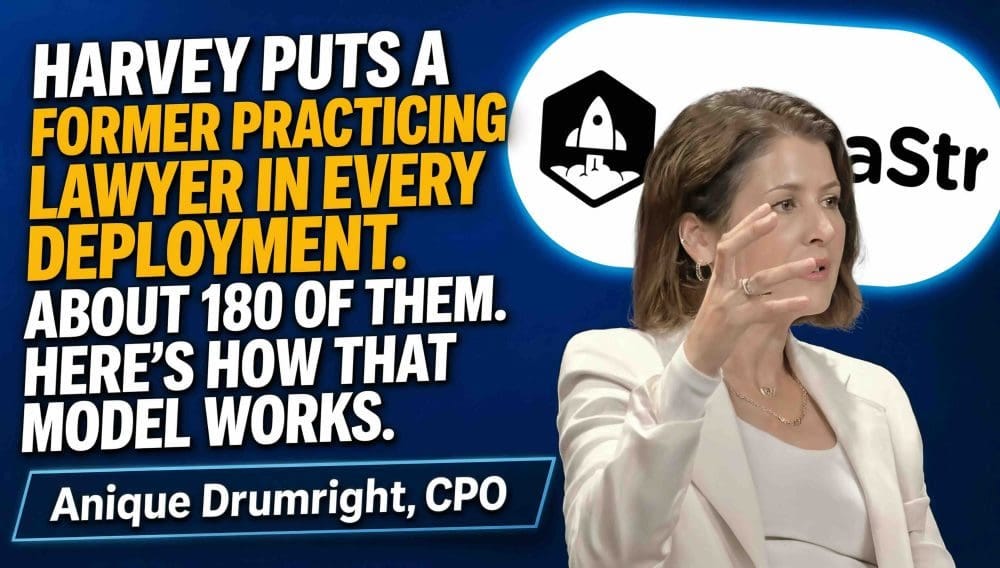
- Harvey's chief product officer, Anique Drumright, told a SaaStr AI audience that the company has roughly 180 legal engineers, all former practicing attorneys, and puts one in every deployment rather than only the largest.
- Harvey's careers page lists $220,000 to $320,000 in on-target earnings for the post-sales Product Specialist version of the role, on a 75/25 base-to-variable split plus equity.
- The company sells into more than 60% of the Am Law 100 and counts over 1,400 customers in 60 countries, with more than 100,000 lawyers on the platform.
- Legal engineering is split into pre-sales, post-sales and custom solutions teams, and Harvey has started certifying legal engineers who do not work for the company.
Compiled by The InvestorSomething wrong?How this is made
Why it matters
- cost Every customer arrives carrying a share of a fixed pay bill of $39.6m to $57.6m a year, about $28,300 to $41,100 across the current base, and equity sits on top of that.
- constraint At about 7.8 customers per legal engineer, capacity to deploy grows only as fast as Harvey can hire people who have already spent eight to ten years in practice.
- contradiction By SaaStr's own cost attribution only the custom solutions track lands in cost of revenue, so the same 180 people count as either an acquisition expense or a services drag, and no per-track headcount has been published.
- precedent Certifying legal engineers outside the company opens a route for firms and third parties to run deployments Harvey would otherwise pay a $220,000-to-$320,000 salary to staff.
Multiply the bench by the published band and the on-target cash comes to between $39.6m and $57.6m a year, before equity [1]. Spread across 1,400-plus customers, that is roughly $28,300 to $41,100 each [2]. Both figures are approximations: the $220,000-to-$320,000 range is posted for one of the three tracks, the post-sales Product Specialist [5], and SaaStr's write-up does not break the 180 down by track [16].
That breakdown decides the gross-margin question. SaaStr's own attribution puts pre-sales legal engineers in sales cost, post-sales product specialists in retention and expansion, and custom solutions in services. Most companies bundle all three and then cannot explain their gross margin, it says [8]. Only the third of those belongs in cost of revenue. A bench of 180 can be a sales and marketing line or a delivery line.
The band pays for experience Harvey would otherwise have to train. SaaStr describes the standard forward deployed engineer as a strong engineer who learns the customer's domain on the job and gets good at it in six to nine months [11]. Drumright's number for most of her team was eight to ten years of practice already behind them [3]. The posted floor is a JD or equivalent plus three years at a top-tier firm, in-house, or advising a corporate legal team [4]. Harvey's own wording for the pre-sales role, as SaaStr quotes it: "solutions architects secure the technical win, legal engineers secure the legal win" [12].
One legal engineer covers about 7.8 customers [3] and roughly 556 of the lawyers on the platform [4], with more than 60% of the Am Law 100 already in the base [6]. Doubling the customer count at that ratio means hiring another 180 or so people who each left practice after eight to ten years [3][3], at the band Harvey publishes [5].
Certification moves some of that staffing off Harvey's payroll. Harvey has begun certifying legal engineers who do not work there [13], and each certified outsider who can run a deployment is one Harvey does not staff at $220,000 to $320,000 [5]. Inside the custom solutions track the build work stays with the lawyer, who meets practice group heads and general counsel, learns how a process runs today, then designs the agents and playbooks with natural language prompting [10]. SaaStr puts the division of labour this way: "A lawyer builds it. No engineer writes code for it." [10]
I would expect the pre-sales bucket to be the largest of the three. That would make most of the 180 a customer acquisition cost that scales with new logos and does not compound with the installed base. If custom solutions is the biggest track, Harvey is a legal consultancy with a model attached, and its cost of revenue will look like one. A track-level headcount, or a disclosed cost of revenue, would settle it. For now SaaStr reports that legal engineers shape the roadmap, and treats that as the thing that keeps the cost from being pure services drag [14].
What to watch
- A track-level headcount for the 180, or a disclosed cost of revenue, which is what decides whether this bench sits above or inside gross margin.
- How many non-Harvey legal engineers get certified, and whether certified outsiders start running deployments Harvey used to staff itself.
- Whether the posted $220,000-to-$320,000 band and the 75/25 variable mix hold as the bench grows past 180.