Science1 publisher2 min readPublished
Hierarchical worldviews track climate policy support in Japan more closely than conservation support
Aya Takagi and Ryosuke Nakadai surveyed 1,133 people in June 2025 and found the worldview gap widest on climate measures. The authors warn the result does not license rebranding a climate policy as conservation.
The Scientist · Science desk
What happened
- Aya Takagi and Ryosuke Nakadai surveyed 1,133 people across Japan in June 2025 about their cultural worldviews, values of nature, risk perceptions and support for three separate kinds of environmental policy.
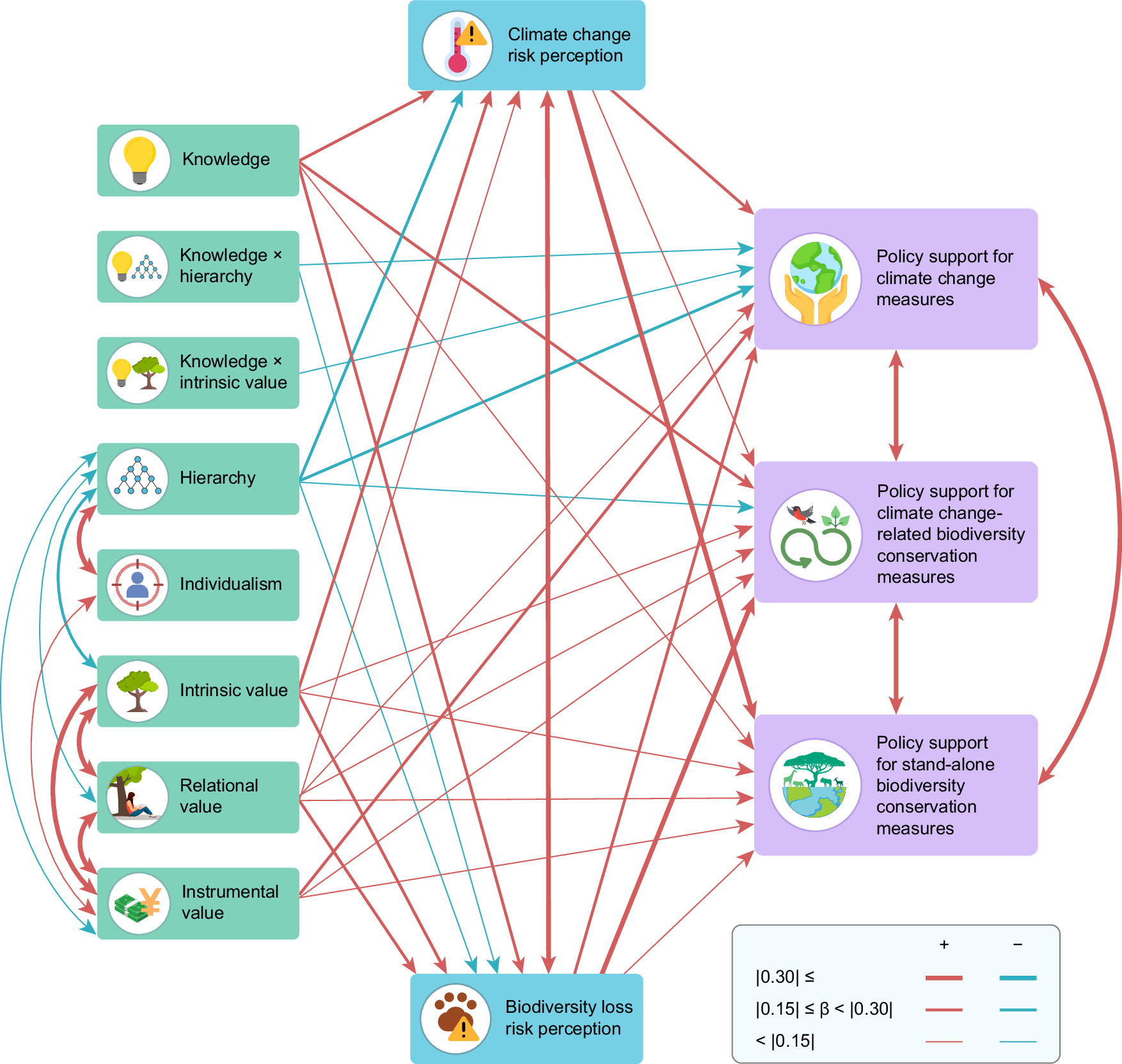
- Respondents with more hierarchical worldviews rated climate change as less risky and backed climate measures less than egalitarian respondents did, the sharpest worldview divide in the survey.
- That same association was considerably weaker for biodiversity measures related to climate change, and showed no clear direct link for stand-alone conservation measures.
Compiled by The ScientistSomething wrong?How this is made
Why it matters
- constraint Because the survey compared different policies rather than different wordings of one policy, a communications team takes a hypothesis from it and not a tested tactic.
- decision Ministries and NGOs weighing whether to lead with conservation language in Japan must decide whether to act on one correlational wave or wait for the experiment the authors say they will run.
- capability An appeal built on people's own ties to nature is the one approach in this dataset with measured support across climate, climate-linked conservation and conservation alone.
Cultural cognition treats worldview as a lens on risk. People who are comfortable with stratified social relations tend to read some hazards as smaller than people who prefer equal ones, and in this Japanese sample that pattern was strongest for climate change, considerably weaker for biodiversity measures tied to climate goals, and not clearly present at all for conservation on its own [4][5].
Takagi and Nakadai asked about three different sets of measures [2]. That is what keeps the appealing reading from holding. Climate policy and stand-alone conservation differ in what they do and what they cost, so a gap in support between them mixes substance with label. The authors say as much: they report associations, not causal relationships, and they caution that presenting a climate policy as biodiversity conservation would not make it more popular [6][7]. The test that would settle it is the one they say comes next, presenting the same policy in different ways while holding its substance constant [10].
"Support for environmental policy may depend not only on what people know, but also on the cultural worldviews they hold and how they value nature," said Takagi, the study's lead author and an associate professor at Yokohama National University's Faculty of Environment and Information Sciences [12].
Knowledge showed up in the data too. Outright denial of human-caused climate change is uncommon in Japan, and support for climate policies still varies [3]. General scientific knowledge was positively associated with support for biodiversity conservation measures, including those related to climate change [8].
Relational values of nature, meaning the personal and cultural connections people have with the natural world, was the one predictor associated with higher support for all three policy types [9]. Hierarchical worldview sorted respondents on the climate items and not on stand-alone conservation; general scientific knowledge showed up on the conservation items [15].
The results don't show how large any of these associations are. The sample is 1,133 people, in one country, in one survey wave in June 2025, and the reported account of the results gives the direction of each association without coefficients or intervals [2][16]. "We found that cultural worldviews were not linked to environmental policy in the same way across every issue domain," said Nakadai, a lecturer at the same faculty and co-author of the study [13].
What to watch
- Whether the planned replication in more politically polarized countries reproduces the same domain-by-domain pattern.
- Whether the full paper reports effect sizes large enough to matter for designing a public campaign.
- Whether extending the method to health and food security finds relational values doing the same cross-domain work.