Invest1 publisher2 min readPublished
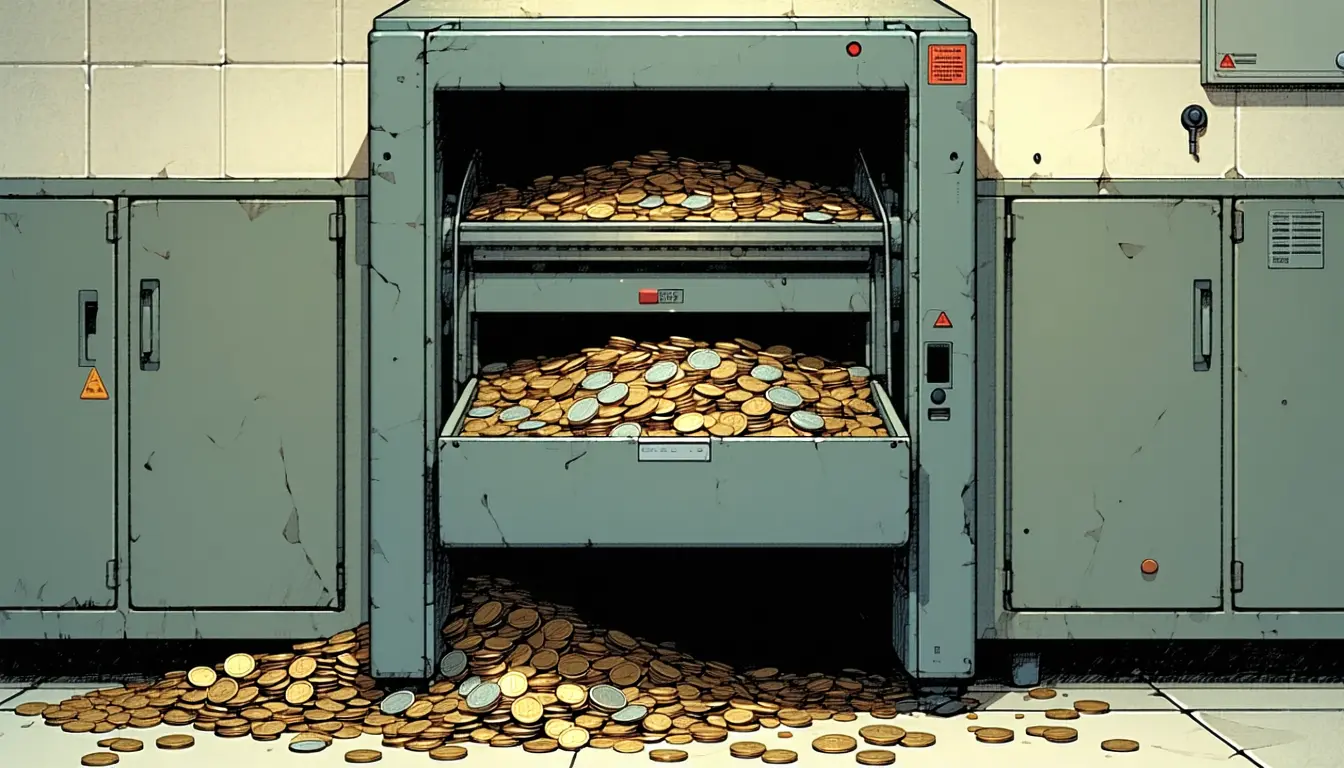
One valid signature emptied Fetch.ai's token converter of 8.7 million FET
Roughly $2 million left Fetch.ai and NuNet on a valid signature, with the token contracts themselves unbroken. The split between the FET drained and the NTX minted decides how much of it the attacker can collect.
The Investor · Invest desk
What happened
- An attacker used compromised signing credentials to take roughly $2 million from the infrastructure connected with Fetch.ai and NuNet.
- Blockaid said the same exploiter wallet that drained the Fetch.ai converter on Ethereum then received a large NTX mint from NuNet's deployer account.
- SlowMist found that TokenConversionManagerV3 authorised conversionIn() on the ECDSA signature of a single externally owned account, with no amount check and no test for on-chain burn or lock proofs.
- The NTX mint created hundreds of millions of unauthorized tokens and added selling pressure to that supply, while the FET drain moved coins that had already been issued.
- Fetch.ai paused its Ethereum bridge, worked with SingularityNET to deactivate the affected wallets and contracts, and paused AGIX-to-FET conversions as a precaution.
Compiled by The InvestorSomething wrong?How this is made
Why it matters
- constraint A checkLimits(amount) test would have capped the worst case at a single transaction; without one, the worst a compromised authorizer key could cost was the converter's entire FET balance.
- exposure NTX holders carry the attack as permanent dilution, because the minted tokens remain in supply; FET holders' token count was untouched by a transfer of existing coins.
- contradiction Fetch.ai's own analysis points at a compromised signing key while the on-chain evidence points at NuNet's minting key, so it is still an open question whether one credential failure spans both projects.
- precedent A published account of a converter emptied on one valid signature is a template for every other single-authoriser bridge, in a half-year where TRM attributes 76% of stolen funds to infrastructure and operational compromises.
PeckShield valued the 408.5 million unauthorised NTX at about $462,730, which implies roughly $0.00113 a token [3][1]. CoinMarketCap showed NTX at about $0.000066 after the mint, almost 95% below the previous day and above an all-time low of $0.00004075 set on September 20 [8]. At that price the same 408.5 million tokens come to about $27,000 [2]. Minting that much supply is what pushed the price down, so most of the NTX leg of the reported $2 million was never collectible [9]. The FET side is the collectible part: 8.7 million tokens, $1.53 million on PeckShield's count and about $1.56 million on Blockaid's [3][4].
An amount check is a line of code, and a converter that releases its full balance on one signature is a design choice a code review can see [6][7]. The compromised key made the transaction possible, and the missing limit set its size.
How many keys were involved is unsettled. Fetch.ai's preliminary analysis said the signing key had likely been compromised, and the on-chain evidence implies NuNet's minting key may also be compromised, but the published evidence does not support a conclusion that one key covered both projects [11]. CoinMarketCap describes NuNet as the second spin-off from SingularityNET, and SingularityNET is the party Fetch.ai worked with to deactivate the affected wallets and contracts [15][10]. Fetch.ai said its on-chain writeup "traces the attack from the compromised signing key to the attacker's cash-out wallets" and added: "This is not the final analysis." [12]
TRM Labs counted 207 hacks and $972 million of losses in the first half of 2026, with infrastructure and operational compromises at about 15% of incidents and roughly 76% of the stolen funds [13]. Those shares work out to about 31 incidents carrying some $739 million, an average near $23.8 million, against about $1.33 million for each of the other 176, or eighteen times as much per incident [3][4][5]. At $2 million this one sits well below the average for the category it belongs to [1].
With the Ethereum bridge and AGIX-to-FET conversions paused, nothing crosses that route while the authorisation design is rechecked [10]. The counter-case for fixing the contract is straightforward: if the compromised authorizer key also held upgrade or ownership rights, the attacker could have stripped out any cap, and credential control is then the only control that was ever available. The published analyses do not say what else that key could sign. I would want that permission list before treating either fix as sufficient.
What to watch
- Fetch.ai says the on-chain report is not final; a final version listing the authorizer key's other permissions would settle whether an in-contract cap could have held.
- Whether NuNet's minting key turns out to be a separately compromised credential or the same one. That answer sets what each project has to rotate.
- The restart terms for the Ethereum bridge and AGIX-to-FET conversions, and whether conversionIn() returns with an amount limit and more than one signer.