Science1 publisher2 min readPublished
Swapping an oxygen vacancy's charge state flips how ZrO2 reduces oxygen
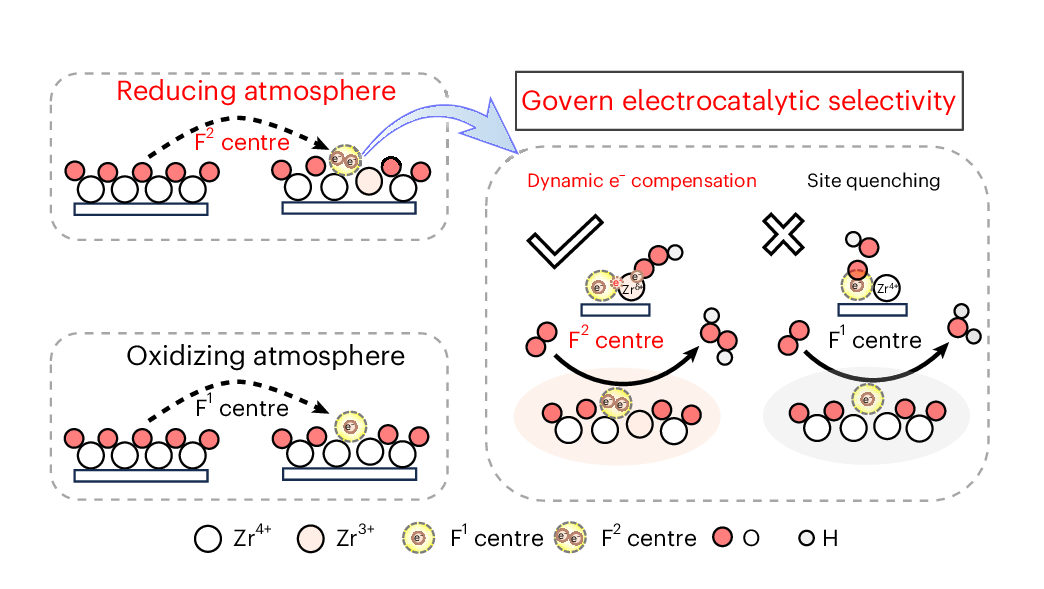
A template-assisted synthesis gave two ZrO2 samples with the same crystal structure and oxygen vacancies in different charge states. In situ EPR then caught the electropositive centre binding O2 and cleaving the bond.
The Scientist · Science desk
What happened
- The team watched the electrodes working, using in situ electrochemical electron paramagnetic resonance to follow F-centre paramagnetism and in situ Raman to follow the reaction intermediates.
- The electropositive F1 centre binds O2 directly, cleaves the O-O bond, and is quenched in the process.
- The authors write that the work establishes charge-state-governed catalysis by distinct F centres and offers a new perspective for vacancy engineering in electrocatalyst design.
Compiled by The ScientistSomething wrong?How this is made
Why it matters
- decision For a group tuning an oxide toward two-electron oxygen reduction, the variable to control is the annealing atmosphere that sets vacancy charge state, and that is a different recipe from maximising vacancy count.
- exposure If the electropositive centre is consumed by the bond cleavage it performs, a durability test that tracks only current will miss a site population changing underneath that number.
- capability Steering selectivity inside one oxide phase means a lab that already makes ZrO2-x has a route to a different product without switching material.
- precedent Once charge state is the governing variable, reporting a vacancy concentration stops being enough support for a selectivity claim about a defective oxide.
The difference between the two centres is whether the vacancy ever touches the oxygen molecule. F1, electropositive, binds O2 directly, cleaves the O-O bond, and is quenched afterwards [8]. F2, electroneutral, is not the primary adsorption site at all. The authors report that its dynamic electronic compensation to adjacent sites is what drives the adsorption and evolution of *OOH, and that this opens the two-electron pathway [6][7].
The synthesis holds the structure fixed. The template-assisted, atmosphere-regulated route produced ZrO2-x with an identical crystal structure and vacancies in one charge state or the other [2][3], so a change in pathway cannot be blamed on a different phase, a different facet or a strain difference. Those are the usual variables in this literature: among the works cited are cobalt(II) oxide nanorods activated by strain engineering [14] and Ru/MnO catalysts where vacancy-dependent intermediates dictate CO2 reduction selectivity [19].
The experiment establishes that charge state alone is enough to switch the pathway. The abstract says the crystal structure was kept identical while charge state varied; it does not say the total vacancy count was matched between the F1 and F2 samples [18]. So the stronger version of the story, that vacancy density is the wrong synthesis target, is not yet on the record. I would want a density series at fixed charge state before retiring vacancy density as a variable.
Counting vacancies has its own trouble. One of the references is a 2021 Surface Science paper arguing that the XPS O1s signal at 531 to 532 eV, routinely assigned to oxygen vacancies in photocatalysts and electrocatalysts, is assigned wrongly [11]. In situ electrochemical electron paramagnetic resonance asks a narrower question. It follows the paramagnetism of the F centres while the electrode is under potential, with in situ Raman following the intermediates alongside it [5].
The claim here is mechanistic. The published abstract carries no faradaic efficiencies or current densities for the ZrO2-x samples [17]. The catalysts the authors cite for two-electron oxygen reduction sit elsewhere in the periodic table: an oxygen-defect bismuth catalyst reported at over 150% cell faradaic efficiency for hydrogen peroxide in a continuously flowing paired-electrosynthesis system [12], and defect-engineered ZnO in N-doped carbon [13]. Only the abstract is public; the paper sells for $39.95, which is $6.96 more than thirty days of Nature+ access at $32.99 [15][16].
What to watch
- Whether the quenched F1 centre regenerates, and how many turnovers pass before the pathway drifts.
- Whether the atmosphere-regulated route transfers to the bismuth and zinc oxide catalysts already used for two-electron oxygen reduction.
- Whether another group reproduces a charge-state pathway switch in a different oxide with the same structure-held-constant control.