Product1 publisher2 min readPublished Updated
Spiegel says Snap made Specs conspicuous so bystanders would ask what they do
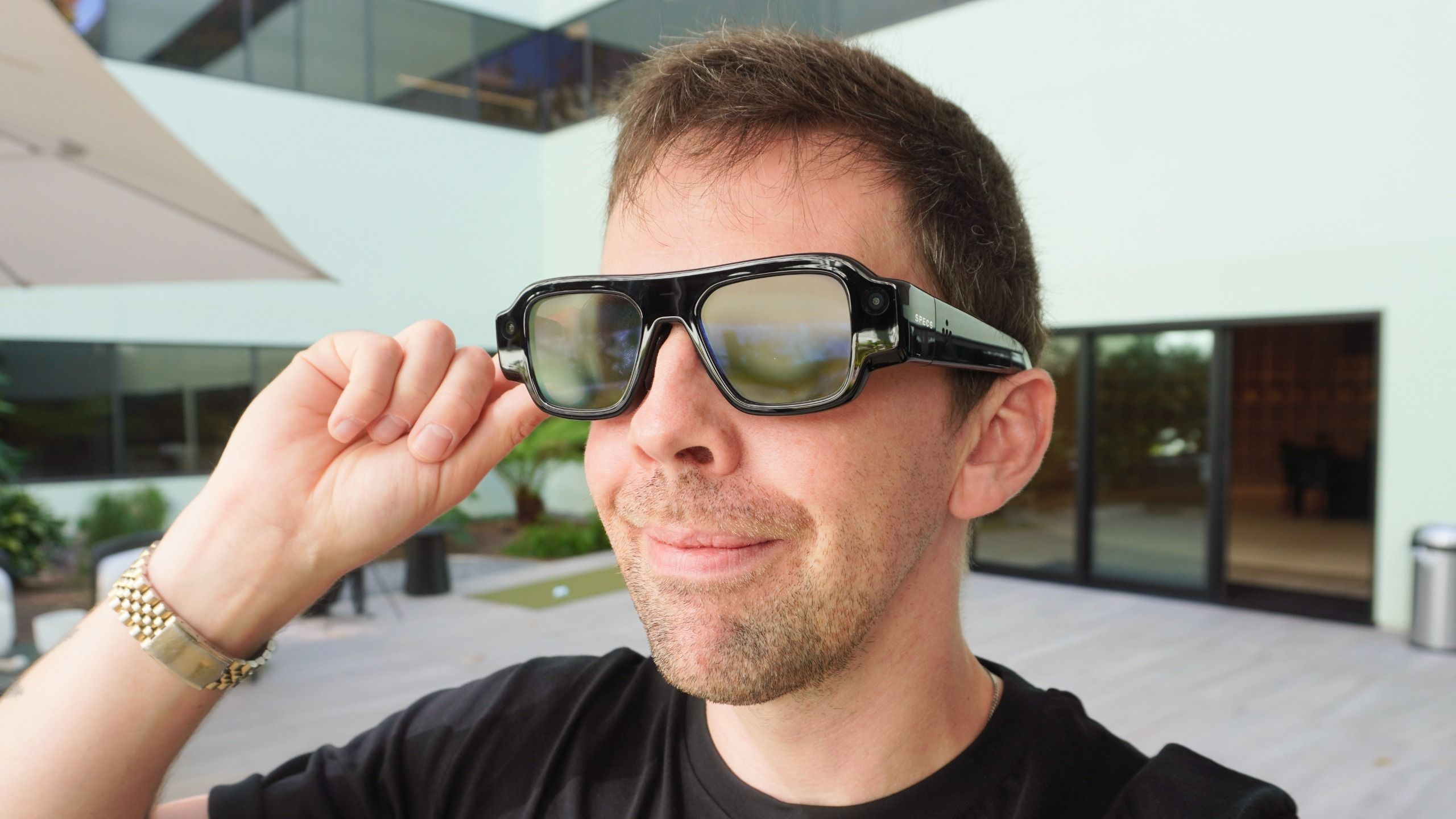
Snap's CEO told Tom's Guide that smart glasses disguised as ordinary frames end up feeling creepy. Specs answer with iridescent lenses and a 130-gram, all-in-frame build that sells for $2,195.
The Product Desk · Product desk
What happened
- Snap CEO Evan Spiegel told Tom's Guide that companies making smart glasses look like normal glasses end up creepy, and that bystanders then wonder whether the wearer is spying on them.
- Specs have iridescent lenses and a deliberately distinct style, and Spiegel said the visibility is there so people can see them coming and start a real conversation.
- The consumer version weighs about 130 grams, against roughly 200 grams for the last developer version, which Spiegel said was too heavy to wear for these experiences.
- Specs cost $2,195, and Tom's Guide's reviewer still called them an early-adopter package even after finding the fit comfortable during his hands-on time.
Compiled by The Product DeskSomething wrong?How this is made
Why it matters
- contradiction Spiegel presents the thick frame as a social design choice; the Tom's Guide writer who interviewed him judged it equally a compromise dictated by physics, and a buyer cannot tell from the product which it is.
- decision Anyone drafting a policy on wearables in meetings now has two questions to settle instead of one: whether people can see the device, and whether they can tell when it is capturing, and a distinctive frame settles only the first.
- cost The etiquette experiment is funded by buyers at the top of the price range, and the bystander norm Snap wants forms only if enough of those buyers wear Specs among strangers.
Spiegel's own illustration of the design working also shows where it stops. He said, "Because the thing I think that's so surprising about Specs is that someone might think, 'Oh, are you recording me?' and it's like, 'No, I'm watching a video on YouTube.'" [4] The frame told the stranger a computer was present, and the stranger guessed wrong about what it was doing.
Device visibility and state legibility are two different properties, and the second one is the privacy question. Tom's Guide's reviewer noted that Specs make themselves obvious "not just with an LED but also with the size and shape of the glasses themselves" [15]. Size and shape carry the visibility, and the LED is the only thing carrying state.
Snap had limited room to be subtle. Specs house the entire computing architecture in the frame [6], with vapor chambers working against the heat of two Snapdragon chips [7], and Spiegel said that mattered because "people don't want to lug around another puck or something like that just to use Specs" [5]. Getting there took 70 grams off the previous developer build, a cut of 35 percent [11]. The writer who conducted the interview judged that the look "is equally a compromise dictated by the laws of physics in 2026" [13], and described Snap's approach as a refusal or an inability to build stealth eyewear [14].
The price puts Specs with people who already want a computer on their face [10]. The bystander had no say in it, and the norm Spiegel describes only forms if enough wearers turn up where strangers are. Reaction inside Tom's Guide was mixed, and one member of the team said the reviewer looked like the front of a pickup truck [12]. The interview does not include unit sales, shipping dates or bystander research [20].
For a decision about your own hardware, or your own policy on what visitors may wear into a room, the grid has two axes: whether a stranger at conversational distance can see the device, and whether they can tell when it is capturing. Invisible and illegible is the pairing Spiegel called a mistake [1]. Visible and illegible is what Specs deliver, and it produces the exchange he describes, in which the stranger asks and then takes the wearer's word for it [3]. Visible and legible is the box to aim at, and the state signal is the harder half. Tom's Guide's own forecast is that the harder sell will be convincing consumers to wear a chunky, two-thousand-dollar face computer in the real world [18].
What to watch
- Whether Snap publishes any bystander reaction or return data once Specs are in customers' hands.
- Whether rival makers keep shrinking frames toward ordinary eyewear, which would test Spiegel's creepiness claim in the market.
- Whether the recording indicator on Specs becomes readable at conversational distance without the wearer explaining it.