Product1 publisher3 min readPublished
PeakMetrics sends hundreds of prompts to five AI assistants to score what they say about a brand
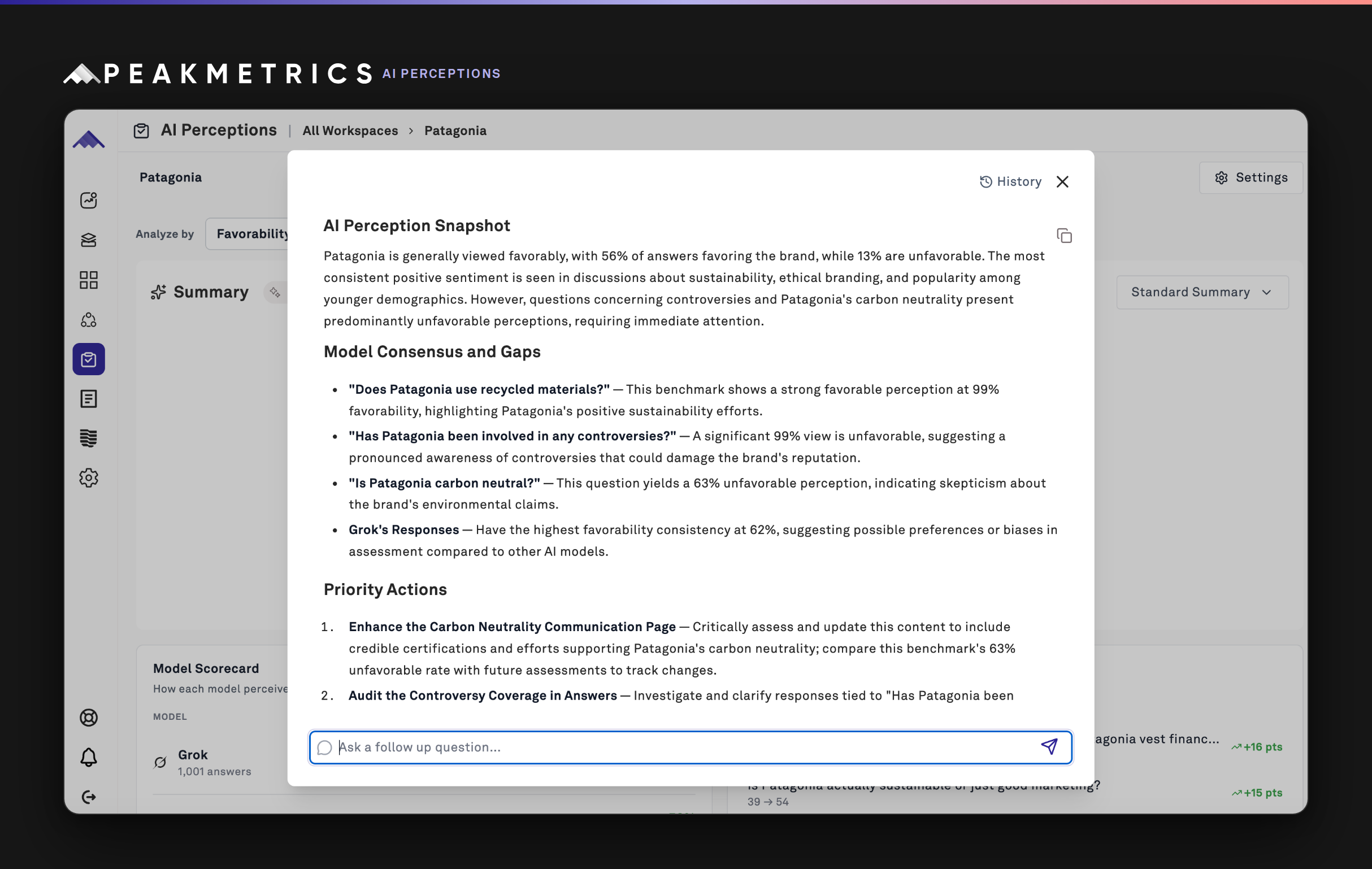
PeakMetrics' AI Perceptions replays customer-chosen prompts through ChatGPT, Gemini, Claude, Grok and Perplexity and scores the answers against criteria the customer writes. Citation tracing works only when the model searched the web.
The Product Desk · Product desk
What happened
- PeakMetrics launched AI Perceptions, a service that records and scores how ChatGPT, Gemini, Claude, Grok and Perplexity answer questions about a company, its products and its competitors.
- Responses are scored against criteria the customer defines, including favorability, trust, competitive positioning, message adoption and purchase intent.
- The tool can name the web pages behind an answer only when the model runs a web search first, so citation analysis covers a subset of the answers collected.
Compiled by The Product DeskSomething wrong?How this is made
Why it matters
- decision Whoever drafts the criteria decides what counts as a reputation problem, and the number the comms team reports upward is one that team defined and will have to defend.
- constraint Answers the model produces without searching come back scored and unsourced. That metric can be charted but not fixed.
- capability When the trace lands on a page the customer already controls, a reputation complaint turns into a CMS ticket with an owner.
- precedent Putting AI answers in the same workspace as news, social and podcast monitoring makes AI portrayal a standing report line that communications teams will be asked to own.
PeakMetrics describes one case where the loop actually closed, and it ran through a content management system. The company said it helped a customer trace inaccurate information about a movie theater chain to an outdated page on the customer's own website, and that correcting the page addressed the misinformation at its source [9].
Whether the next bad answer has an address like that depends on a choice the model makes at request time. The platform records the citations a model finds when it searches the web before answering, and that analysis exists only when the system invokes search [7]. "We give the different LLMs access to do a web search and then determine whether or not it chooses to do so," Childress said [8].
The volume is set by the buyer. Childress said customers typically monitor hundreds of prompts, from broad industry topics to questions about specific products or services [5]. Take 200, the low end of hundreds: one pass across the five platforms records 1,000 answers, and a weekly pass produces about 52,000 in a year [17]. At that volume I would expect the team to read a sample and let the scores decide what gets escalated.
Those scores come from criteria the customer defines, among them favorability, trust, competitive positioning, message adoption and purchase intent [6]. Purchase intent here is a rule a human wrote, applied to a paragraph of model output. It describes how the answer reads. What a shopper did after reading it is a separate measurement. SiliconANGLE's launch report does not include a price [18].
The service also grades the discussion underneath the answers. Jessica Pratt, PeakMetrics' vice president of marketing and communications, said bot activity typically accounts for 20% to 30% of the social media content in a customer workspace and can rise during a crisis [12]. Bot scores come from posting frequency, account age and follower patterns, and a partnership with Reality Defender adds analysis of potentially synthetic text, images and video [11]. "Actors can use agentic workflows to reword messages while pushing the same underlying narrative, making campaigns harder to catch through basic copy-and-paste detection," Pratt said [13].
The service is available immediately and is aimed principally at corporate communications teams [16][3]. Search engine optimization turns on rankings and website traffic; generative engine optimization turns on whether and how a brand appears in an AI-generated answer [15]. PeakMetrics positions the product as reputation management, not an AI visibility monitor [19]. "It's less about visibility of their brand and more around reputation of their brand," Childress said [14].
Every question on the prompt list carries the same test before it goes in: what would change if the answer came back unfavorable. A page the customer owns goes to whoever owns the CMS, with a date. A third-party page goes to whoever pitches reporters. An answer with no citation goes on a watch list. If most of the list is that third kind, the customer is paying for a chart of something no one can edit.
What to watch
- Whether PeakMetrics publishes pricing, or the share of monitored answers in which the model actually invoked web search.
- Whether any of the five platforms restricts automated prompt submission or blocks monitoring traffic.
- Whether customers report answers changing after they edit the pages the tool identifies, beyond the movie theater case.