Product1 publisher3 min readPublished
iPhone Duo matches inner and outer display ratios, swaps Face ID for Touch ID
Apple says the Duo's outer and inner displays share one aspect ratio, which spares app teams the reflow pass other foldables demand. The same phone has no Face ID, so the unlock prompt is where users meet the change.
The Product Desk · Product desk
What happened
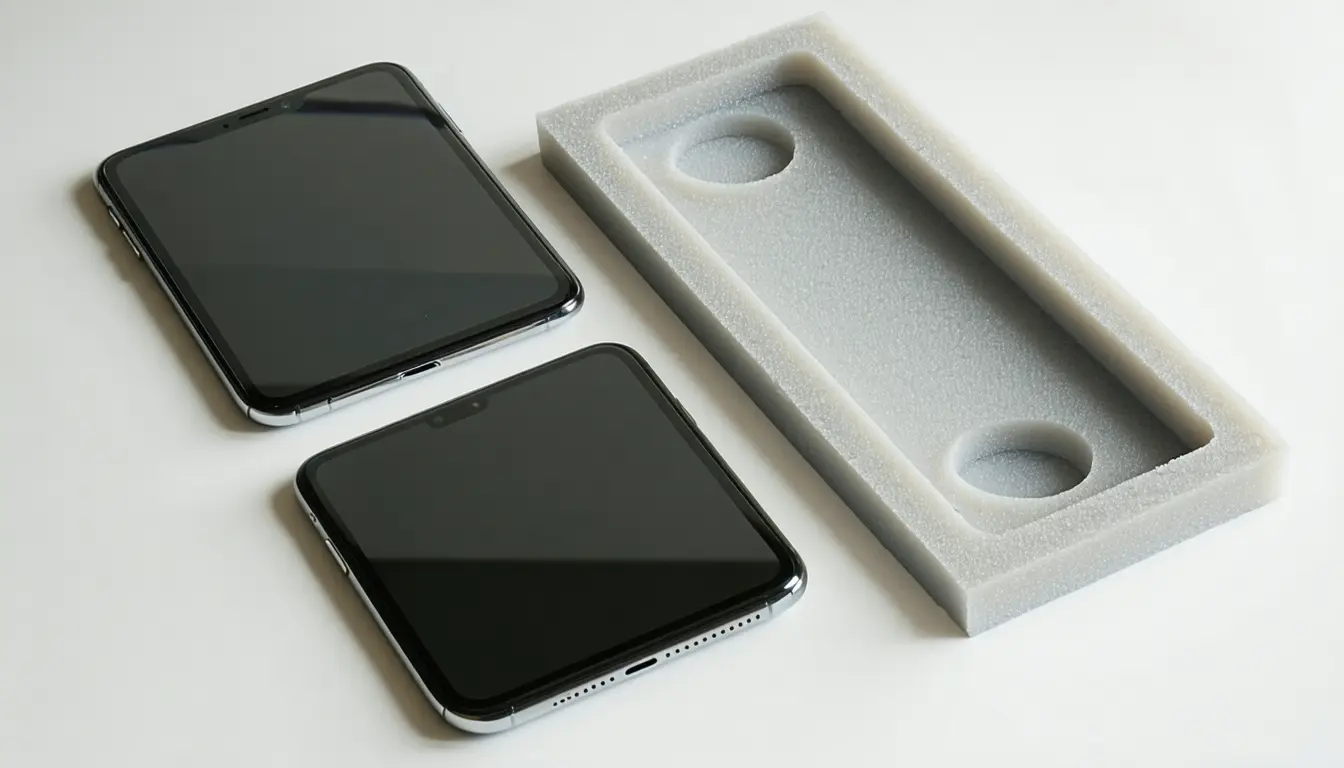
- Apple's first folding phone, the iPhone Duo, has a 5.4-inch outer display that opens to a 7.6-inch inner display with the same ratio inside and out, which Apple says lets apps flow in and out.
- The Duo drops Face ID in favour of Touch ID built into the power button, and puts a 12MP FaceTime camera entirely under the display for the first time on an iPhone.
- The Pro starts at $1,199 and the Pro Max at $1,299 with 256GB, both above last year's opening prices, with shipping on September 18.
- Apple rates the Duo IP68 for dust, credits a hinge of more than 100 components, and adds a nano-textured inner cover layer it says minimises wear and creasing.
Compiled by The Product DeskSomething wrong?How this is made
Why it matters
- decision A fingerprint fallback stops being a legacy path and becomes the only biometric unlock on the priciest iPhone in the range, so whoever owns login has to schedule that work before late October rather than treat it as a backlog item.
- capability If Apple's flow-through behaviour holds up, a foldable stops being a separate design target for any app that already handles window resizing, which is a far cheaper form of support than commissioning a second layout.
- cost Test hardware for the second wave costs $1,999 a unit, $800 more than the Pro, on top of devices already bought in September, and that lands on whichever team has to certify both.
- exposure Products that depend on front-camera image quality now have a lens shooting through the display, and nobody outside Apple can measure what that does until units are in hands.
A user closes the Duo, reaches for the power button, and the phone wants a thumb rather than a look at the screen [4]. That is the smallest thing Apple changed in September and the first thing a real person will hit, because it is the only change that breaks a flow somebody already shipped and tested.
The pitch for a foldable is a bigger canvas. The work a foldable creates is mostly reflow, because the aspect ratio usually changes when the device opens and a second layout has to exist. Apple's answer is to keep the ratio the same inside and out, 5.4 inches on the outer display and 7.6 on the inner, which Macworld reports as apps flowing in and out [2]. If that holds, foldable support turns into a resize test rather than a design project. Apple's own description is the only evidence for it so far, and the announcement carried no developer detail [18].
Same gap on the camera. The headline change on the Pro is a variable aperture on the 48MP main wide camera, described as dynamically adjusting how much light the lens lets in for low light and bright light [10], on phones that otherwise look like last year's [14]. Nothing announced says whether an app can read that aperture or set it [18]. A capture pipeline rewritten this quarter is being built against a description of the resulting photo. Reviewers with test charts will characterise this lens long before any team gets a control surface for it.
The calendar is the part that can be planned against now. The Pro ships September 18 [13] and the Duo ships October 23 [3]: twelve days left in September plus twenty-three in October, so 35 days sit between the two waves [16]. One more number for whoever buys accessories: folded, the Duo measures 11.3mm against 5.2mm open [7], which leaves 0.9mm of hinge and air in the stack [17].
Two axes sort the backlog. The first is whether a flow assumes a face at the point of authentication. The second is whether it assumes a fixed window size at runtime. A flow that assumes neither needs nothing done to it. A flow that assumes a face needs a fingerprint path, on the most expensive iPhone in the range [4][3]. A flow that assumes a size needs a resize pass, because 5.4 inches and 7.6 inches are different amounts of room even at one ratio [2]. A flow that assumes both is where October goes.
Order those four by how loudly they fail. A layout that reflows badly gets a screenshot in a bug tracker; an unlock that never prompts gets a phone call from someone who just paid $1,999 [3] and cannot get into your app.
What to watch
- Whether Apple publishes developer guidance or a capture control for the variable aperture before the Duo ships on October 23.
- Whether apps that gate on Face ID prompt correctly on a Touch-ID-only iPhone once Duo units reach users.
- Whether reviewers find the under-display 12MP FaceTime camera holds image quality in ordinary video calls.