Product1 publisher2 min readPublished
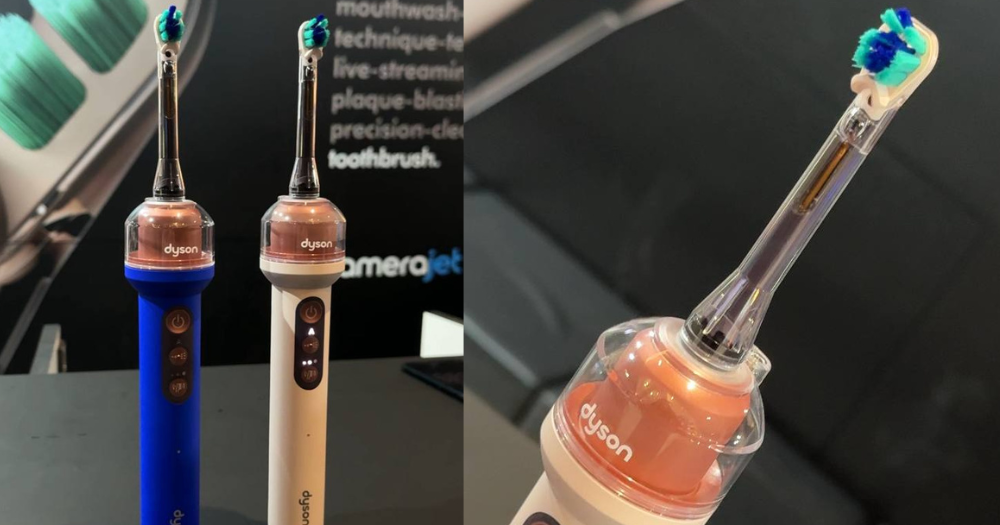
Dyson's $499 CameraJet disappeared from sale in four countries within a week of launch
The camera toothbrush went on sale in US stores on September 8 and was gone from shops in France, the US, UK and Singapore by September 15. Dyson blames one unnamed component in early batches.
The Product Desk · Product desk
What happened
- Dyson unveiled the $499 CameraJet this month, a toothbrush that uses a tiny camera to aim streams of rinsing fluid into the gaps between the user's teeth.
- It reached US stores on September 8, and a day later buyers began reporting water in the battery compartment and failures within 30 seconds of use; Consumer Reports' review unit stopped working in under 24 hours.
- Numerama reported on September 11 that French stores and Dyson's French site had stopped selling the brush, and by September 15 stores in the US, UK and Singapore had done the same.
- Liv Thomas, Dyson's head of Beauty Communications, told WIRED the brush has not been recalled and is "experiencing strong demand globally" with "shortages of supply as we are in the process of scaling up production."
- Thomas cited "a single component issue affecting a small number of early batches," and Dyson declined to name the part, say how many units are affected, or explain why there is no formal recall.
Compiled by The Product DeskSomething wrong?How this is made
Why it matters
- contradiction Dyson's two explanations point in different directions: demand outrunning supply, and a bad component in early batches. An owner holding a brush that died in week two has no way to tell which one applies to it.
- exposure With no recall declared, there is no company-initiated route back for a $499 device, so the loss lands on whichever buyer cannot meet a retailer's return conditions.
- precedent A sales stop in four countries described as a supply shortage gives the next firm with a bad batch a ready vocabulary for clearing stock without using the word recall.
One buyer on Dyson's Reddit forums wrote: "Bought two of these and both of them have stopped working. Since I bought it in the UK and wasn't planning to return it and have thrown the packaging away, I can't even return them. Disappointed that they scammed so good. Unbelievable that it lasted just two weeks." [18] Other posters started calling it the "ScameraJet" [19]. Dyson would not give a failure rate [16].
Kyle Wiens, chief executive of the repair company iFixit, told WIRED the problem is probably the seal. "This sounds like a waterproofing issue. Making products at scale with the tolerances required to waterproof are hard," he said [20]. "My guess without getting a chance to look at a failed unit is that we either have a tolerance issue where some parts aren't mating perfectly, or a failure in the adhesive curing process, either during manufacturing or in shipping" [21]. Wiens said an adhesive-curing failure of that kind can let a unit pass factory testing and then fail in heat or humidity [22].
Dyson spent six years and 38 patents on the device [3], and trained its targeting system on 470,000 dental images to pick a spot inside 100 milliseconds from a 12.5 milliliter reservoir [4]. The US selling window was seven days, September 8 to September 15 [25]. As far as WIRED could establish, the CameraJet cannot now be bought anywhere [27].
Waterpik's Sonic-Fusion 2.0 had already put brushing and water flossing in one handle [23]. The camera is the new part. Wiens points at the seal. Dyson has reworked stick vacuums and premium hair dryers with considerable success, and air-purifying headphones with less [24].
Two variables decide whether a launch can absorb a bad batch. The first is when the failure appears: inside the retailer's return window, or after it. The second is who moves first, the company or the buyer. Early failure with a company-initiated fix is a returns bill and a bad week. Late failure with a buyer-initiated fix is where the CameraJet sits on the evidence so far, and the two policies that soften it only exist if they were written before the first pallet shipped: a return route that does not require the original box, and a list of owners the company can contact without waiting for them to write in. Thomas said units will reappear in "the coming weeks" [12].
What to watch
- Whether Dyson names the single component or files a formal recall in any market.
- Whether the CameraJet returns to sale in the US, UK, France or Singapore within the "coming weeks" Thomas promised.
- Whether anyone publishes a teardown of a failed unit. Wiens said he has not been able to examine one.