Product1 publisher3 min readPublished
Dyson prices the mop at $150 above its cheapest new robot vacuum
Dyson's three new robot vacuums are $550, $700 and $1,200, which makes wet cleaning a $150 step inside its own line at a moment when Gizmodo says rival flagships are pushing toward $2,000.
The Product Desk · Product desk
What happened
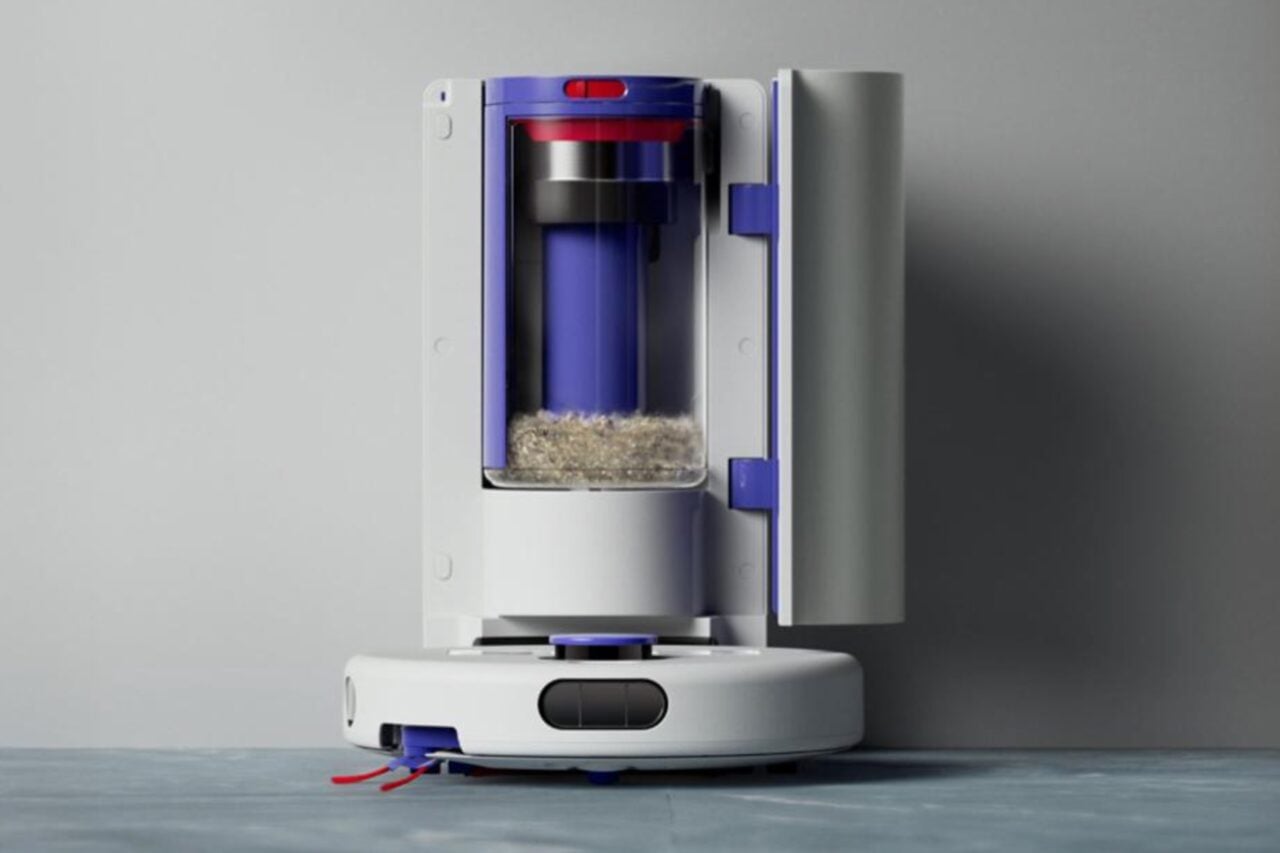
- Dyson released three robot vacuums this week: the $550 R1 Nurovi Dry, the $700 R2 Nurovi Wash+Dry and the $1,200 R3 Nurovi Spot+Scrub.
- The R1 does not mop, and uses LiDAR for mapping and navigation plus what Dyson calls line lasers and edge sensors for object avoidance.
- The R1 and R3 are on sale on Dyson's website, while the R2 is available exclusively at Costco.
Compiled by The Product DeskSomething wrong?How this is made
Why it matters
- constraint A buyer shopping Dyson's own site cannot get wet cleaning under $1,200, because the mid tier sits behind a Costco membership.
- cost The R1's cyclonic dock takes a recurring purchase out of ownership, since there is no dust bag to swap every few months; Gizmodo does not price what those bags cost elsewhere.
- decision Anyone weighing a flagship near $2,000 now has a cheaper reference point from a premium brand, and has to say out loud which features the extra money is buying.
- precedent If the dry-only tier sells, other makers get cover to unbundle mopping and sell it as a step up rather than loading tanks onto every model.
A shopper comparing the two cheapest machines in this line is deciding whether a wet pad is worth $150. The R1 Nurovi Dry is $550 and the R2 Nurovi Wash+Dry is $700 [1]. By Gizmodo's account the R2 is the R1 with two triangular mop pads added and a dock that washes them in 167-degree water [12]. Subtract one price from the other and wet cleaning costs $150 inside Dyson's own catalogue [16].
The next step up is $500 [17]. It buys 30,000Pa of suction instead of 21,000, AI vision cameras, and a UV lamp Dyson uses for what it calls "forensic checks" after a run [13][2]. It also takes something away. The R3's roller mop extends to reach edges, but it does without the articulating side brush the cheaper two carry [13][8].
Jake Dyson, the company's chief engineer, said in the launch release: "Robotic cleaning isn't just about suction power" [3]. The machine his company charges $1,200 for is also the one carrying the biggest suction number [13][1]. Gizmodo's reviewer, who has tested a run of these robots, writes that the best performer for picking up dust and dirt is still the Matic, which moves air at 3,200Pa in its standard mode [4]. One tester, one machine. It is the only performance evidence in the record, and it points away from the peak Pa spec this tiering is priced on.
Height is priced oddly too. The R1 stands 3.78 inches tall and climbs floor transitions up to 0.79 inch [9]. The Dreame X60 Max Ultra Complete gets down to 3.12 inches when its sensor mast retracts, and it costs $1,700 [11]. The difference between them is two thirds of an inch of clearance and $1,150 in price [19].
The record here is a launch price list plus one reviewer's history with other machines, and no sales or usage figures. Gizmodo's framing is that high-end floor bot pricing has ballooned, with some models encroaching on $2,000 [15], and that expensive robots such as the Dreame Aqua10 Ultra Roller "can whiff so hard on the basics that it's impossible to justify spending that cash" [21]. The R1 sells for 27.5% of that $2,000 marker [18].
Two things sort these features: whether the owner touches it on every run, and whether a buyer can judge it before a month on their own floors. The R1's two-channel debris path, which routes fine dust into one chamber and larger chunks into another, sits in the first group, as does the angle of its side brush [5][8]. The UV proof of a clean and the peak Pa number sit in the second [13]. Dyson put the first group at $550 and asked $650 more for the second [20].
For most households I would buy the tier that carries the things you cannot inspect and would notice daily, and skip the tier priced on the UV proof and the peak Pa number. The tradeoff is that Dyson's claims about the brush are claims: Gizmodo says it has seen similar ones from other makers and would like to see how this plays out in real-world testing [22].
What to watch
- Independent dust-pickup numbers for the 21,000Pa R1 against the 3,200Pa Matic would test whether Dyson's suction tiering tracks performance.
- Whether competitors answer with dry-only models near $550 or keep adding tanks to flagships near $2,000.
- Whether the R3's UV and camera features hold the $1,200 price through the first discount season.