Science1 publisher2 min readPublished
Passive samplers detected contaminants more often than grab bottles in a Pennsylvania creek
Grab bottles and passive in-stream samplers, run side by side for two growing seasons, produced records that disagree about where contamination concentrates and when it peaks. Penn State's team says a program needs both.
The Scientist · Science desk
What happened
- A Penn State team collected grab samples and passive POCIS samples from the same five stream sites every two weeks through the May-to-September growing seasons of 2023 and 2024.
- Writing in the Journal of Natural Resources and Agricultural Ecosystems, the researchers concluded that both methods are needed to assess the variety and concentration of contaminants of emerging concern in a watershed.
- Both methods picked up contaminants, and both also missed significant information about what was in the stream.
- Sampling five nested sites instead of only the watershed outlet let the team flag stretches where levels were consistently higher, which Preisendanz linked to nearby fields or wastewater inputs.
Compiled by The ScientistSomething wrong?How this is made
Why it matters
- decision A program that can fund only one method is choosing which question it can answer: which parts of the watershed are worse, or how high concentrations climb after an application or a storm.
- constraint An archive of grab bottles supports a weaker comparison between sites than a passive record does, and no reanalysis can add detections from days nobody sampled.
- exposure Whatever sits near the higher-reading reaches becomes the first candidate source. Follow-up work moves off the outlet gauge and onto the tributaries.
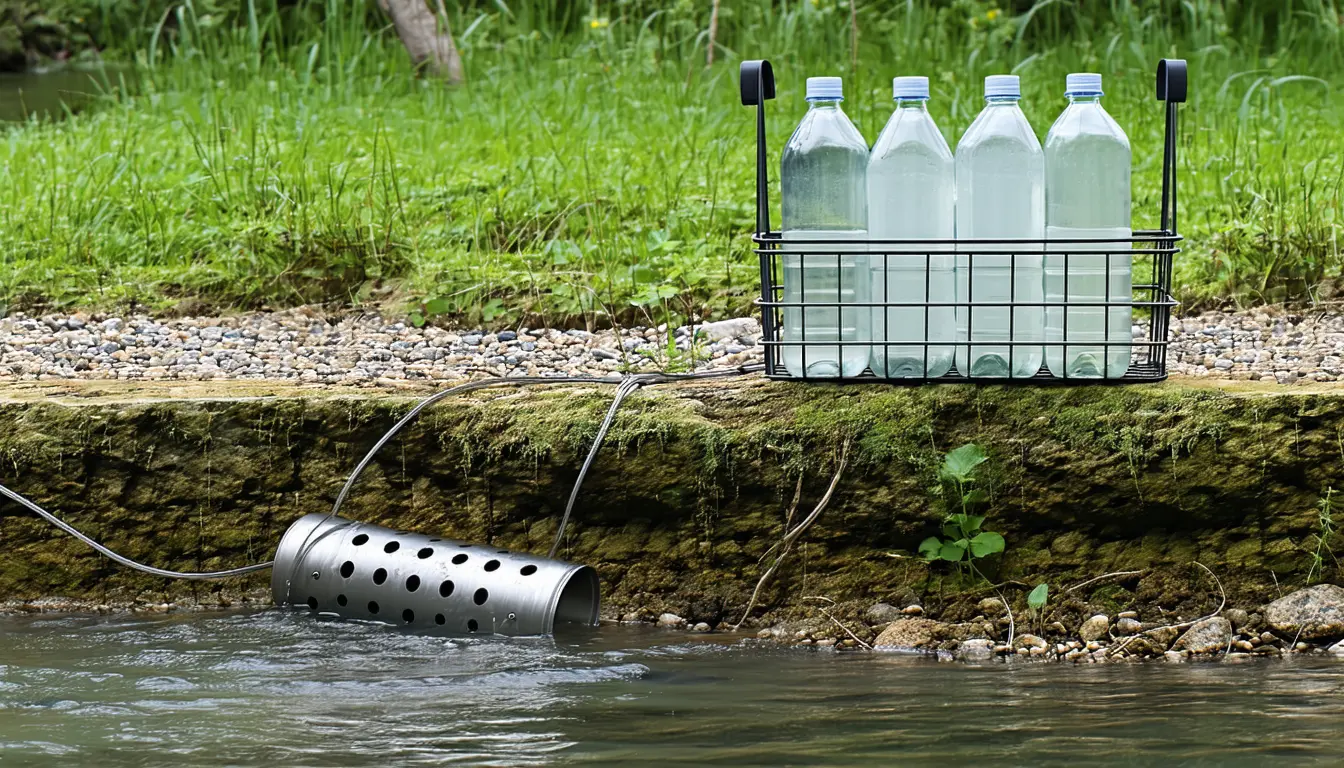
The difference between the two methods is how long each one averages over. A grab sample is a bottle filled at a moment, and it records what was in the stream at that instant [6]. A POCIS device sits in the water for days or weeks and absorbs certain compounds the whole time, so it reports average exposure across the deployment [7]. A pesticide present for a few hours after an application or a storm has to coincide with a site visit to reach a bottle at all, and the Penn State team attributes the passive samplers' higher detection rate to that [13].
"Even at trace levels, contaminants of emerging concern in surface waters can threaten aquatic organisms and human health," said Heather Preisendanz, the study's senior author and a professor of agricultural and biological engineering in Penn State's College of Agricultural Sciences [4]. "We wanted to determine the best way to detect trace amounts of chemicals in streams, so we could determine where and when those chemicals are entering a watershed," she said [5].
Four compounds turned up most often in both datasets: the herbicides atrazine and simazine, the insecticide clothianidin and the stimulant caffeine, each in at least 68% of samples from both methods [12]. Even the least frequently detected of the four was therefore absent from up to 32% of samples [16]. That 68% is a detection frequency, counting the samples a compound appeared in and not the concentration it appeared at [20]. Fortnightly collection from May through September comes to about 11 rounds a season, so across two seasons and five sites the comparison rests on roughly 110 grab samples and 110 passive deployments [17].
The two methods parted company in a patterned way. Compared as whole mixtures, the passive samples separated the five locations more clearly than the grab samples did, and the researchers said that suggests passive sampling may be better for comparing long-term contamination patterns across a watershed [14]. Grab concentrations moved more sharply across the season. Preisendanz said that makes sense because a bottle measures only one moment in time [15].
This is a comparison of two methods at five sites in one 24-square-mile agricultural watershed over two crop seasons [8][9]. How much a single-method program elsewhere under-reports is a different measurement, and this design does not make it [18]. The team has sampled the same five sites since 2021 [8].
What to watch
- Whether the full paper reports POCIS time-averaged concentrations alongside grab peaks for the same fortnights.
- Whether the same split between methods appears in a watershed dominated by wastewater inputs instead of cropland.
- Whether follow-up sampling ties the Halfmoon Creek hotspots to specific fields or discharge points.