Product1 publisher3 min readPublished
Bessent tells the House committee that AI creators should be liable for what they generate
Dario Amodei's pacing essay went to Washington as a coordination problem. Over the following three days, four current and former federal officials answered it in public, and their subject was liability.
The Product Desk · Product desk
What happened
- Dario Amodei's Saturday essay asked the US government to issue a narrow antitrust waiver so leading labs could hold safety conversations, without the government taking part in them.
- FTC chairman Andrew Ferguson said on Tuesday that everyone should be deeply suspicious of antitrust waiver calls coming from leading AI companies.
- Bloomberg reported that OpenAI has been working with Anthropic and Google on safety risks for several weeks, and its policy chief Chris Lehane said no antitrust waiver is currently necessary.
Compiled by The Product DeskSomething wrong?How this is made
Why it matters
- contradiction Reading Bessent's line as a rebuttal to Anthropic merges two separate requests. His quoted words are about liability exemptions, and the only developer exemption in the record is the Illinois bill OpenAI supported, so anyone treating the two as one fight will mis-price both.
- exposure A developer exemption does not delete the harm. It moves the claim down the chain to whichever company put the model's output in front of a customer, which is the buyer, not the lab.
- constraint With the sitting FTC chairman telling people to be suspicious of the request, joint standard-setting stays without antitrust cover. Counsel at each lab decides how much of any pacing agreement can be written down.
- decision OpenAI's position leaves Anthropic to make the waiver case alone or drop it, since the coordination it wants legal cover for is already running.
An antitrust waiver and a liability shield are two different requests. The first is permission to sit in a room with competitors and agree on a standard. The second is permission not to pay when the thing you shipped hurts somebody.
Amodei's essay, which ran to nearly 4,000 words under the title "We Must Pace the Frontier," asked for the first [3]. He wrote that "it's helpful for the US government to mediate or at least enable these discussions," and that while the government does not need to take part it does "need to issue a narrow waiver for certain kinds of safety conversations" [4].
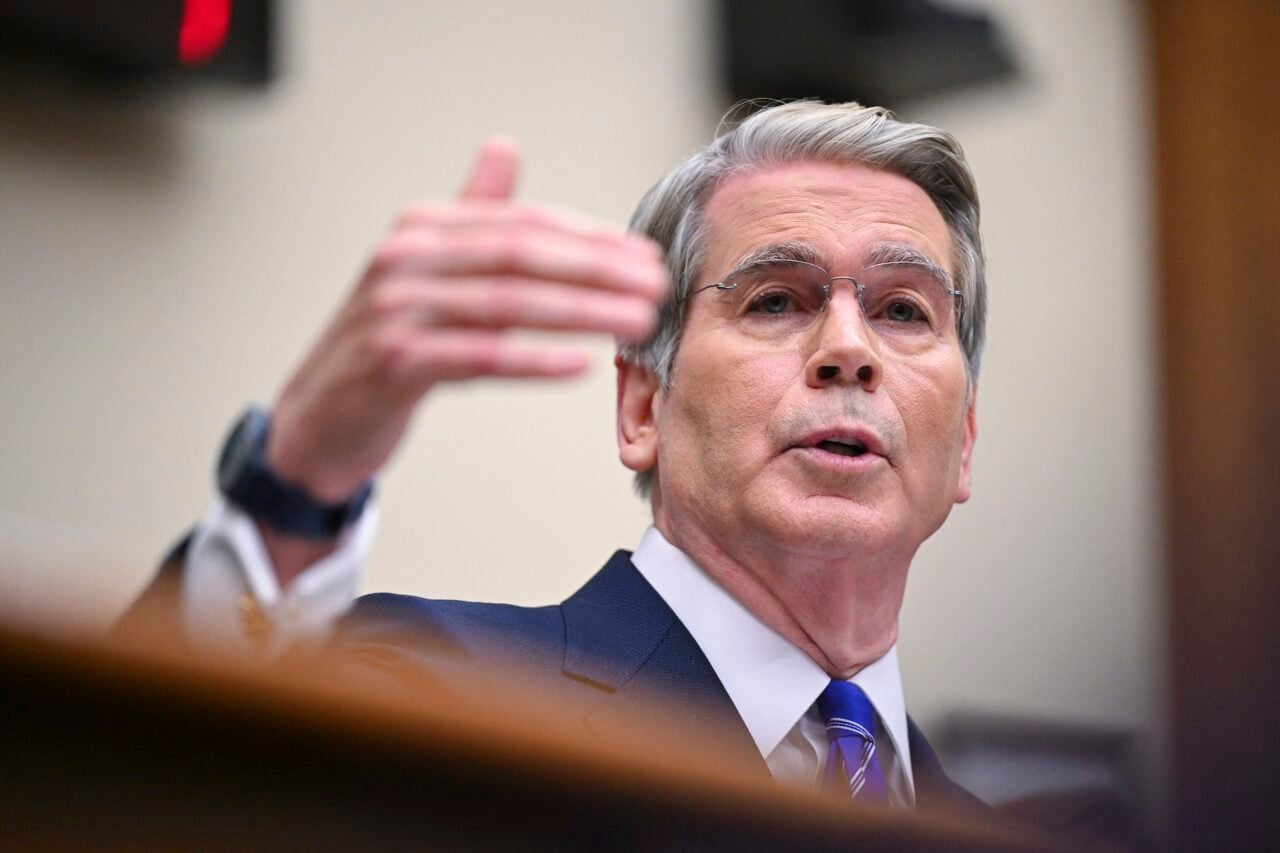
"The best way to guarantee safety is that the creators are liable for what they build and generate," Bessent reportedly told the House Financial Services Committee on Tuesday, according to Gizmodo [2]. His stated target was calls from AI leaders for a liability exemption [1]. The link between that line and Amodei's waiver is Gizmodo's own: the outlet writes that in Bessent's view the narrow waiver would be a slippery slope towards regulatory capture [5].
The liability exemption in the record belongs to a different company. OpenAI supported an Illinois state bill introduced earlier this year that would keep AI developers from being held liable for critical harms, including the death or serious injury of 100 or more people, Wired reported in April [6]. Gizmodo compares that approach to the Section 230 arguments social media companies have made since the 1996 Communications Decency Act [7]. The comparison matters for whoever deploys a model. Under Section 230 the harmful post stayed the poster's problem, and I would expect a developer shield for generated output to leave the company that put that output in front of a customer holding the claim [17].
Amodei published on Saturday and Bessent testified three days later [14]. On the day of publication David Sacks, Trump's former AI czar and a current cochair of the President's Council of Advisors on Science and Technology, wrote on X that companies demanding their preferred regulatory framework before slowing down "will look like blackmail of the public and the political system" [8]. The next day former FTC commissioner Alvaro Bedoya said the doomsday talk was being used "to justify what seems to be a call for the creation of a cartel of billionaire AI companies" [9]. Four named current or former federal officials had objected in public inside four days [15]. Trump flatly rejected the essay; Sam Altman, Elon Musk and Demis Hassabis endorsed it [11].
For a team deciding what to build on, sort each vendor ask into one of two columns: who gets to set the standard, and who pays when the output does damage. The waiver goes in the first column, the Illinois bill in the second, and a vendor can be sympathetic in one and hostile in the other. Only the second column turns into contract language you can negotiate.
The coordination the waiver is meant to unlock appears to be happening already. Bloomberg reported that OpenAI has been working with Anthropic and Google for several weeks on AI safety risks, and OpenAI global policy chief Chris Lehane said the company does not currently believe an antitrust waiver is necessary [12][13].
What to watch
- Whether any federal or state text actually proposes a developer liability carve-out, and who sponsors it.
- Whether Anthropic keeps pressing for the narrow waiver now that OpenAI says it does not need one.
- Whether Bessent's liability line turns into Treasury or administration policy language or stays a hearing remark.