Leadership1 distinct publisher3 min readPublished
Over a quarter of Americans eat most of their meals alone, and 52% now say they would rather order their own dish. That shift is why the personalization Domino's, Wonder and DoorDash are building reprices portioning and the cost to serve a party.
The Board Room · Leadership desk

Compiled by The Board RoomSomething wrong?How this is made
The larger part of this demand change sits at tables where people are still together. Set the two numbers in the record beside each other: a 2026 OpenTable survey puts 52% of Americans on the side of ordering their own dish rather than sharing, while Bureau of Labor Statistics time-use data has just over a quarter spending most of their eating and drinking time alone as of 2023 [3][2]. The roughly 27-point gap between those measures, imperfect as the comparison is, describes people who show up to a group meal and then transact individually [13]. Party sizes stay the same while order counts climb.
That is what reprices the unit. Take the arithmetic of a four-top: one large pizza split four ways is one container and one assembly step, while four personal pizzas are four of each [14]. The three companies in this story put the cost of that somewhere different. Domino's puts it in the SKU and the box [1]. Wonder puts it in the kitchen, cooking several menus off one production line so a party's disagreement never leaves the building [4]. DoorDash puts it in logistics, consolidating separate restaurant orders from a company's employees into a single delivery [5]. Whoever absorbs it, that cost still has to land somewhere on the ledger, since the party itself no longer settles on one order.
A personal pizza could read as a simple menu addition, since small pizzas are not new. What separates the two is the copy: according to Business Insider's reading of the announcement, Domino's is selling customization "without compromise" and the avoidance of "sacrifice" [1]. Positioning a format against the act of agreeing is a commitment, and commitments in marketing become defaults in operations.
The clock speeds are worth separating. Solo eating went from a fifth of Americans to over a quarter across fifteen years, about a quarter more solo eaters in relative terms [12], which is a decade-scale trend. The portioning and packaging decisions that answer it are this quarter's, and they will still be sitting in the operating model when the trend has moved another few points.
What gets traded away has evidence behind it. Kaitlin Woolley of Cornell ran pairs through a management-versus-union wage negotiation after they either shared a bowl of chips and salsa or ate from their own, and the sharers reached agreement faster [6]. Ayelet Fishbach of the University of Chicago argues the individual cost of eating what the group eats is usually negligible against the social gain [7]. Kevin Kniffin's study of firefighters found crews who ate together performed better as a group than crews who ate alone [8].
So the exchange is access traded for coordination. The record does not price that trade. The one worked example of divergence without apparent loss is the vegan firefighter in Kniffin's study, who brought his own meal but ate at the same table at the same time as the crew and took part in the shared clean-up [11]. If synchrony rather than shared food is doing the work, then an employer deciding how to feed people this quarter is making a scheduling decision more than a menu one, and the consolidated multi-restaurant delivery is the option that keeps the timing intact while conceding the plate.
Ranked by verification strength, evidence, and original report placement.
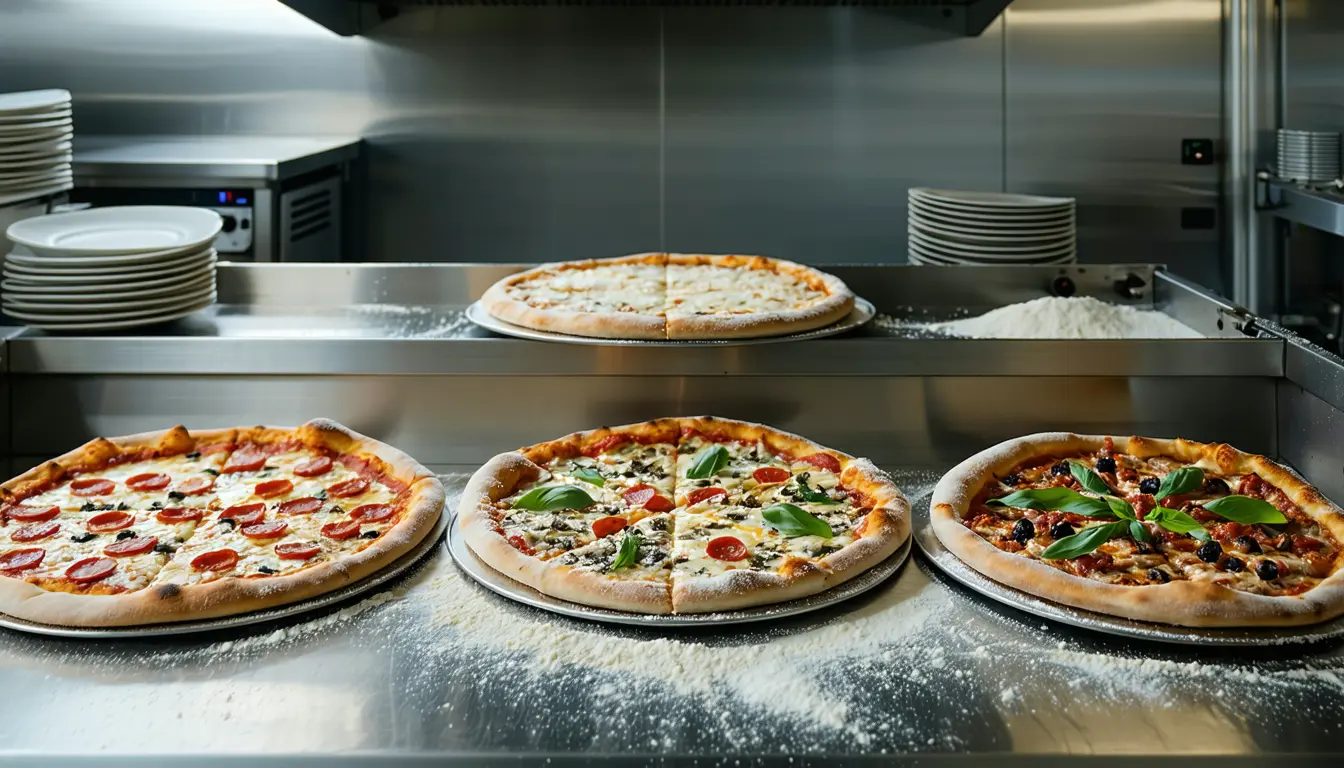
Domino's is launching a truly personal pizza, and its announcement says diners can customize "without compromise", avoid "sacrifice", and share a meal without actually sharing.
The Bureau of Labor Statistics' American Time Use Survey shows that as of 2023, over a quarter of Americans spent most of their eating and drinking time alone, up from a fifth in 2008.
A 2026 OpenTable survey found that 52% of Americans say they would rather order their own dish than share with the table, even as group dining overall is up.
Wonder, a food hall-inspired startup, makes meals from multiple menus out of the same kitchen, so no one has to choose between cuisines.
DoorDash has launched a feature for business customers that lets employees choose separate lunches from different places and get them delivered all at once.
In a study by Kaitlin Woolley, a professor of management at Cornell University, pairs who shared a bowl of chips and salsa reached a wage agreement faster in a management-versus-union negotiation scenario than pairs who each had their own snack.
Distinct publishers with included, body-backed reporting in this cluster.
businessinsider.com
1 article · September 3, 2026
Follow any of these and your For You feed starts watching them — no settings page required.
product
Serve adds Grubhub, and sidewalk delivery quietly becomes a shared utility1 distinct publisher
invest
Meta's internal agent gets its own computer to run errands across the open web1 distinct publisher
product
Rillet's $100M reads as proof mid-market ERP is rip-and-replace, mostly at the cheap end1 distinct publisher
leadership
AI's answer keys are being written for $85 an hour by people who cannot get other work1 distinct publisher
Evidence-backed comparisons of source perspectives and observed adoption signals. Read the methodology
Which Builder, Operator, and Investor concerns the observed source mix emphasized—not a truth score.
Evidence, demonstrated adoption, hype gap, incentives, and confidence are assessed independently, each on its own current evidence. How these are measured.
Named datasets, one anonymous study
The two headline numbers are checkable in principle — the Bureau of Labor Statistics' time-use survey and a 2026 OpenTable poll — and three academics describe their own work on the record, which is stronger footing than press-release science. The weak seam is the sentence doing the most emotional work: that people with dietary restrictions fear not being invited again is sourced to "research shows" and nothing more. Product details are thinner still; Domino's marketing copy is quoted, its pricing and specifications are not.
Shipping products, unstated scale
This is not a trailer for future launches: a national chain is reformulating its core product, Wonder is running multi-menu kitchens today, and DoorDash's split-lunch feature is live for business accounts. What no one supplies is size — no unit volumes, no share of orders that split, no revenue. So the behavior is measured while the commercial uptake is merely described, and the strongest quantitative support for adoption comes from consumer surveys rather than from any company's numbers.
Cultural verdict outruns the findings
The distance travelled here is from three product launches to a diagnosis of American loneliness, and the bridge is a chips-and-salsa lab task plus a firehouse study from roughly a decade ago. Both findings are real; neither shows that a personal pizza costs anyone a friendship. Business Insider half concedes it — we have always ordered separate entrées at restaurants, the piece notes, without social collapse — which undercuts the framing more than the framing admits. Meanwhile the honest counterweight, that customization lets people with allergies join a table instead of vetoing it, is granted and then set aside.
A booking platform's poll, a chain's copy
Follow who produced each number. The 52% comes from OpenTable, whose survey also happens to report group dining rising — a finding that flatters reservations either way. The "without compromise" and "no sacrifice" phrasing is Domino's advertising, quoted as a reading of the national mood rather than as a campaign trying to sell more pizza per party. And a declinist culture take on a pizza is dependable traffic for a general business outlet, which is not a knock on the reporting so much as a reason the framing was available.
One account, firsthand quotes
Nothing here has been checked twice. The academic material is firsthand and hard to dispute, since the researchers describe their own studies. Everything commercial — what the pizza costs, how a store assembles four of them instead of one, how many customers actually order it — rests on the company's word or is simply absent, and there is no second outlet to compare against.