Product1 publisher3 min readPublished
DJI's SDR Transmission II carries 4K60 HDR video 2.5 miles at 349 euros a radio
DJI's old wireless video link topped out at 1080p and 20Mbps. The new one runs 4K 60fps HDR at 50Mbps to as many as 40 receivers with latency as low as 35 milliseconds. Transceivers start at 349 euros, and there is no US release yet.
The Product Desk · Product desk
What happened
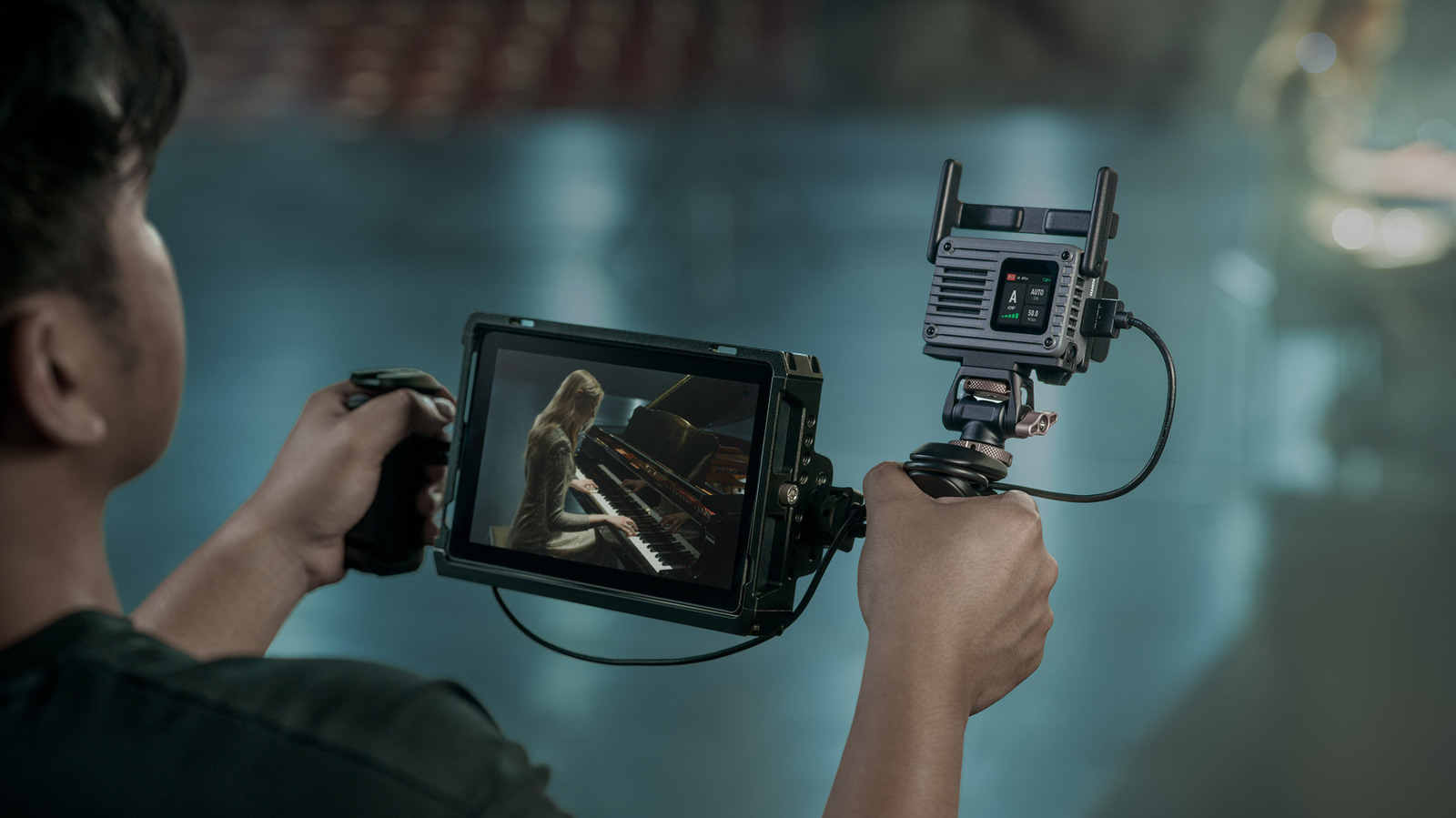
- DJI's SDR Transmission II in TX mode sends 4K 60 fps HDR video at 50Mbps to receiving transceivers as far as 2.5 miles away, where the original system was capped at 1080p, 20Mbps and 1.8 miles.
- One transceiver can link to up to eight others with remote control on each, and a large production can run five transmitters and 40 receivers at the same time.
- Switching between camera feeds is now a tap instead of the re-booting, disconnecting and searching the previous generation required, with latency as low as 35 milliseconds.
Compiled by The Product DeskSomething wrong?How this is made
Why it matters
- capability A director calling for camera B gets it without a receiver reboot, so the person choosing shots no longer has to be positioned at the end of one particular camera's link.
- constraint At roughly 0.1 bits per pixel, this is a link for judging a picture, and whatever path a production uses to capture the picture is untouched by the upgrade.
- decision Speccing the maximum rig means buying 45 radios at 14,187 euros, a line item that competes with cable runs and the crew who lay them.
- exposure US productions are the ones left out, so a company shooting on both sides of the Atlantic maintains two monitoring workflows and trains crew on both.
A director asks for camera B. Under the arrangement DJI is replacing, that meant rebooting the receiver and searching for the other transmitter [5]. The new system makes it a tap, at latency DJI puts as low as 35 milliseconds for commands like focus pulling and gimbal moves [5][6].
The picture upgrade is narrower than the spec line implies. Bitrate went up 2.5 times, from 20Mbps to 50Mbps [15]. Taking 4K as 3840 by 2160, the pixels per frame went up four times [16], and 4K at 60 frames a second is about 498 million pixels a second, which puts 50Mbps at roughly 0.1 bits per pixel [17].
DJI describes the job in matching terms. The system provides monitoring for directors, producers and set personnel, with smartphone monitoring plus assist tools including focus peaking and waveforms [9][10]. It "lets camera operators and focus pullers remotely adjust settings and control the camera," DJI said [8]. It also supports PTP control of capture, aperture, shutter speed and ISO on compatible cameras [11].
On range, the underlying figures are 3 km to 4 km, a third further, which Engadget renders as 1.8 miles to 2.5 miles [18]. DJI says that with the new system "a reliable link can be established in various environments from open stadiums to dense mountain forests, and through demanding car-to-car shots or challenging FPV drone work" [7]. Engadget did not publish the conditions behind the range or latency figures, or say how they hold with 40 receivers on air.
Pricing is per radio, and that is where a multi-camera plan gets expensive. Transceivers start at 349 euros, or 309 pounds, with a two-pack at 629 euros [12]. The largest configuration DJI quotes is five transmitters and 40 receivers running at once [4], which is 45 radios [19]. Bought as 22 two-packs plus one single, that is 14,187 euros before any camera bodies [20].
None of it is orderable in the US yet, and Engadget attributes that to a ban on certain DJI products [13]. A US-based rental house cannot standardise a monitoring workflow on hardware it cannot buy. The radio family underneath is the same one in DJI's drones, OcuSync [14].
Two questions sort the camera positions on any given day. First, does the camera move in a way a cable cannot follow, such as a car-to-car rig or an FPV drone [7]. Second, is the feed being looked at or being recorded. Positions that move and only need looking at are where a 349-euro radio does more than a cable: the director's monitor, the focus puller's pull, an ISO change from the cart [8][11]. A single transceiver reaches up to eight others, each supporting remote control, so a modest rig is four or five radios [3]. For static positions, and for any feed that has to be recorded, the cable stays; DJI is selling the link between the camera and the people watching it [9].
What to watch
- Whether DJI opens US sales of SDR Transmission II, and what regulation is keeping it out for now.
- Whether DJI publishes test conditions for the 2.5 mile range and 35ms latency, and how both behave with 40 receivers live.
- Whether the OcuSync link on DJI's drones gets the same 4K 60p treatment as the professional system.