Science1 publisher3 min readPublished
A benchtop flow chamber grows Pseudomonas biofilms at cystic fibrosis airway shear stress
IBEC's XpertBiofilm holds shear stress between 0.02 and 0.9 mPa on a removable coverslip that a standard microplate reader can score, and within that range more flow produced more Pseudomonas aeruginosa biomass.
The Scientist · Science desk
What happened
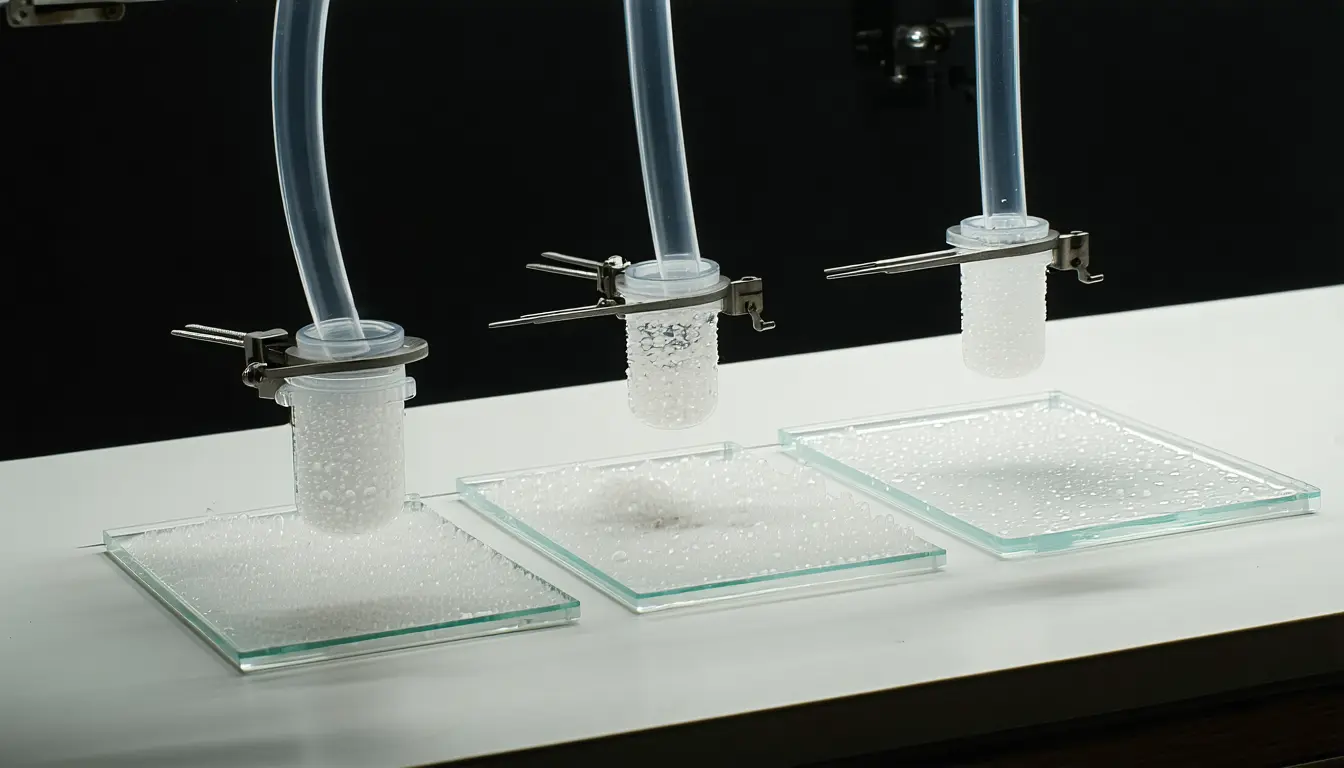
- A team at the Institute for Bioengineering of Catalonia built XpertBiofilm, a chamber that grows biofilms under continuous controlled liquid flow instead of in a still culture medium.
- The chamber reproduces shear stress from 0.02 to 0.9 mPa, the low-flow band the authors match to cystic fibrosis lungs rather than to healthy airways.
- Within that band, Pseudomonas aeruginosa formed more biofilm biomass as the flow increased, the result the group reports from the device.
- The biofilm grows on a removable round coverslip that can be read directly in a microplate reader, with no specialized microscope in the workflow.
- The work appeared in Colloids and Surfaces B: Biointerfaces, led by Eduard Torrents of IBEC and the University of Barcelona with Nuria Blanco-Cabra as first author.
Compiled by The ScientistSomething wrong?How this is made
Why it matters
- constraint The 0.9 mPa ceiling confines the device to diseased-airway conditions; healthy-lung and cough shear sit tens to hundreds of thousands of times above it, so vascular, urinary and cough-cleared surfaces stay out of range.
- capability A microplate-reader endpoint puts flow-grown biofilm assays inside the equipment budget of labs that have no confocal microscope and no imaging specialist on staff.
- decision A lab weighing this against its static plates is deciding on growth conditions and readout, because the published paper does not report a susceptibility comparison showing that the flow answer differs from the static one.
- exposure If the authors' reading is right, cystic fibrosis patients are exposed twice over: low shear both encourages biofilm attachment and weakens the clearance that would remove it.
The quantity XpertBiofilm sets is shear stress, the friction a moving liquid exerts on the surface bacteria settle on [6]. The chamber holds it between 0.02 and 0.9 mPa across a small removable round coverslip, a 45-fold span from bottom to top [8][11][19]. Shear in a healthy lung runs around 80 mPa, and a cough can push it to 170,000 mPa [10]. Dividing through, the chamber's ceiling is about one eighty-ninth of healthy-airway shear, and a cough is roughly 190,000 times that ceiling [17][18]. The target is the thick, slow mucus of cystic fibrosis and COPD airways, which are frequently complicated by Pseudomonas aeruginosa biofilm infections [11][13].
Inside that narrow band, biomass rose with flow: the more liquid moving over the coverslip, the more biofilm P. aeruginosa laid down [12]. According to the authors, that helps explain why the bacteria adhere so strongly in cystic fibrosis airways, where the very low shear stress leaves the airways much less able to sweep bacteria out, leading to chronic infection [14].
The practical part is the readout. Flow systems for biofilms already exist, and the group describes them as complex, expensive and dependent on specialized microscopy and staff with advanced technical training [7][5]. That is one reason most labs still grow biofilms in static plates, where the medium does not move. Here the coverslip lifts out and goes straight into a microplate reader [9].
"Reproducing in the laboratory the flow conditions that bacteria actually encounter in the body in the context of a disease is key to understanding how biofilms form and, above all, to better predicting whether an antibiotic will work. XpertBiofilm allows us to do this with simple, accessible equipment, without relying on specialized microscopy," said Eduard Torrents, who led the work with first author Nuria Blanco-Cabra [15][4].
Torrents puts the payoff in antibiotic prediction. What the study demonstrates is the growth side of that: an environment matched to one clinical setting, scored on equipment many hospital labs already own [11][9]. Whether an antibiotic that clears a flow-grown biofilm also clears a patient's infection is a comparison against clinical outcomes. The paper, in Colloids and Surfaces B: Biointerfaces, does not make that comparison, and it does not report paired static-versus-flow susceptibility numbers or a price for the device [4][20].
The biofilm matrix is the reason any of this is worth the trouble. It shields bacteria from antibiotics and from the immune system far more effectively than free-floating growth does. That shielding is why biofilms sit behind chronic wounds, catheter and prosthetic infections, and the lung infections of cystic fibrosis and COPD [1][2]. If susceptibility read from a still plate and susceptibility read under flow diverge, the flow number is the one to use. Testing whether they do is the experiment the field still needs, and the authors tie its urgency to the global rise in antibiotic resistance [16].
What to watch
- Paired susceptibility results for the same isolate grown static and grown at 0.02 to 0.9 mPa, read on the microplate reader.
- Whether the chamber geometry can be pushed toward the higher shear of blood vessels, urinary catheters or a healthy airway.
- Whether species other than Pseudomonas aeruginosa show the same rise in biomass with flow inside that low range.