Build1 publisher3 min readPublished
NVFP4 squeezes Qwen3.8's 2.4 trillion weights onto eight B300s at 150 GB a GPU
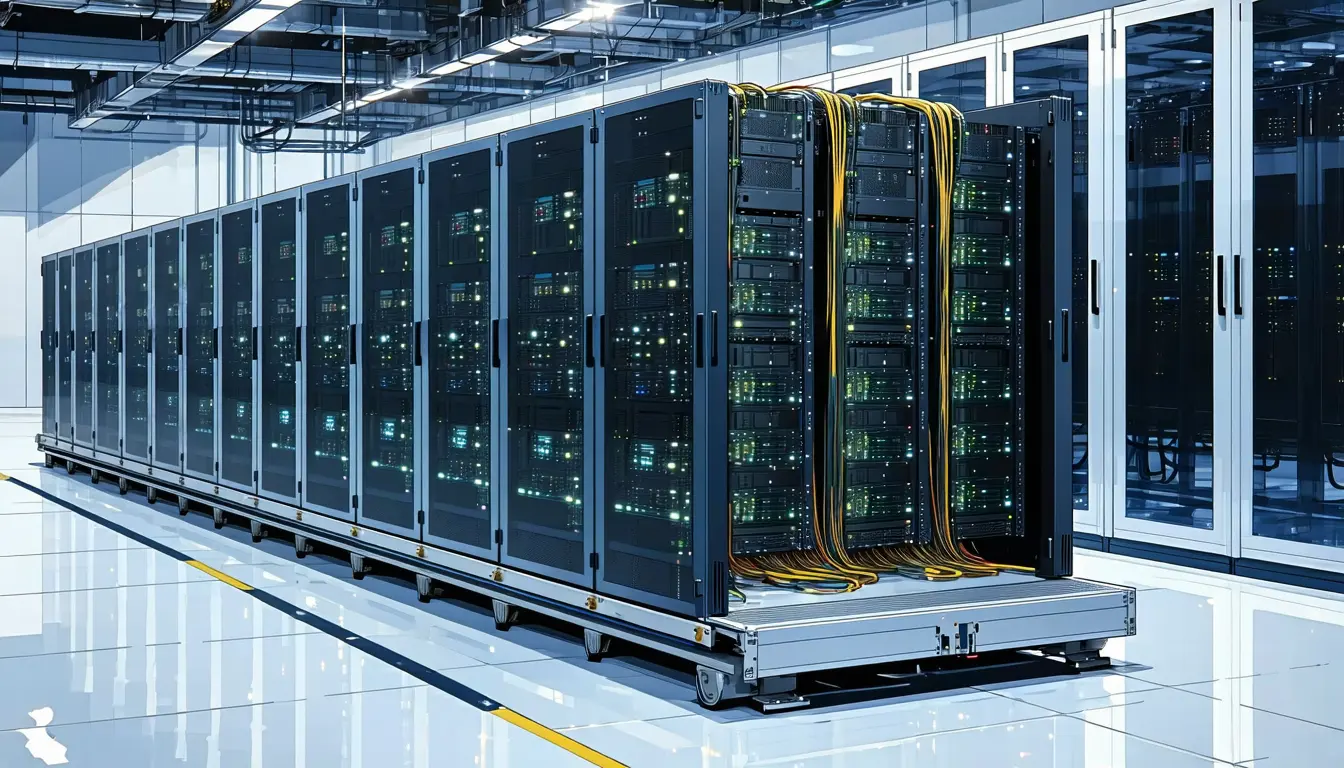
Alibaba's largest open-weight release fits on a single eight-GPU node only because a community four-bit build takes it down to 1.2 TB. AWS publishes the vLLM config for it and skips the price.
The Engineer · Build desk
What happened
- Alibaba's Qwen team released Qwen3.8-2.4T-A95B on August 12, 2026, the first Qwen-Max-class model published as open weights.
- AWS has published a guide serving it on one ml.p6-b300 instance, eight NVIDIA B300 Blackwell Ultra GPUs, running vLLM on SageMaker HyperPod behind an OpenAI-compatible endpoint.
- Community MXFP4 and NVFP4 quantizations compress the 2.4-trillion-parameter checkpoint to roughly 1.2 TB, which is what makes the single-node fit possible at all.
- Of the model's 92 layers, 69 are Gated DeltaNet layers with a bounded recurrent state and 23 use full quadratic attention, a 3:1 ratio AWS credits for bounded memory at long context.
- Alibaba's own benchmark figures put the model at PaperBench 93.0, IFBench 82.8 and 86.6 on terminal-based coding, with headroom left on SWE-bench Pro and Toolathlon.
Compiled by The EngineerSomething wrong?How this is made
Why it matters
- cost Self-hosting bills by the node-hour, not the token, and the guide supplies no instance price, so anyone weighing this against an API has to source the rate and their own utilization forecast before the comparison exists.
- constraint With 150 GB of weights resident on each GPU, cache, activations and draft state contend for the remainder, so the concurrency you can actually serve is set by leftover HBM rather than by the 262K context figure.
- decision The artifact that fits the node is a community quantization the vendor's scores are not tied to, which puts the burden of proving W4A4 preserves behavior on whoever deploys it.
- capability Per-request reasoning_effort control moves the compute-versus-depth dial inside your own cluster, where it trades against your GPU hours instead of a provider's pricing tier.
Two point four trillion parameters at four bits apiece is 1.2 TB, which is exactly the footprint the community NVFP4 build reports [2][6][15]. That match means the checkpoint sits at the arithmetic floor for W4A4, so there is no slack for a layer someone decided to leave in higher precision. Divide across the node and the weights alone claim 150 GB per GPU [14]. KV cache, activations and multi-token-prediction draft state all live in what is left.
That is where the attention split stops being an architecture footnote. One layer in four runs full quadratic attention, 23 of 92, while the other 69 are Gated DeltaNet layers with a bounded recurrent state instead of a growing cache [7][16]. A 262K native window extensible to 1M is a memory claim before it is a quality claim [3], and only a quarter of the stack is paying the per-token memory tax.
The MoE side is cheaper than the headline number suggests and more expensive than the activated one. About 4 percent of parameters fire per forward pass [17], and serving compute tracks that count [8], but capacity does not. All 512 experts stay resident, which is the 1.2 TB you just divided by eight [8].
AWS frames the trade-off as operational, with no per-token API fees at scale on one side and purpose-built GPU infrastructure on the other [11]. The text does not close the loop with a number: there is no hourly rate for the ml.p6-b300 instance and no break-even against API pricing [18]. The unit of cost here is an eight-GPU Blackwell Ultra node held for as long as the endpoint exists [4], not a token. Utilization sets the break-even, and a node at a 10 percent duty cycle bills the same as a saturated one.
The benchmark scores are Alibaba's own, and the post does not tie them to the quantized artifact it actually deploys [10][19]. For PaperBench 93.0 or 86.6 on terminal coding to transfer to your endpoint, several things have to hold: W4A4 has to be behavior-preserving on your prompt distribution, your `reasoning_effort` setting has to match whatever produced the table [9], and MTP acceptance has to be high enough that speculative decoding earns back the draft compute [5]. Those are a validation run, not something readable off a table.
The least glamorous part of the guide is the part that is doing real work. HyperPod puts EKS in front of driver installation, model download, health monitoring, autoscaling and node replacement [12], because a single node holding 1.2 TB of weights is also a single failure domain, and recovery means pulling that 1.2 TB again. Kimi K3 got the same treatment in the first post of the series [13].</body_markdown> </invoke>
What to watch
- Throughput and MTP acceptance-rate figures for the NVFP4 build on ml.p6-b300, which decide whether speculative decoding pays for itself.
- An independent benchmark run on the W4A4 quantization rather than on the weights Alibaba benchmarked.
- Whether the 1M-token extension is demonstrated on a single node, since that is where the 23 full-attention layers bite hardest.