Leadership1 publisher3 min readPublished Updated
Your Face Is Now Inventory: ASIC Logged 19,400 Scam Reports and $7.4m Lost to Ten Deepfaked Figures
Impersonation of named executives, economists and politicians has moved from nuisance to regulated-scale fraud. The takedown pipeline is now an operating function, not a PR reflex.
The Board Room · Leadership desk
Drafted by a language model from the sources cited here and checked against its claim ledger before publication. How we use AISend a correction
What happened
- ASIC dealt with more than 19,400 scams last financial year, almost triple the amount in the year before.
- According to reports to the National Anti-Scam Centre's Scamwatch, Australians lost $7.4m to the top 10 impersonated public figures.
- Anthony Albanese is the figure most commonly co-opted in these deepfake investment scams and was at the top of the impersonation list.
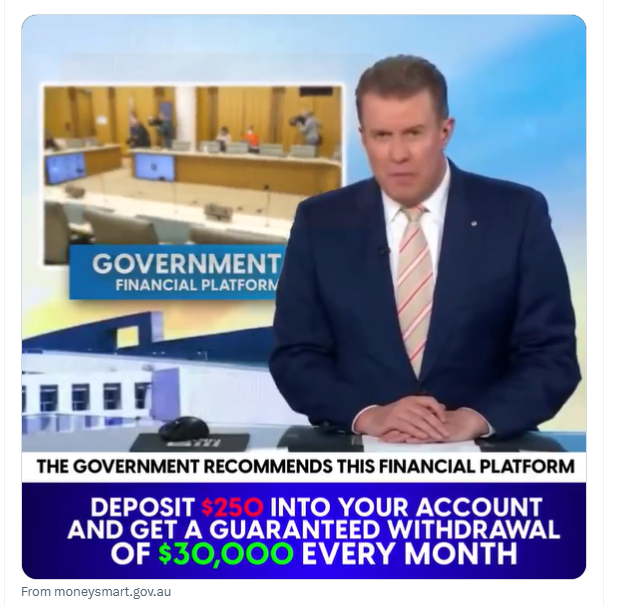
- One video online uses real footage of the prime minister overlaid with fake audio promising Australians can invest $4,000 to earn $40,000 a month, with the deepfake falsely describing it as an 'official platform' with a government guarantee.
- In one video, a deepfake of the prime minister promises people can earn $35 an hour, which is 'about $850 per day' and 'over $25,000 per month', according to the Australian Financial Review, presented with an American accent.
Compiled by The Board RoomSomething wrong?How this is made
Why it matters
Australia's corporate regulator dealt with more than 19,400 scams last financial year, almost triple the number in the year before, and reports to the National Anti-Scam Centre's Scamwatch show Australians lost $7.4m to fraud built on deepfakes of just ten public figures [1][2]. That works out to an average of about $740,000 in reported losses attached to each impersonated name [21], which is the number worth putting in front of a board: your likeness and your brand are now inputs to someone else's revenue model.
Prime Minister Anthony Albanese is the figure most commonly co-opted, according to the Australian Securities and Investments Commission [3]. One video takes real footage of him and overlays fake audio promising that $4,000 invested returns $40,000 a month, described as an "official platform" carrying a government guarantee [4] - a claimed tenfold monthly return [23]. Another, reported by the Australian Financial Review, has the fake Albanese promising $35 an hour, "about $850 per day" and "over $25,000 per month", delivered in an American accent [5]. At $35 an hour, $850 a day requires 24.3 hours of work [24]. The arithmetic does not survive ten seconds of scrutiny, and it does not need to.
The rest of the list is the part operators should read closely. The top five also features economists Tom Piotrowski and Stephen Koukoulas, ABC financial journalist Alan Kohler, and politicians Jacqui Lambie and Angus Taylor [7]. Behind them: entrepreneur Dick Smith, billionaire Gina Rinehart, economist Alan Oster, Pauline Hanson and the late broadcaster John Laws [8]. The selection criterion is not fame. It is perceived authority on money.
ASIC says fake celebrities were only the entry point, and that scammers now assemble networks of fake brands, websites, reviews, news articles and videos that reinforce each other before the victim transfers funds to overseas criminals [9]. The enforcement volume gives the scale: 5,476 phishing hyperlinks taken down, almost four times the prior year; 7,051 fake investment platforms, 2.5 times higher; and 3,106 cryptocurrency scams, up almost 30% [10][11][12]. That is 15,633 takedowns across three categories in one year [22].
ASIC chair Sarah Court put the operative point bluntly: "The presence of polished content, familiar branding or convincing testimonials does not mean an investment is legitimate" [13]. She added that AI is making investment scams harder to detect and that a simple online search is no longer sufficient verification [14]. Anyone relying on customers to distinguish a real brand from a cloned one should note Commonwealth Bank research finding about nine in ten Australians are confident they can spot an AI scam while actually managing it less than half the time [18], a gap of more than 40 percentage points between confidence and competence [25].
The practical implications are unglamorous. ASIC's own guidance is that consumers should verify website addresses, check whether a person or company is who they claim to be, and be wary of urgent calls to act [15]; that a certified Australian financial services licence should be checked against ASIC's professional registers because scammers misuse licence numbers [17]; and that scams should be reported to Scamwatch, the victim's bank, or cyber.gov.au [16]. Each of those is a step a company can pre-empt with a permanent verification page, a monitored reporting channel and a standing relationship with the platforms.
Two things to watch. ASIC warns that scammers track the news cycle and switch impersonation targets opportunistically to match topical issues [19], which means exposure spikes around results, appointments and public appearances rather than sitting flat. And independent MP Zali Steggall has proposed a bill requiring AI-generated content that could mislead voters to be clearly identified [20]; labelling obligations that start in political advertising rarely stay there.