Product1 distinct publisher3 min readPublished
The pitch to buyers is real: only live combat produces this kind of failure data. Which rules govern combat-derived training data once it leaves the front line remains an open question.
The Product Desk · Product desk

security
Britain buys into Ukraine's battlefield data, and the first thing built with it watches a UK fence2 distinct publishers
product
Geologic hydrogen's firmest numbers come from mine vents, not reservoirs1 distinct publisher
product
China built nearly 90% of last year's humanoids. Everyone else shipped about 1,3001 distinct publisher
product
A peer-reviewed number for orbital glare turns Reflect Orbital's demo into a regulatory test1 distinct publisher
Compiled by The Product DeskSomething wrong?How this is made
Somebody at a commercial drone company will be handed a data sheet this quarter offering flight records from an active war, and they will have to decide what to put in the box marked provenance.
The case for buying is real and worth stating first. The training value sits in the exceptions, according to MIT Technology Review: the moment visibility disappears, a signal jams, or an operator improvises [5]. Firms chasing those moments through controlled testing spend years and large sums assembling enough of them [6]. A delivery or remote-sensing drone will never be shot at, but it still has to act on incomplete information around people who do not behave predictably, which is the same problem stretched over a longer timeline [7].
Then there is the number being counted. Take the processed footage total and divide it by a working week: 500,000 hours over 40 hours is 12,500 weeks of one person's attention, close to 240 years of it [9]. Hours are a supply metric, telling you the pipe is full rather than that anything downstream improved, and the reporting so far covers how many organisations hold access [2] and how many hours have been prepared [3] without naming a single fielded system that improved because of it. A buyer who treats hours as evidence of value is doing what a growth team does when it reports sessions and calls it retention.
The paperwork remains the missing piece. The January announcement set out who may have access [1]; it did not arrive with published pricing, resale limits, retention rules or re-export terms, and none appear in the reporting [13]. MIT Technology Review's argument is that the legal vacuum has to be filled by the countries and companies involved together, rather than left to a country fighting for its survival [8]. Until then, your own contract functions as the entire regime.
An earlier round of this data flowed as well. American drones over Syria and Yemen produced records that shaped the first generation of semiautonomous military hardware in the late 2010s [12]. What has changed is that access now feeds a wider development ecosystem rather than one buyer [15].
Two axes sort the decision. The first is whether your failure modes are adversarial, meaning something is actively trying to deceive the aircraft, or merely degraded, meaning fog and lost GPS. The second is whether you can write down, in a sentence a customer would accept, where the data came from and what you are permitted to do with it.
Adversarial and documented is the quadrant where battlefield records are the only source that exists, and the purchase defends itself. Adversarial and undocumented means financing a supply chain that will eventually acquire a regulatory name, with no way to show where you stood in it. Degraded and documented means your own fleet already generates most of what you need, more cheaply. Degraded and undocumented is a legal premium paid for footage answering a question you did not have.
The clause worth arguing over is the exit: how you stop using the data, and who can require you to, if the terms move once other countries follow Ukraine's lead [10]. For now, that clause is doing the regulator's job.
Ranked by verification strength, evidence, and original report placement.
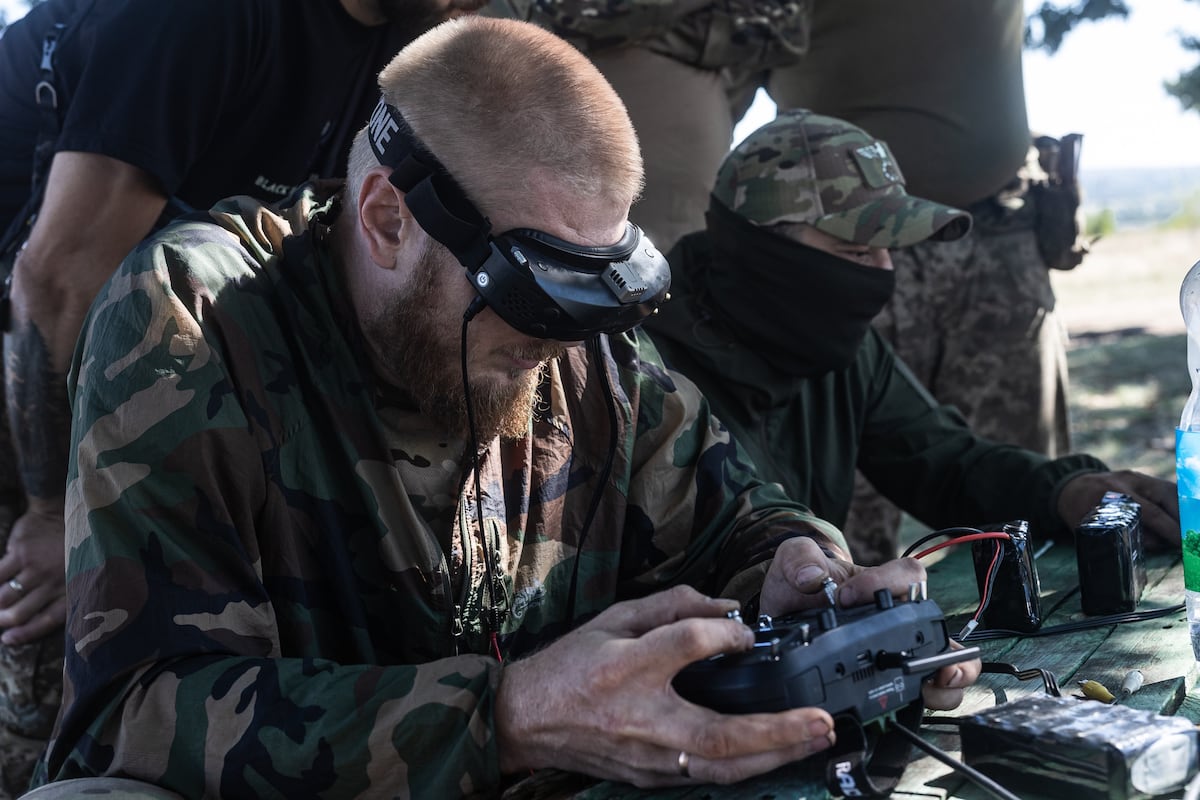
Ukraine's Ministry of Defense announced in January that it would make millions of data points gathered during tens of thousands of drone flights available to both military contractors and commercial companies.
Since the announcement, more than 100 companies and the UK government have gained access to the Ukrainian drone data.
Enabled Intelligence, an American company that specialises in processing data for AI training, says it has already made more than half a million hours of Ukrainian drone footage available to feed into the next round of models, advertising possible uses in both military and commercial systems.
Military intelligence programs held data generated by sensor-heavy systems such as Predator and Reaper drones for nearly a decade through programs like Project Maven, with access confined to restricted, classified channels for the sole purpose of developing new weapons systems that fed back into the same military.
The data most valuable for training AI models comes from exceptions: the moment visibility disappears, a signal jams, or a human operator improvises; war produces such moments at a frequency controlled testing cannot match.
AI companies spend years and enormous sums trying to capture enough of these exception moments to make their models more robust.
Distinct publishers with included, body-backed reporting in this cluster.
1 article · September 4, 2026
Follow any of these and your For You feed starts watching them — no settings page required.
Evidence-backed comparisons of source perspectives and observed adoption signals. Read the methodology
Which Builder, Operator, and Investor concerns the observed source mix emphasized—not a truth score.
Evidence, demonstrated adoption, hype gap, incentives, and confidence are assessed independently, each on its own current evidence. How these are measured.
One outlet, two uncounted counts
Everything factual here passes through a single account in MIT Technology Review, and the two figures that make the story a story — 100-plus companies with access, half a million hours processed — come from the seller and the vendor respectively. No contract, no buyer list, no third-party audit of footage volume appears. The historical spine about Project Maven and the Syria and Yemen flights is well-established background rather than new verification.
Access is real, recipients are a number
This is not a pilot announcement. A defence ministry has opened the tap, a national government and triple-digit companies are through it, a named American firm has industrialised the processing, and there is a downstream deployment — jam-trained drones surveying farmland without cell coverage. Adoption is genuine and already at scale. What holds the score down is that almost every participant is described by category rather than by name, so the breadth cannot be independently sized.
Sober argument, unfalsifiable numbers
Modest overstatement, and not of the usual kind. MIT Technology Review is careful about mechanism — the exception-data argument holds up on its own logic — but the 'Wild West marketplace' and 'gold mine' framing rests on one vendor's self-reported hours and an unpriced trade, while the prediction that other states will follow arrives with no second country attached. Nothing here is inflated; several load points simply cannot be tested from what is on the page.
Seller, processor and advocate all pulling
Follow the motives and they line up in one direction. Ukraine, as the piece itself says, is monetising for funding and partnerships. Enabled Intelligence is advertising an inventory it wants sold, and it supplied the only volume figure in the story. MIT Technology Review closes with a call for the countries and companies involved to fill a legal vacuum, which is a legitimate editorial stance but shapes which risks get paragraphs — provenance, extraction, a market incentive for war continuing — and which get a sentence, such as the existing purchase controls.
Direction firm, particulars missing
We are reasonably sure the trade exists and is already sizeable, because a defence ministry announcement and a named processor's marketing both point the same way. We are not in a position to say who holds the data, on what terms, or how much of it there is, and with only one outlet reporting, there is nothing to cross-check the two numbers against. Treat the mechanism as solid and every quantity as provisional.