Leadership1 distinct publisher3 min readPublished
Amazon walked away from Project Blue after the city council refused it a connection to municipal utilities. The orbital data center plans now sitting with regulators read better as a price tag on permitting delay than as an escape from it.
The Board Room · Leadership desk

Compiled by The Board RoomSomething wrong?How this is made
The instructive part of Project Blue is where in the sequence it died. Land can be optioned and cleared quietly; water and utilities cannot, because they run through a body that answers to voters, and in this case those voters were in a drought-stricken district [1]. Vox describes the site as already under construction when the council voted [2]. A developer who secures acreage first and the hookup later has converted local politics into sunk cost [3].
The systemic version of the same constraint is the queue. Vox puts the wait to connect to the power grid at 12 years, alongside what it calls an explosive populist backlash [5]. Twelve years counted from a decision made now runs past the end of this decade, which is the window inside which SpaceX says it might assemble its first data center in orbit [15]. For anyone buying capacity, that arithmetic makes the scarce input an interconnection slot and a water source whose owner is under no obligation to sell.
The board-deck version says orbit routes around all of it, and it is incomplete in one specific way. On the aerospace engineer Andrew McCalip's analysis, a one-gigawatt data center in space costs about $51.5bn against $16bn on the ground [9]. Divide the two and orbit runs at 3.2 times terrestrial cost, a premium of $35.5bn for every gigawatt [13]. Jason Aspiotis, who leads an orbital data center startup, told Vox the physics is not in dispute and the engineering is solvable with time and money, but that "the gray area is, well, what about the economics?" [10]
Scale the figure the industry has attached to the idea and the gap becomes easier to hold in view. SpaceX's eventual ambition is 100 gigawatts of new solar energy harvested for AI each year, which Vox calls a very iffy promise and equates to one-fifth of all US electricity consumption last year [7]. At today's orbital cost basis, and holding cost per gigawatt flat in a way nobody actually claims it would, that is roughly $5.15 trillion of capital [14]. Attached to engineering that Vox itself flags as unprecedented [16], a number that size is better read as a statement about how blocked the ground route feels than as a construction budget.
One council in one desert district is not, on its own, a national siting constraint: the source offers no tally of comparable denials, so the breadth of the veto is not established here. The answer is in who moved. Amazon Web Services withdrew rather than contest the outcome [3], and Blue Origin's filing for tens of thousands of possible orbital data centers arrived in the same period [4].
The piece leaves two questions, and only one of them is decidable this quarter. The near question is whether water and interconnection terms are committed in writing before land is committed in concrete, and which jurisdictions will do that. The 2030s question is whether launch costs fall far enough to close a 3.2x premium [13], which the experts Vox spoke to treat as the open item now that feasibility is not [12]. Choosing a water-constrained site this year on the assumption that the utility question resolves itself later is a decision to learn at the end of the process what Project Blue learned [3].
Ranked by verification strength, evidence, and original report placement.
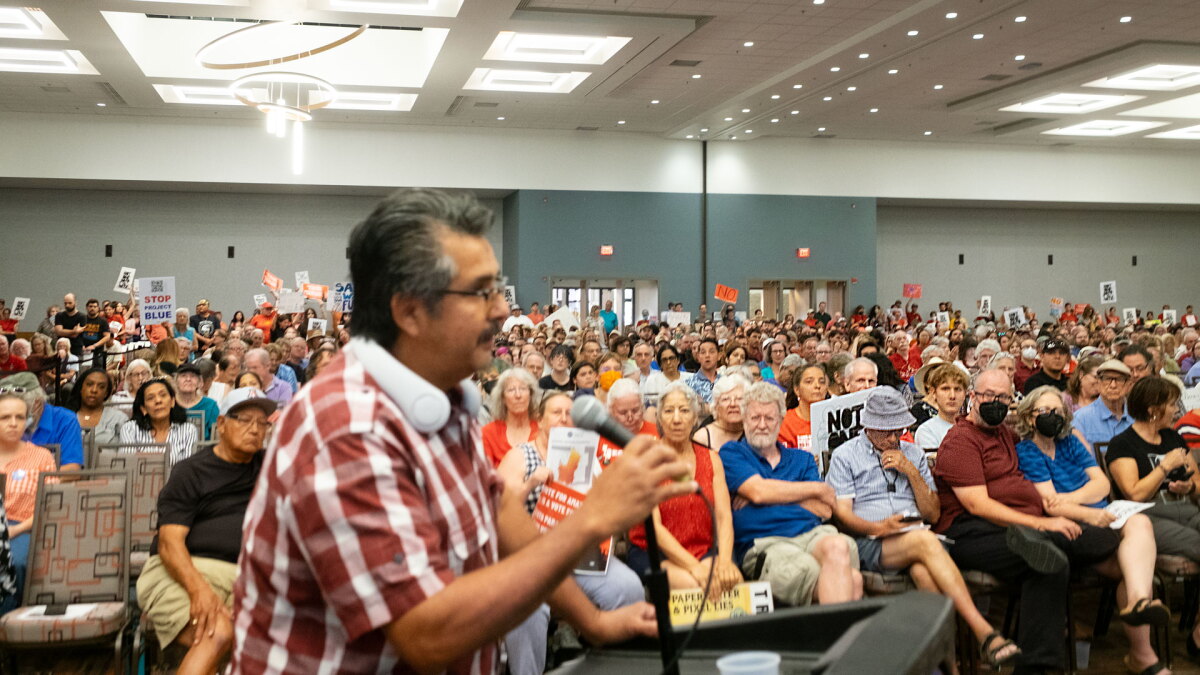
During a tense vote last summer on a data center in her drought-stricken Arizona district, Tucson City Councilmember Nikki Lee opposed Project Blue over its use of local drinking water, saying "We need to put data centers where they belong" and "we don't think data centers belong in the desert."
Vox describes Project Blue as a sprawling 290-acre data center that was being built in Lee's district.
The Tucson City Council rejected Project Blue's attempt to connect to city utilities, and soon after Amazon Web Services, the secretive intended beneficiary, pulled out of the project.
Blue Origin filed a plan with regulators for tens of thousands of possible new data centers destined for orbit.
Vox lists the terrestrial roadblocks facing AI data centers as including an explosive populist backlash and a 12-year wait to connect to the power grid.
According to an analysis by aerospace engineer Andrew McCalip, building a one-gigawatt data center in space would cost about $51.5 billion, compared with $16 billion for one on land.
Distinct publishers with included, body-backed reporting in this cluster.
1 article · September 3, 2026
Follow any of these and your For You feed starts watching them — no settings page required.
invest
A million satellites on paper: read the filings, not Musk's 2029 deadline1 distinct publisher
product
183 towns said no, so AI compute is heading offshore, underground, and into orbit1 distinct publisher
product
Nvidia shows up three times in Anthropic's $35bn deal with Lambda4 distinct publishers
product
Starcloud raises $250M at $2.3bn because rockets, not GPUs, are the scarce input5 distinct publishers
Evidence-backed comparisons of source perspectives and observed adoption signals. Read the methodology
Which Builder, Operator, and Investor concerns the observed source mix emphasized—not a truth score.
Evidence, demonstrated adoption, hype gap, incentives, and confidence are assessed independently, each on its own current evidence. How these are measured.
One essay carrying every number
The Tucson half of this story is the sturdy half: a public vote and a corporate withdrawal, both checkable. Everything else — the tens of thousands of orbital facilities in Blue Origin's filing, the 2028 date, the $51.5 billion — reaches the reader through Vox alone, and the cost comparison rests on one named engineer's analysis that nobody in this reporting tests. No filing text, no company statement, no second estimate.
Filings and a prospectus, nothing switched on
Tally what has actually occurred: a council said no, Amazon left a site, Blue Origin sent paperwork to regulators, Google published a study, SpaceX sold the idea to public markets. Not one orbital rack is processing anything, and the fleet underwriting the offering is described in this reporting as unrealized. The only completed deployment event in the story is a cancellation.
The pitch outruns its own cost sheet
One-fifth of US electricity harvested in orbit, first assembly perhaps in 2028 — against capacity that currently prices at more than three times the terrestrial equivalent and a queue of exactly zero working examples. The overstatement belongs to the companies, not to Vox, which calls the 100-gigawatt promise iffy and lets a startup founder reduce the whole venture to a question about economics. The framing that orbit escapes permitting is where the reporting itself leans: a 12-year interconnection wait outlasts the very window SpaceX is promising.
Every optimist here is long the trade
SpaceX's offering was priced partly on this fleet. Google's cost-parity study evaluates Google's own deployment plan. The engineer who says the challenges are all solvable runs an orbital data center startup. Blue Origin's filing arrives from another Bezos company days after a Bezos-adjacent terrestrial project died. Vox discloses each of these positions, which is to its credit, and the disclosure is also the finding: the only voice with nothing to sell is the councilmember who voted no.
Firm on the vote, thin on the balance sheet
We would stand behind the Tucson sequence without much hesitation and behind the arithmetic drawn from the reported figures. We would not stand behind the dates, the gigawatts, or the parity forecast, all of which are corporate projections relayed once. With a single publisher and no corroborating documents, the ceiling on confidence is set by the sourcing rather than by any internal contradiction.