Science1 publisher2 min readPublished
Stuttgart holds a giant circular Rydberg atom stable for 11 milliseconds at room temperature
Physicists in Stuttgart kept a circular Rydberg atom's electron in a stable orbit for 11 milliseconds without cryogenic cooling, and held the atom in an optical tweezer for 133 milliseconds. Both are records for these giant atoms.
The Scientist · Science desk
What happened
- The 5th Institute of Physics at the University of Stuttgart reports record values for the lifetime, size and storage time of circular Rydberg atoms in Nature Communications.
- The highly excited electron was forced into a circular orbit that stayed stable for 11 milliseconds, which the group puts at more than 20 times longer than comparable states last in free space.
- A laser beam held the atoms in place for 133 milliseconds, which the group calls the longest storage time recorded for such atoms in optical tweezers.
Compiled by The ScientistSomething wrong?How this is made
Why it matters
- cost Meinert attributes the result to room-temperature operation without the liquid helium cooling previously required, so the cryostat and its running costs drop out of the build for any group attempting long-lived circular states.
- constraint The trap now holds an atom about twelve times longer than its circular state survives, so the atom itself, not the tweezer, sets the ceiling on a single run.
- capability Interaction sequences that previously had to finish inside roughly half a millisecond have milliseconds of headroom. That changes what a simulation designer can fit between preparation and readout.
- precedent A shielding concept from the 1980s now has a working demonstration on a modern tweezer platform.
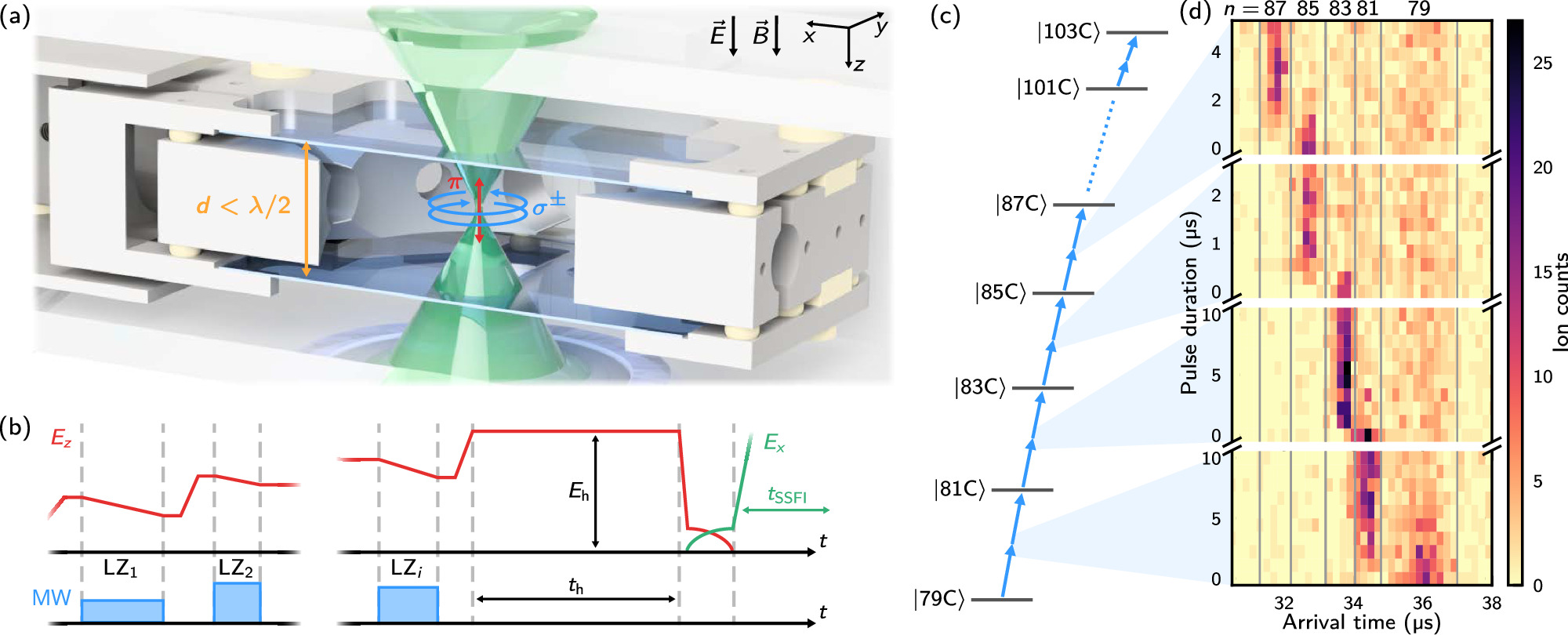
The obstacle was radiation. Even at room temperature every surface emits microwave photons that can knock a highly excited Rydberg atom out of its state. That is why experiments of this kind have needed complex cooling systems [9]. The Stuttgart fix is geometric: the atoms sit between two transparent, electrically conductive plates that suppress those microwaves [8]. "We achieved these record results at room temperature without the costly liquid helium cooling previously required," said Florian Meinert, a group leader at the 5th Institute of Physics [7].
The two records bound different things. Set 133 milliseconds in the trap against 11 milliseconds of stable circular orbit and the ratio is about 12, so the state expires long before the tweezer lets go [1]. Taking the group's own comparison at face value, the same state in free space survives under about 0.55 milliseconds [2].
The account reports lifetime, size and storage time. It does not give coherence times, gate error rates or how many atoms the platform holds [15]. Meinert said the team "set three international records at once: the longest lifetime ever measured for individual Rydberg atoms, the largest controlled circular Rydberg atoms and the longest storage time for such atoms in optical tweezers" [5]. Those are single-atom measurements. Stability and phase coherence are also separate quantities, and the group states the computational benefit as an expectation: that preserving quantum information longer and controlling interactions more precisely will let calculations run longer with fewer errors [13].
Size and interaction range scale with each other here. The controlled orbits are about 1.1 micrometres across, roughly 10,000 times the size of orbits in ordinary atoms [3], and Rydberg atoms of this kind interact over distances of about 5 micrometres [10]. The electron's orbit therefore spans about a fifth of the gap to the atom it interacts with [3].
"One major challenge in developing high-performance quantum simulators was that Rydberg atoms are highly sensitive and remain stable for only a short time. We overcame this challenge and increased the stability of the atoms by a factor of 20," said Tilman Pfau, who heads the institute [6]. The paper, by Einius Pultinevicius and colleagues, is titled "Long-lived giant circular Rydberg atoms at room temperature" and appears in Nature Communications [14].
What to watch
- A published coherence-time measurement on this platform would settle how much of the 11 milliseconds a computation can actually use.
- Whether the 133 millisecond storage time survives when many tweezers are loaded at once instead of single atoms.
- Whether another neutral-atom group reproduces the conductive-plate shielding and retires its cryostat for circular Rydberg work.