Invest1 publisher3 min readPublished
Brightray pitches Yangzhou-built data centers to US buyers under a Singapore registration
Singapore-registered Brightray is pitching data centers built by Chinese manufacturer PrefabDC to US buyers, promising to halve two-to-three-year build times. A buyer who takes the faster schedule also takes the risk that Washington bans new types of Chinese data center components.
The Investor · Invest desk
What happened
- Singapore-registered Brightray manages construction of prefabricated data centers whose sole manufacturer is the Chinese firm PrefabDC.
- Brightray global vice president S.K. Lee said the company sees stronger demand in the US than in China, while calling the Chinese market equally important.
- Brightray says buildings made with PrefabDC cut construction time by at least half, against US builds that average two to three years.
- Alphabet, Microsoft, Meta and Amazon are estimated to spend around $765 billion combined on AI infrastructure this year.
Compiled by The InvestorSomething wrong?How this is made
Why it matters
- decision A US builder choosing PrefabDC modules weighs 12 to 18 months or more of saved construction time against the chance that a component ban catches a Chinese-made building shell.
- exposure Incorporating in Singapore leaves production in Yangzhou, so a ban written around country of manufacture would reach Brightray's product wherever the seller is registered.
- contradiction Wood Mackenzie's Boucher calls China "definitely very important" to the US data center supply chain, the same dependence policymakers cite as a security risk.
Halve a 24-to-36-month build and it becomes a 12-to-18-month build, or shorter [10]. The US is short of key components such as electrical equipment, and what it does have comes with long lead times, according to Benjamin Boucher, principal analyst on supply chains at Wood Mackenzie [11]. China "can offer those at a much more favorable timing," Boucher said [11].
Demand in China explains why the pitch points west. Beijing's plan to spend $295 billion on data centers over five years [17] works out to about $59 billion a year, roughly 7.7% of what the four US tech giants are estimated to spend on AI infrastructure this year alone [18]. Jeffrey Ding, an assistant professor at The George Washington University, said Chinese companies are not generating as much revenue from their AI services, and that this is one reason they cannot invest in data center buildouts as large as those of their US competitors [19]. The deeper issue, Ding said, is that "there is not as much demand for the AI services" [20]. Stanford's Institute for Human-Centered Artificial Intelligence counted 5,427 AI data centers in the US in 2025 and 449 in China, about 12 to one [21][22].
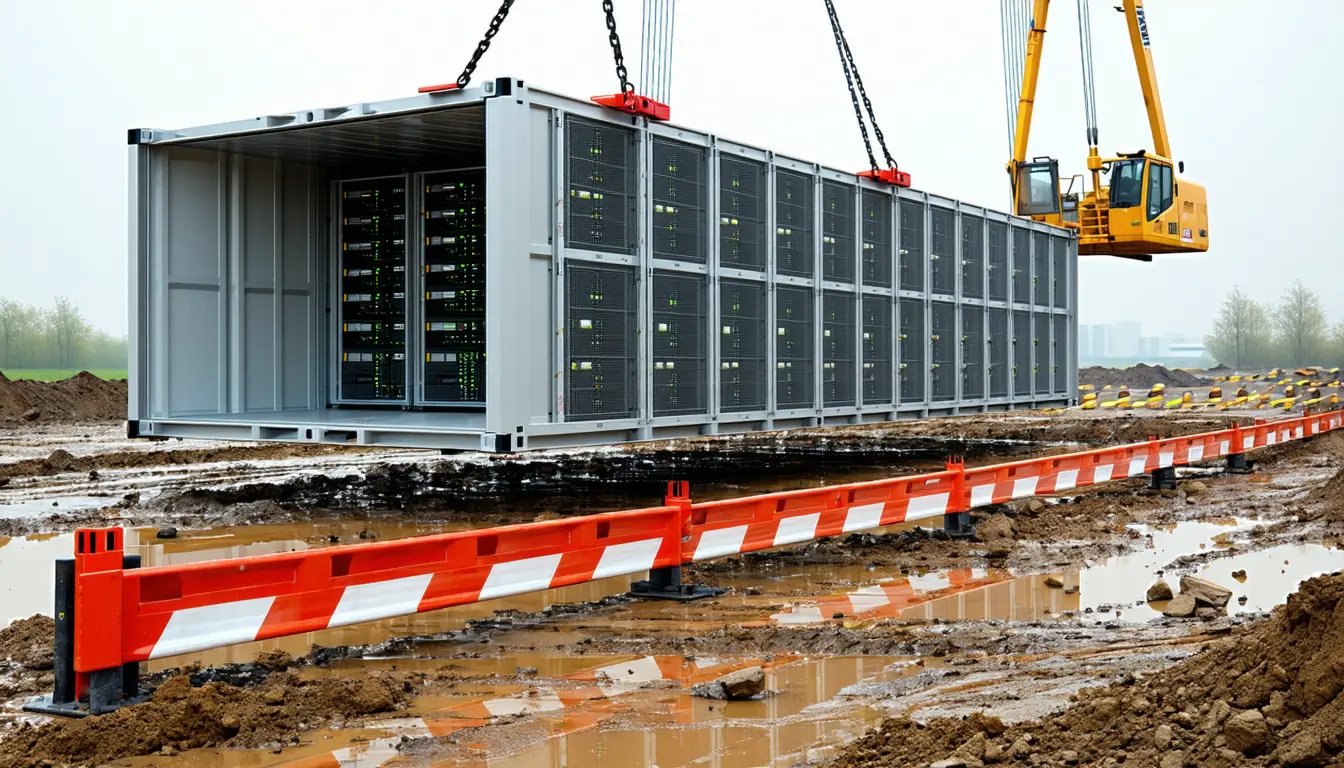
The factory stays in Yangzhou. A "very big portion" of the materials and equipment comes from China "because China's supply chain is very integrated and comprehensive," Lee said [15]. "That's the reason why we have the factory here in China," he said [15]. Prefabrication in the US is mostly used for modules inside a building. Brightray says its modules include the exterior [16].
So a Chinese-made building shell, and not only the equipment inside it, would go into a US project [15][16]. Chinese content in US data centers is older than that: Chinese companies supply transformers, batteries and fiber-optic cables, among other products [14]. CNBC's report does not name a US customer for Brightray, give its revenue, or say how a component ban would treat a Chinese-built module sold by a Singapore company [1][6]. The exposure is real and unsized, set against spending that JPMorgan Chase's Jamie Dimon said could reach $1 trillion next year, about 31% above this year's estimate [5][23].
Should the administration write its component bans around the country of manufacture, a Singapore registration does little for a module built in Yangzhou [1][15]. Should no ban come while shortages persist, saving a year or more per build is an easy case to make to buyers whose budgets are still rising [10][23]. Buyers could also stay away on security grounds with no rule forcing them to. In my view the shell is more exposed than the transformers and batteries already in the chain. It is a new category in US construction, and the administration is weighing bans on new types of Chinese data center components [6][16].
The counter-case is Boucher's. US shortages and lead times make China hard to replace [11], and he said "it is just going to depend on what we see at a political level over the coming years in terms of how it evolves" [13]. A US hyperscaler signing for PrefabDC-built modules before the ban question is settled would show buyers price that risk lower than I do.
What to watch
- Whether the administration's ban on new types of Chinese data center components names prefabricated modules, and whether it keys on the seller's registration or the country of manufacture.
- A first named US customer for Brightray or PrefabDC modules, particularly one of the four big hyperscaler spenders.
- Whether next year's hyperscaler budgets move toward Dimon's $1 trillion while electrical equipment stays short, the conditions under which a faster build is easiest to sell.