Invest1 publisher3 min readPublished
China's bar and coin buyers took on more gold than jewelry buyers gave up in the first half
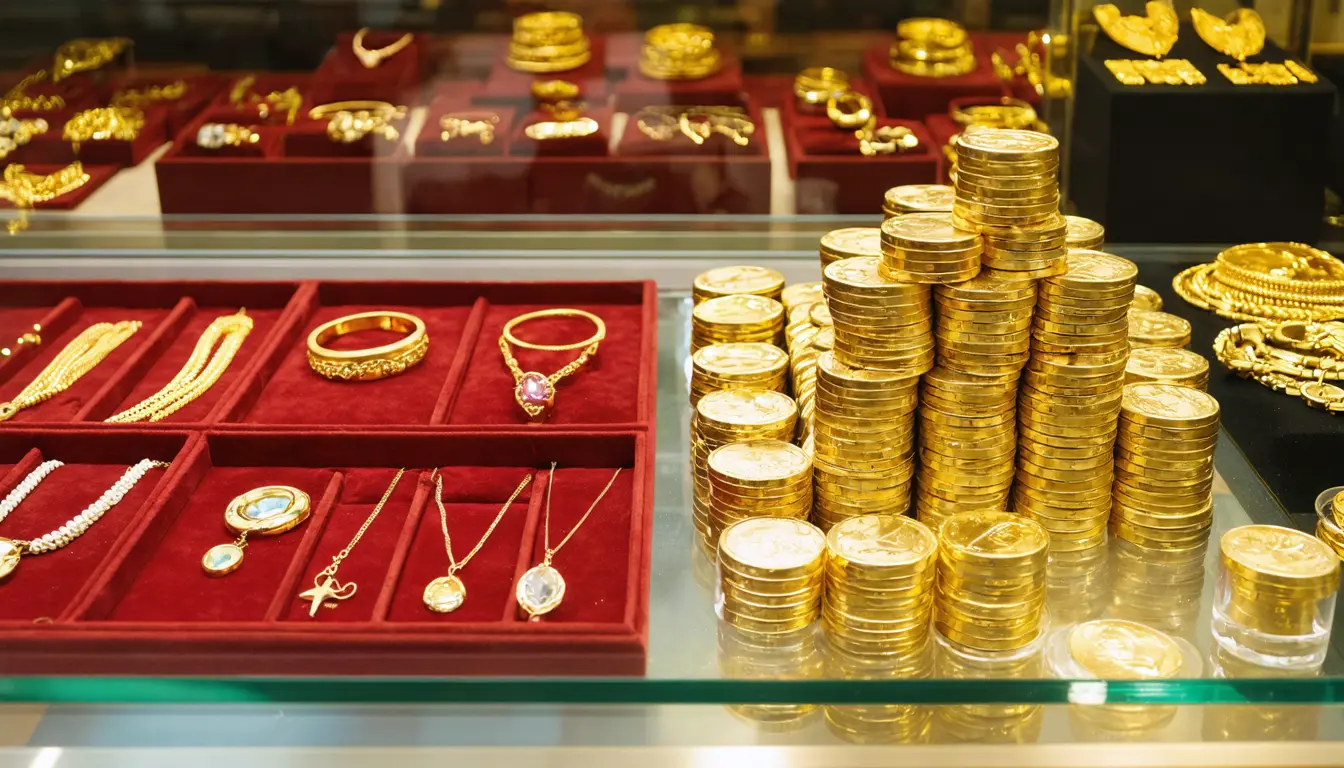
China's gold jewelry consumption fell 33.88% to 132 tons in the first half while bars and coins rose 28.42% to 339 tons, China Gold Association data show. Young buyers' turn to cheap gold-look alloy squeezes the jewelry counter, though combined tonnage still rose about 1.6%.
The Investor · Invest desk
Drafted by a language model from the sources cited here and checked against its claim ledger before publication. How we use AISend a correction
What happened
- The World Gold Council said mainland China's gold jewelry demand fell 28% in the second quarter, its weakest second quarter since 2004, citing high prices and large swings.
- China's marriage registrations fell 7.46% to 3.275 million in the first half, cutting demand for wedding-gift gold.
- Stores selling gold-clad silver and alloy gold have spread to county-level markets since the Lunar New Year, Tianxia Wangshang reported on March 12.
Compiled by The InvestorSomething wrong?How this is made
Why it matters
- contradiction The idea that price swings are eroding Chinese gold demand holds only for jewelry; with combined tonnage up about 1.6%, sellers of bars and coins gained what the jewelry counter lost.
- cost Jewelers who sell solid gold by weight lose the daily-wear buyer to copper-zinc pieces, and that lost volume goes to a product that adds nothing to their gram-based sales.
- exposure Buyers paying up to several thousand yuan for gold-clad silver risk overpaying for gold content that even specialists struggle to verify.
Work the China Gold Association's percentages backwards and the first half of last year comes out at about 199.8 tons of jewelry and 264.2 tons of bars and coins [1][2]. Jewelry lost about 67.7 tons this year. Bars and coins gained about 75.1 [3][4]. Together the two categories went from roughly 464.1 tons to 471.5, a rise of about 1.6% [5]. A year ago Chinese buyers held about 1.3 tons of gold in bars and coins for every ton they wore; now it is about 2.6 [6].
Sedaily, drawing on Dahe Daily, says sharp swings in bullion prices are pushing young Chinese buyers toward gold-colored pieces they call disposable gold [1]. The alloy versions are copper and zinc treated for shine, sell for 50 to 60 yuan online and move in high volumes [3]. None of that copper and zinc appears in a count of gold tons. Xiao Qiu bought an alloy necklace and described it as inexpensive and good-looking; losing it, Xiao Qiu said, would cause no distress [6]. Dahe Daily, pointing to its 2025 Gen Z Emotional Consumption Report, said about 90% of young shoppers put their money toward emotional value [8].
One reading of the jewelry fall is the World Gold Council's, which blamed its 28% second-quarter decline on high prices and large swings [9]. Those hit every buyer, old or young, and on that reading alloy is a side effect that fades when the price settles. Weddings explain some of it. Marriage registrations fell 7.46% [12], while jewelry consumption fell about 4.5 times as fast [7], so the wedding channel can carry most of the drop only if each couple also bought less gold. The reading the alloy trend implies is the slowest to reverse: a generation that buys gold-look pieces as fashion, in the same spirit as Labubu figures and pet stones [15], stops buying jewelry as a store of value.
I think that last reading is right about the jewelry counter and wrong about gold. A shop that sells worn gold by the gram loses the buyer who wants something new to wear every day, and stores selling gold-clad silver and alloy gold have spread as far as county-level markets since the Lunar New Year, according to Tianxia Wangshang [13]. The bullion side took on more tonnage than jewelry gave up [3][4]. The reporting does not include any jeweler's sales or margins, so whether the same shops lost on one side and gained on the other cannot be read from it. The view is wrong if the council's explanation wins. If prices calm and jewelry tonnage recovers while alloy shops keep opening, the young buyers were an extra market for cheap shine, never substitutes for solid gold.
Gold-clad silver is the odder product. A thin gold layer over a silver base, it costs several hundred to several thousand yuan and looks as heavy as pure gold while holding only small amounts of the metal [5]. A jewelry retailer quoted by Xinhuanet on Dec. 23 last year said more than 99% of gold-clad silver on the market is electroplated, not hand-clad, and that even specialists struggle to determine the actual gold and silver content [14].
What to watch
- Whether bars and coins keep rising in the China Gold Association's full-year figures; a decline there alongside jewelry would mean money leaving gold altogether.
- Any testing standard or disclosure rule for gold-clad silver, given a retailer's estimate that more than 99% of it is electroplated.
- Second-half marriage registrations from the Ministry of Civil Affairs, which set the base for wedding-gift jewelry demand.