Invest1 publisher3 min readPublished
Beijing's eight-point summit readout omits the US coal purchases in the White House fact sheet
Xinhua's list of eight outcomes from Xi Jinping's Washington visit leaves out the White House figure of at least 10 million tons of US coal a year. Both governments print May's $30 billion tariff package, but the coal, the goods lists and the rare-earth talks appear only in Washington's account.
The Investor · Invest desk
What happened
- Xinhua published China's account on the 26th, listing eight outcomes from Xi Jinping's state visit to the United States from the 23rd to the 25th.
- The White House said the two sides are consulting on US rare-earth supply shortages, while China's statement did not mention rare earths at all.
- China said the leaders agreed Iran should keep its commitment not to develop nuclear weapons and that no country should impose tolls on international waterways.
Compiled by The InvestorSomething wrong?How this is made
Why it matters
- exposure US coal producers planning for at least 20 million tons of Chinese demand across 2027 and 2028 are relying on a number only their own government has published.
- constraint Exporters of farm goods, seafood, logs and medical devices see their products named as tariff-cut beneficiaries only in the US text, so their eligibility is confirmed by one side.
- exposure US buyers facing rare-earth shortages have only their own government's stated aim to restore supply to plan around, with Beijing uncommitted in print.
- contradiction Each readout contains items the other drops, Russia and North Korea in Washington's and the military memorandum in Beijing's, so neither text alone describes the full agreement.
Xinhua wrote its trade outcome as an endorsement of process. The leaders "affirmed the positive role of the bilateral economic and trade consultation mechanism and the results achieved by the two economic and trade teams," the statement said [7]. The concrete items under that line (a trade committee, mutual and equivalent tariff cuts on $30 billion of goods, a longer truce in the tariff war) were agreed at the Beijing summit in May and presented again as outcomes [8].
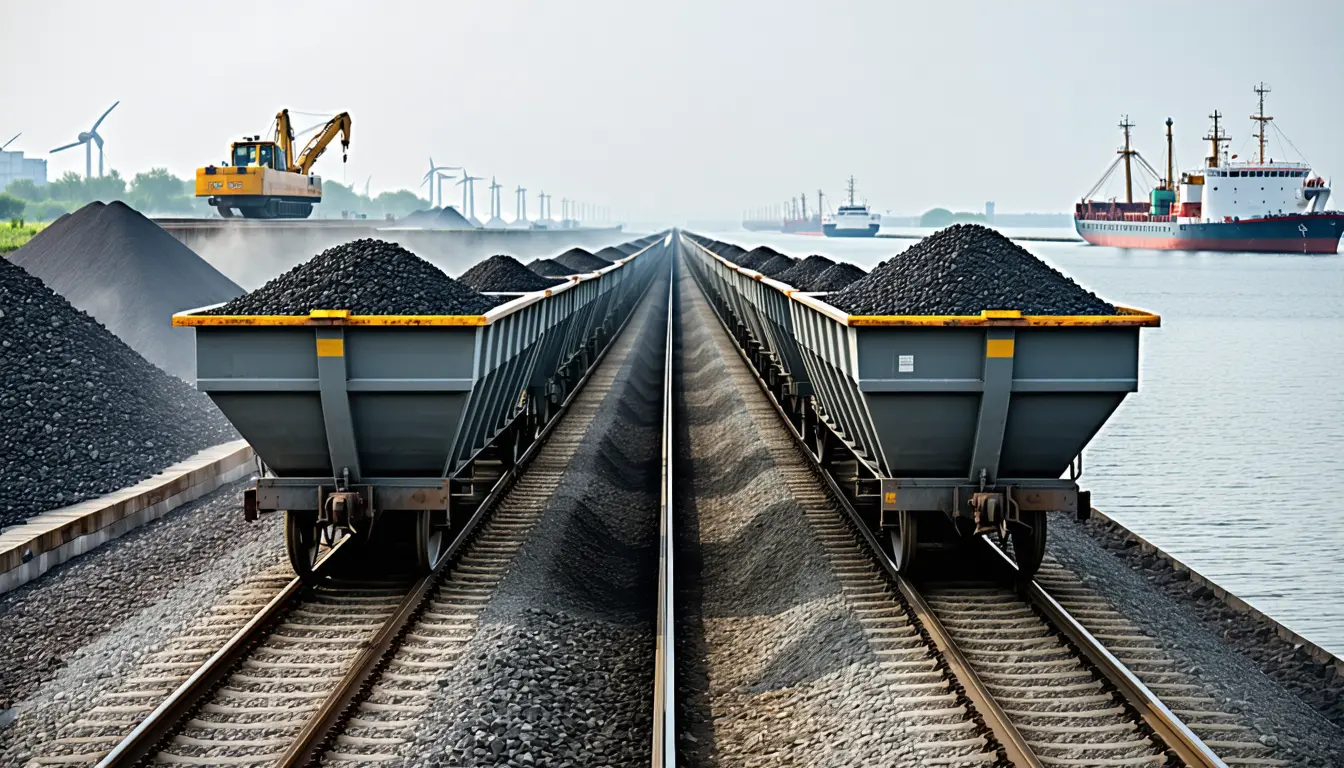
The new detail is in the White House fact sheet. It names the goods: US farm products, seafood, logs and medical devices on one side, Chinese small home appliances, toys and children's car seats on the other [9]. The fact sheet also says China plans to import at least 10 million tons of US coal in each of 2027 and 2028 [10]. That is at least 20 million tons across the two years [1]. Xinhua printed neither the goods nor the coal [9][10].
Beijing may have agreed to the coal and chosen not to publish a purchase target for readers at home. The figure may instead be a US projection China never accepted, or the detail may sit with the trade teams whose "results" Xinhua endorses without listing them [7]. I'd treat the 20 million tons as Washington's reading until a Chinese ministry publishes the number or Chinese import data for 2027 show US coal arriving at 10 million tons a year; either would prove this wrong. The counter-case is reasonable. China did not dispute the figure, and Xinhua's statement, like the fact sheet, summarizes the summit from one government's perspective [15].
Rare earths follow the same pattern. The White House said the sides "are continuing consultations to address U.S. concerns about supply chain shortages" and are "aiming to restore appropriate levels of supply" [11]. China made no mention of the issue [11]. In my view this is the cheaper omission for Beijing to make. It keeps any promise to restore supply out of its own text, while the tariff cuts it does print were already conceded in May [8].
The Seoul Economic Daily reports that Beijing counted narcotics among the areas of agreement [2]. Its account does not describe narcotics terms from either government, so this record cannot say which of those commitments both sides hold.
Beijing also edited in its own direction. It put "based on respect, fairness and equality" in front of the relationship formula it had offered in May [3]. The Russia and North Korea discussion the White House reported is missing from the Chinese text [12]. Only Beijing's statement said the two militaries "agreed to conclude at an early date a memorandum of understanding on strengthening crisis communication and prevention, and to continue cooperating on the search for the remains of U.S. servicemen missing in China" [13]. On Beijing's own wording, that memorandum is still to be concluded [13].
On Iran, Xinhua's text moves toward Washington's. It said the leaders agreed that "Iran should duly fulfill its commitment not to develop nuclear weapons, and that no country or institution should impose tolls on international waterways" [5]. The Seoul Economic Daily interprets that as a check on Iran's attempt to levy tolls in the Strait of Hormuz and as Xi lending weight to Trump's stance [14].
What to watch
- Whether Xi and Trump attend each other's APEC summit in Shenzhen in November and G20 summit in Miami in December, as Xinhua said both were willing to.
- Whether China's trade teams publish the goods lists behind the $30 billion of mutual tariff cuts, which so far appear only in the White House text.
- Whether the military crisis-communication memorandum is signed, and whether Washington ever lists it as a summit outcome.