Loading today’s stories
Science1 distinct publisher3 min readUpdated
A cave near Valencia now holds more Latin inscriptions than any other Roman site
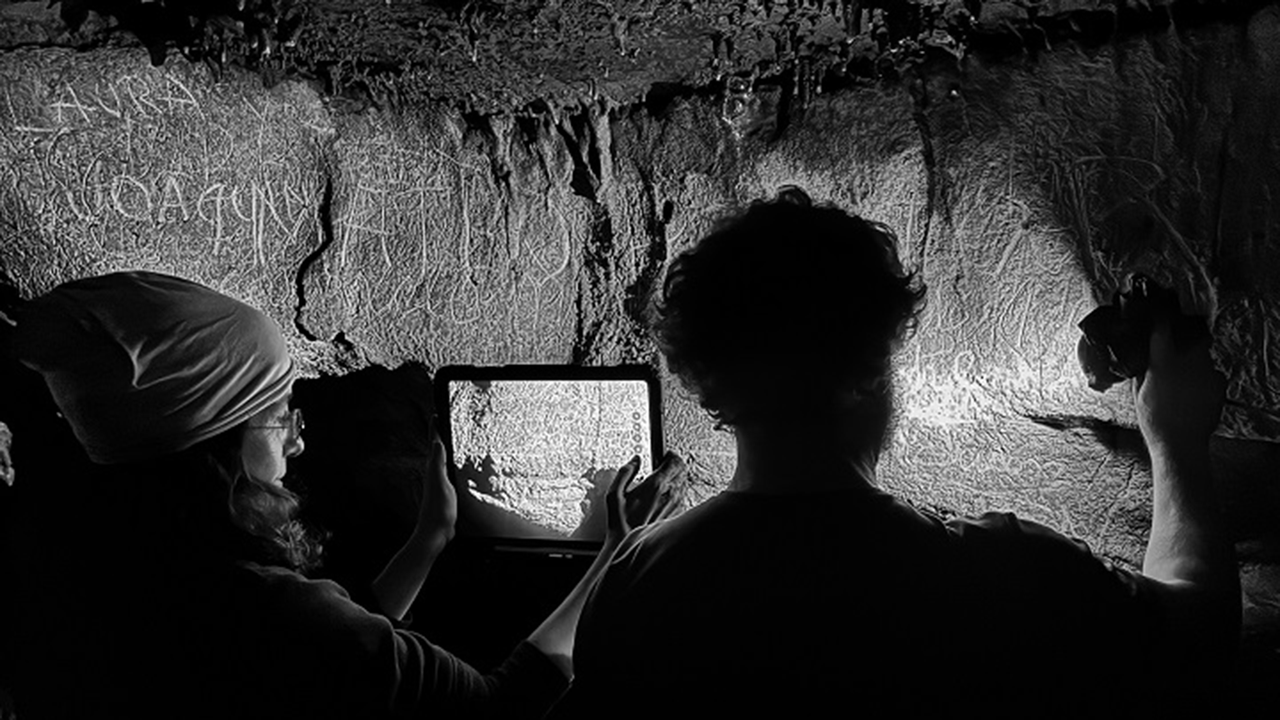
Archaeologists at Cova de les Dones logged more than 120 texts, five naming a goddess called Domina. The clustering deep inside the cave is the strongest part of the argument for an organised cult.
The Scientist · Science desk
What happened
- Archaeologists documented more than 120 Latin inscriptions at an underground sanctuary in a cave in eastern Spain.
- The total is described as the highest number of Latin inscriptions known anywhere in the Roman Empire.
- The researchers think the cave hosted a dedicated cult centred on a previously unknown goddess whom worshippers called Domina, meaning 'the Lady'.
- Five of the inscriptions mention the goddess Domina, 'the Lady'.
- The site had 15 initially documented inscriptions in 2024.
Compiled by The ScientistSomething wrong?How this is made
Why it matters
Archaeologists working in Cova de les Dones, a cave near Valencia on Spain's east coast, have documented more than 120 Latin inscriptions, which the research team describes as the highest number known at any single site in the Roman Empire [1] [2]. Five of them name a goddess absent from the Roman pantheon as previously recorded, addressed simply as Domina, "the Lady" [3] [4].
The scale of the revision matters as much as the total. The same cave yielded 15 documented inscriptions in 2024; a 2026 excavation raised the count above 120, roughly an eightfold increase [5] [6] [7]. Most of the texts date to the first and second centuries A.D. and were found on the walls and ceilings of a deep chamber the team calls the "Roman Sanctuary" [8] [9].
The strongest structural claim is about where the writing is, not what it says. "The fact that the texts are concentrated in a specific and delimited area of the cave, away from the entrance, confirms that it is an organized cult," Sergio Garcia-Dils, an archaeologist and speleologist at the Seville National University of Distance Education, said in a translated statement [10].
The theology is thinner. Domina appears on five of the more than 120 inscriptions, about 4 percent of the corpus [4] [1] [11]. Three of those five also carry the name "Malaci," which the researchers suggest may be an epithet [12]. Silvia Alfaye, a professor of ancient history at the University of Zaragoza, said the goddess "had a specific aspect, perhaps related to water, the definitive interpretation of which we are currently working on" [13]. The sanctuary chamber contains gours, small natural pools that collect groundwater, and visitors appear to have deposited offerings in them; whether those offerings were meant for Domina or for other deities is unresolved [14] [15].
The case for women as participants rather than subjects is circumstantial but consistent. The excavation recovered chalice-shaped vessels, two rings, a bracelet, ceramic fragments and plant remains [16]. Several inscriptions contain female names, and the team found numerous spindle whorls, textile-working tools conventionally associated with women in the ancient world [17] [18]. On that combination, the statement argues women may have taken part directly in ceremonies or offerings [19]. That is an inference from assemblage and onomastics, not a described rite.
The cave was already a long-term landmark: more than 100 Paleolithic paintings and engravings have been identified there, some more than 24,000 years old [20]. The project coordinators attribute that persistence to the permanent presence of water, the underground landscape, or the cave's easy access [21].
What to watch: more inscriptions remain undeciphered and may add to what is known about the goddess and her worshippers [22]. Two specifics would settle a lot. First, whether "Malaci" holds up as an epithet across further texts or turns out to be a personal or place name. Second, whether the female names cluster inside the sanctuary chamber or scatter through the cave, which is the difference between a congregation and a set of visitors. The identification currently rests on a translated institutional statement rather than a published excavation report [10] [13].
Loading topic controls
Loading related stories