Loading today’s stories
Build1 distinct publisher2 min readUpdated
A $10 mesh robot moves the classroom bottleneck from the purchase order to the radio
LearnOBots costs a mesh-networked ESP32 swarm robot at $10.10 per unit. The tested network stops at 12 nodes, and that is now the number deciding what a class of thirty can be taught.
The Engineer · Build desk
What happened
- LearnOBots has been teaching robotics to children across Pakistan since 2014.
- A dev.to post from LearnOBots presents itself as a practical, tested guide to building multi-robot swarms with ESP32 BLE mesh networking, designed for classrooms in Pakistan and other emerging markets where budget constraints make traditional robotics platforms impossible.
- The post is headlined "Building a $12 Multi-Robot Swarm: ESP32 BLE Mesh for STEAM Education in Emerging Markets".
- The per-robot bill of materials is: ESP32 DevKit PKR 1,100 ($4); L298N motor driver PKR 350 ($1.30); two geared DC motors plus wheels PKR 600 ($2.20); 3.7V 18650 Li-ion cell PKR 250 ($0.90); chassis PKR 200 ($0.75); HC-SR04 ultrasonic sensor PKR 150 ($0.55); jumper wires and misc PKR 100 ($0.40). Total per robot about PKR 2,750 ($10.10).
- A class set of 10 robots costs PKR 27,500 (about $101), which the author describes as less than half the price of one kit that builds a single robot at a time.
Compiled by The EngineerSomething wrong?How this is made
Why it matters
Forty percent of the robot is the chip and about thirty-five percent is the drivetrain, since the two geared motors and the L298N driver together come to $3.50 [15][3]. The radio that makes coordination possible costs roughly what the wheels cost, which is why the choice of an ESP32 over an Arduino or a Raspberry Pi is doing the real work: LearnOBots reports the mesh stack is native to ESP-IDF, so there are no shields, no add-on modules and no wires between robots [7].
The sub-dollar lines are where a school actually pays. The 18650 cell is $0.90 because it is recycled from a laptop pack, the motors are $2.20 because they are surplus from old toys or local vendors, and the chassis is $0.75 because it is laser-cut, printed, or cardboard [11]. For one robot that is a weekend of scrounging. For thirty it is thirty used lithium cells that somebody has to source, match and check before a room of children charges them. None of that appears on an invoice, and all of it lands on a teacher or a lab technician.
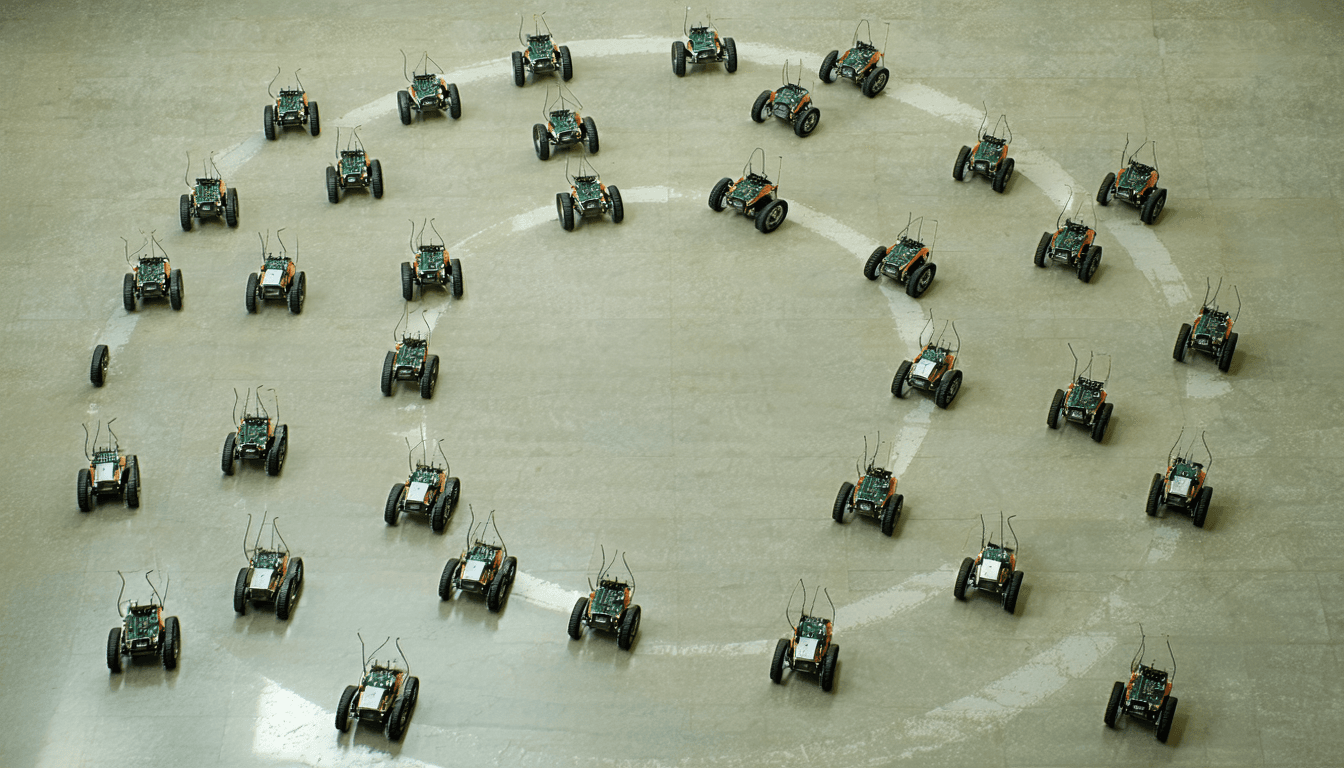
The classroom arithmetic is where the cost curve actually bites. Under the shared-kit pattern the post describes, a class of thirty works in teams of four or five, which is six robots in the room [6][19][17]. One node per child is thirty, a five-fold increase in nodes for the same hour and the same floor space [17]. Six robots can demonstrate a swarm. Thirty can be partitioned, starved of relays, and made to reform, which is the subject the post says it wants to teach: managed flooding, message propagation, and what happens when the node in the middle drops out [8].
Provenance deserves a line. This is one practitioner writing up his own classroom results, with parts priced in Pakistani rupees from local markets, and the reliability figure is self-measured rather than replicated by anyone else [2][3]. The build reads as tested rather than theoretical, which is worth more than most vendor documentation, but the ceiling it reports is the number the author reached, not a limit anyone has independently probed [8].
Loading topic controls
Loading related stories