Science1 publisher2 min readPublished
Engineered compost enzyme degrades 1.4% of a shoe sole in three days
Researchers in Denmark and Portugal engineered a bacterial enzyme that attacks commercial polyurethane foam with no pre-treatment and at mild temperature and pressure. The rate they measured sets the distance to a plant.
The Scientist · Science desk
What happened
- Researchers reported in Chem Catalysis on Sept. 11 a newly engineered enzyme, based on a bacterium found in compost, that degrades the polyurethane in shoe foam.
- The starting point was CCPUR1, an enzyme from Chelatococcus composti, a microbe isolated from Danish compost samples, which stood out for its ability to degrade polyurethane.
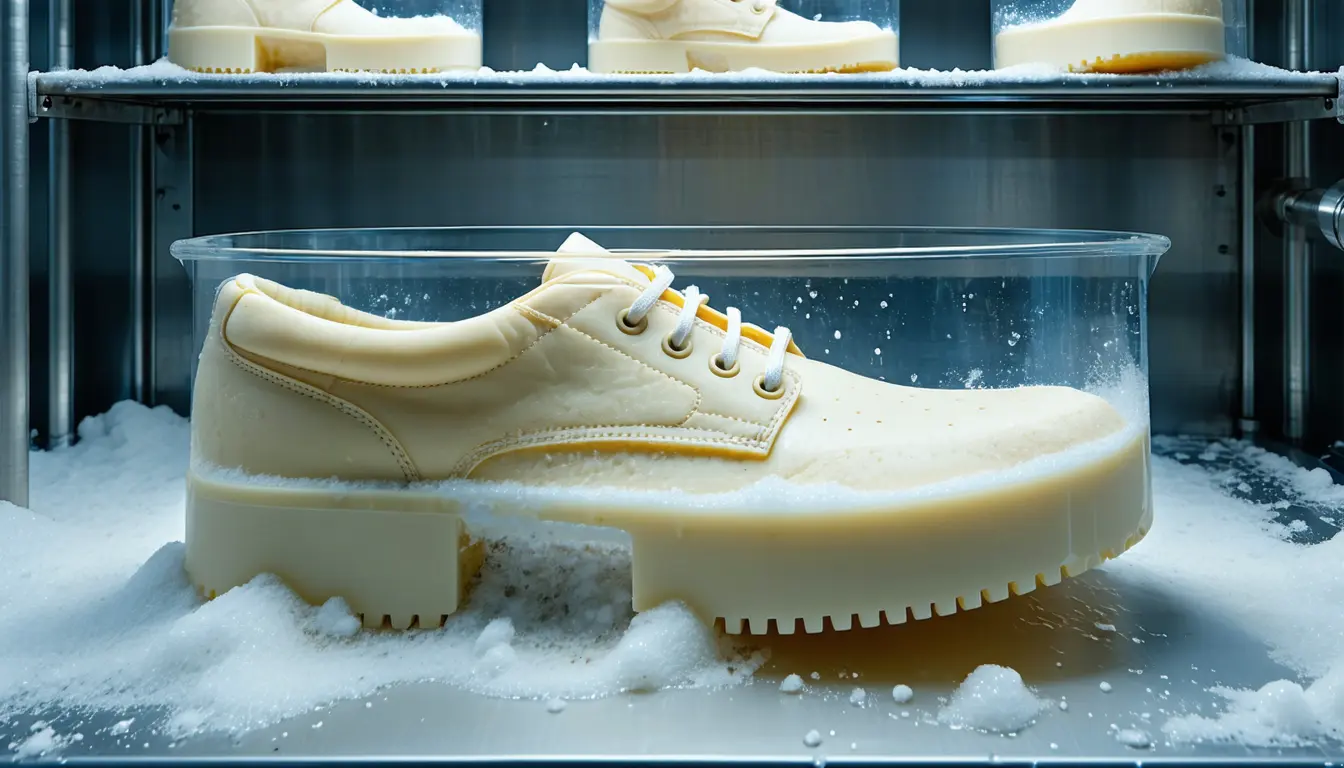
- Pieces cut from a shoe sole and incubated with the modified enzyme lost about 1.4% of their polyurethane over three days, split into smaller pieces the team describes as reusable.
Compiled by The ScientistSomething wrong?How this is made
Why it matters
- capability A thermoset foam that ends up in landfill now has a laboratory route that starts from the product as sold, with no grinding or chemical pre-treatment ahead of the enzyme.
- constraint Throughput stands between this result and a facility: a plant is costed in mass converted per hour, and a percent-and-a-bit over three days is far outside that range.
- decision Anyone assessing enzymatic polyurethane recycling should be asking for grams converted per hour per gram of enzyme and for the wild-type comparison, because a single end-point percentage cannot separate a good catalyst from a slow one.
- precedent The simulation-then-mutate workflow transfers, and mattress foam and kitchen sponges are the obvious next substrates for anyone repeating it.
Hold that rate steady and the same piece of sole clears in about 214 days: 100 divided by 1.4, multiplied by the three days of the experiment [15]. That is a magnitude check on a linear assumption. The published account does not include a time course or a degradation figure for the unmodified CCPUR1, so neither the shape of the curve nor the size of the gain from the mutations can be read from it [18].
The input, though, is unambiguous. The foam went into the reaction as sold, with no chemical or mechanical preparation step. "This is an early demonstration that shows that we can degrade polyurethane with enzymes without processing it beforehand," said Pedro Paiva of the University of Porto, a co-first author on the paper. "It's quite significant." [10] [17]
Other groups can pick up the design route. CCPUR1 came out of a survey of microorganisms already used around the world to break down garbage, and of the enzymes those organisms use on plastics [5]. Simulations showed how the protein sat against plastic-like material, and the team then edited the bacterium's DNA to swap a few key amino acids for bulkier ones [6]. "What if we try to change specific amino acids to larger ones that could better fill the empty space between the enzyme and the substrate?" said Paiva [7]. The published title describes the result as a thermostable polyurethane hydrolase [13].
Polyurethane output runs around 20 million tonnes a year, which the researchers put at more than 5% of all plastics reaching the market [2]. By that share the whole market sits below roughly 400 million tonnes a year [16]. The thermoset grades turn up in soles and heels [3], and the stated target is those products piling up in landfills [14]. The case for enzymes here rests on mild conditions. "The real plus about using enzymes for recycling is that they work under mild conditions, so at lower temperatures and pressures than currently used in most recycling technologies today," said Rosie Graham of Aarhus University, the other co-first author [9] [17].
What comes off the polymer matters as much as how fast. The team reports the enzyme splitting the waste into smaller, reusable pieces [8]. Calling any of this recycling depends on recovering usable feedstock. Graham put the premise plainly: "We have flooded the environment with so much plastic of different kinds," she said. "But there are lots of organisms out there that are already using these materials as a source of energy." [11] The researchers describe the work as still in its infancy [12].
What to watch
- A published time course: whether the 1.4% accumulated steadily over the three days or stalled after the accessible surface was consumed.
- Activity of the same mutant on other thermoset polyurethane products, and a wild-type comparison that shows what the amino acid swaps actually bought.
- Whether the released fragments can be repolymerised into new foam at usable purity, which is the test of a recycling route.