Science1 publisher2 min readPublished
VLT spectra catch Sakurai's Object growing a Wolf-Rayet wind 30 years after its outburst
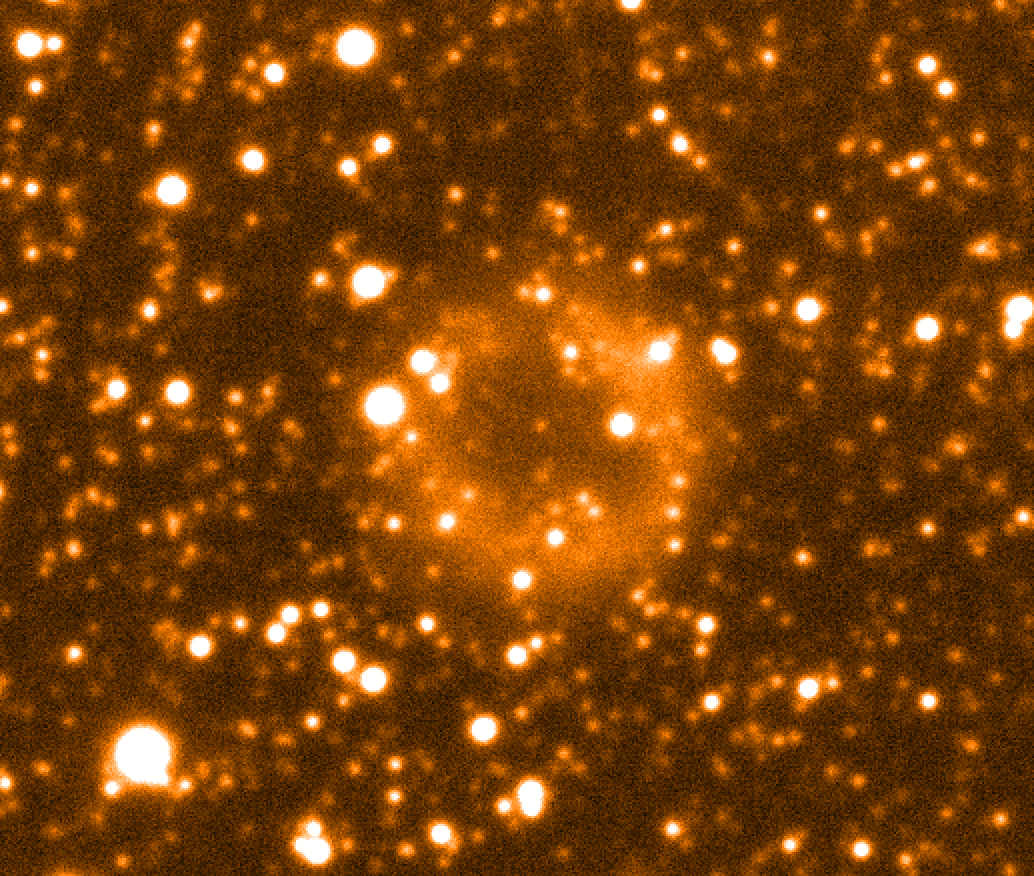
Most stars change too slowly for anyone to watch. Sakurai's Object has moved through a whole stage of stellar death in three decades, and the new measurement says it is recovering more gradually than some models predicted.
The Scientist · Science desk
What happened
- Astronomers report in Monthly Notices of the Royal Astronomical Society that Sakurai's Object has entered a new phase and developed the powerful stellar wind characteristic of Wolf-Rayet stars.
- In 1996 the star, already past nuclear burning, expanded and cooled after a helium layer deep inside reignited, throwing off large amounts of material and briefly looking younger than it was.
- With the star hidden behind the gas and dust of its own eruption, the team read carbon and helium signatures in Very Large Telescope light against models of Wolf-Rayet atmospheres and winds.
- Only two stars have ever been caught in this kind of rebirth, and the analysis places Sakurai's Object at an earlier stage of the process than V605 Aquilae.
Compiled by The ScientistSomething wrong?How this is made
Why it matters
- capability Models of how a star recovers from a very late thermal pulse can now be graded against a temperature climb measured in one object while it happens.
- constraint A model that fails this comparison is falsified for this star. The sample is still far too small to say how typical the recovery rate is.
- exposure The temperature rests on atmosphere codes applied to a star seen through its own ejecta, so a revision to those codes moves the number the theory is being scored against.
- precedent The two objects, half a century apart in the same process, become the reference pair that any theory of this phase is expected to fit.
The fit puts the star's surface between 27,000 K and 36,000 K [12]. That range is 9,000 K wide, roughly 14 percent either side of its midpoint [22]. Both ends are hot enough to show the star climbing back up after its eruption [12], and where in the range it sits depends on how the atmosphere codes handle a wind like this one [10].
The spectra track the surface and what it has done since [12]. The reignited helium layer that set all this off sits deep inside the dead star, where no observation reaches it [6].
Albert Zijlstra of the Jodrell Bank Center for Astrophysics at the University of Manchester [24] said: "Our measurements show that the star is reheating more gradually than some earlier models predicted. That gives us an important way of testing which theories best describe what happens when a dying star briefly springs back to life." [14] The Manchester announcement does not say which models those were.
Normally this stage would be reconstructed at a distance. Zijlstra said astronomers "usually have to piece together snapshots of stellar evolution by comparing different stars at different stages of their lives" [15]. Here there are two stars to compare [8]. V605 Aquilae went through its own outburst about 80 years ago, and Sakurai's Object erupted 30 years before this year's paper, so the two objects sample the same process roughly 50 years apart [16] [20] [21].
A snapshot of one obscured star is a weak constraint; a sequence of them, on an object whose starting conditions in 1996 are known [4], is a rate that a very late thermal pulse model has to match. The published work helps test theories that would otherwise take thousands or millions of years to verify [17].
The team will keep observing as the star continues to reheat and resumes its journey toward becoming a white dwarf [19].
What to watch
- Whether continued VLT monitoring shows the temperature climb steepening or flattening over the next few years.
- A fresh measurement of V605 Aquilae's present state, to anchor the later end of the two-star sequence.
- Discovery of a third born-again object, which would give the models more than two stars to fit.