Invest1 publisher2 min readPublished
Bessent takes open-weight models to the rare earths table days before the Sept. 24 summit
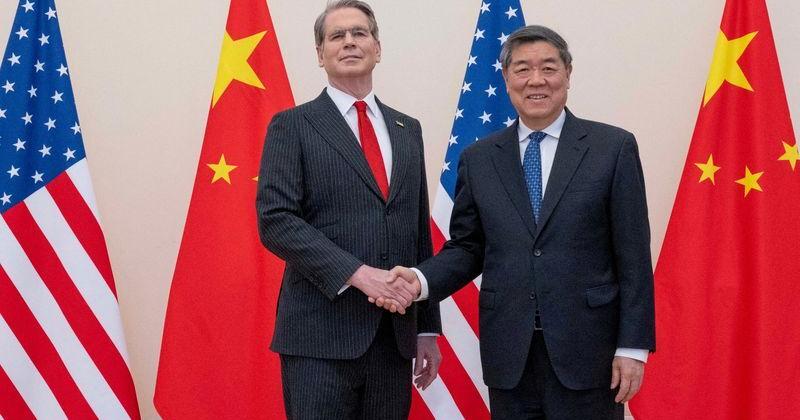
Scott Bessent meets He Lifeng in New York this weekend with AI models, chips and minerals on one agenda. Anyone hedging chip or magnet supply now holds a single position priced off a single negotiation.
The Investor · Invest desk
What happened
- Scott Bessent is expected to meet Chinese Vice Premier He Lifeng in New York this weekend to discuss AI, rare earths and trade, days before Trump and Xi meet in Washington on September 24.
- Reuters, citing a source familiar with the plans, said the talks could continue at technical or working level into Monday, and the Associated Press first reported the US plans.
- Bessent said the agenda should cover both open-weight and closed-weight models, putting model licensing in the same conversation as minerals and chips.
- CSIS reported that Chinese models accounted for 41% of Hugging Face downloads over the last year.
- China's 2025 export limits hit defense, semiconductor and automotive supply chains before the two leaders agreed to suspend the restrictions for one year.
Compiled by The InvestorSomething wrong?How this is made
Why it matters
- decision A buyer choosing a cheaper Chinese open-weight model for coding work is taking a position in a government negotiation, because the meeting that covers magnets also covers weights.
- constraint Nothing agreed in September adds non-Chinese magnet tonnage this year, so the only hedges available to a manufacturer are inventory and contract terms.
- contradiction Bessent says the two governments can avoid bifurcation while BCG describes separate US and Chinese ecosystems already forming across chips, cloud and applications, and a buyer has to choose which of the two forecasts to plan against.
AI, chips and minerals are on one agenda because the same hardware sits under all three. Making and running large models takes chips, data centres, energy and critical minerals, and disagreements about AI therefore land on trade and industrial rules in both directions [4]. Bessent told Axios: "We are open to discussions on avoiding shared risks and avoiding bifurcation of our two systems." [10]
On the model side the numbers are close. CSIS rates Z.ai's GLM-5.2, at around 750 billion parameters, as competitive with the best American closed models on coding and agent performance [8], and Stanford's 2026 AI Index measured the top US model 2.7% ahead of the top Chinese model in March, after the two exchanged the lead repeatedly since the start of 2025 [9]. Reuters reports American buyers are drawn to Chinese open-weight models because they cost less than the closed models from US labs [6]. A 2.7% capability discount against a real price discount is a budget question inside a company, and from this weekend it is also an item between two governments.
On minerals the money is already committed. Washington has used financial support, production agreements and price subsidies to stand up non-Chinese sources [12], and CSIS says the MP Materials agreement includes a decade-long neodymium-praseodymium production floor at $110 per kilogram [13]. The export-control suspension runs twelve months, and the price support runs nine years past the truce it was written against [14]. The subsidy supports the price. New vertically integrated mine-to-magnet chains outside China still take years to appear [15].
If Sept. 24 produces a tariffs and minerals package and leaves model policy alone, the AI items were agenda decoration and buyers can pick models on merit. If the stacks keep separating, as BCG says they are across AI systems, cloud services, processors and applications [16], a Chinese open-weight model inside a US production system acquires a compliance budget of its own.
Washington is already holding both positions at once. Reuters reported that the National Archives website used Alibaba's Qwen model to search proposed federal regulations [17], and the FBI accused Alibaba of stealing Anthropic's technology [18].
In my view model policy stays attached to the minerals file, because the leverage over magnets takes years to unwind and the leverage over weights costs nothing to hold. The evidence against that would be a Sept. 24 readout covering tariffs and rare earths that leaves weights out.
What to watch
- Whether the Bessent-He talks carry into Monday at technical or working level, as Reuters said they could.
- Whether federal sites keep running Alibaba's Qwen while the FBI's allegation about Anthropic's technology stands.
- Whether the next AI Index reading widens or closes the 2.7% gap between the top US and Chinese models.