Leadership1 publisher2 min readPublished
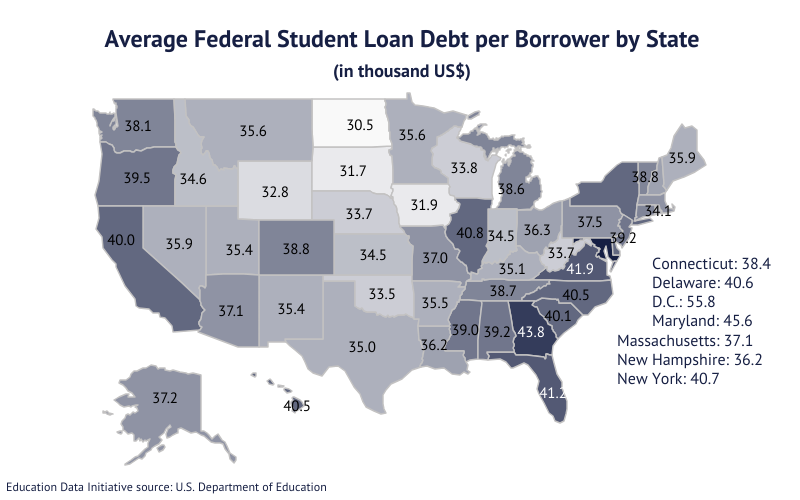
At least 31 states fall below the $40,768 national average for federal student debt
Business Insider's ranking of Education Department data puts federal student debt at $40,768 per borrower across 42.3 million people. Employers who plan benefits off that figure would overshoot the average in most states.
The Board Room · Leadership desk
Drafted by a language model from the sources cited here and checked against its claim ledger before publication. How we use AISend a correction
What happened
- As of June 30, Education Department figures put total outstanding federal student loans at more than $1.72 trillion.
- North Dakota ranks last, with 88,400 borrowers owing $2.7 billion for an estimated average of $30,543.
- Texas has 3,949,800 borrowers owing $138.3 billion, yet ranks only 38th with an estimated average of $35,014.
- Connecticut, ranked 20th, averages an estimated $38,417 per borrower, still under the national figure.
Compiled by The Board RoomSomething wrong?How this is made
Why it matters
- cost A benefits budget sized on the national mean overstates the average Texas balance by $5,754 per borrower, in a state that holds about 9% of all federal borrowers.
- decision A flat dollar benefit pays off about a third more of the average North Dakota balance than of the national one, so choosing one uniform amount means choosing to favor low-balance states.
- constraint The federal data excludes what students borrow today, so it cannot size a benefit aimed at recruiting new graduates.
Nearly half of all federal borrowers live in states that average less than $40,768. Every state ranked 20th or lower comes in under that line, which accounts for at least 31 of the 50 [1]. Together those states hold 19.49 million borrowers, about 46% of the national total [2]. Texas, Pennsylvania and Ohio are among them, and each has more than 1.7 million borrowers [7][11]. The other 22.8 million or so live in the 19 higher-ranked states or outside the 50-state table. For the national figure to hold, they must average more than $40,768 between them [7].
The ranking text breaks off at Michigan, 19th, after its $53.2 billion total [9]. This record does not show which state leads, or by how much. Every average in the table, including the national one, is a Business Insider estimate built from Education Department balances and borrower counts [2][3].
Business Insider states the main limit itself. According to its analysis, the federal data does not reflect the colleges borrowers attended or where they took out their loans, and it shows only where they live now [4]. For an employer, the residence half is the useful one. A retention benefit pays people who already live near a company's sites, and those are the people a state average describes.
Location-based pay fits the data less well. Each state's entry is a total balance, a borrower count and the average worked out from them [3]. A pay band built on that would rank states by debt alone. Wage and living-cost figures would have to come from another source.
This quarter's trade-off is simplicity against fit. One national amount is easy to explain and to administer. I'd expect the cost to show up at the next design review. At that point, tiering by state would mean cutting the benefit for workers in places like North Dakota, where the average sits $10,225 below the national figure [3]. Tiering at launch means more administration now, and it avoids that cut later.
What to watch
- Averages for Michigan and the 18 states above it, to see how far the top of the table runs above $40,768.
- The Education Department's next federal portfolio release, replacing the June 30 balances behind every state average.
- Any federal figure on what current students borrow, the input a recruiting-focused benefit would need.