Product1 publisher3 min readPublished
Amazon moves seller pricing and inventory controls into Anthropic's Claude
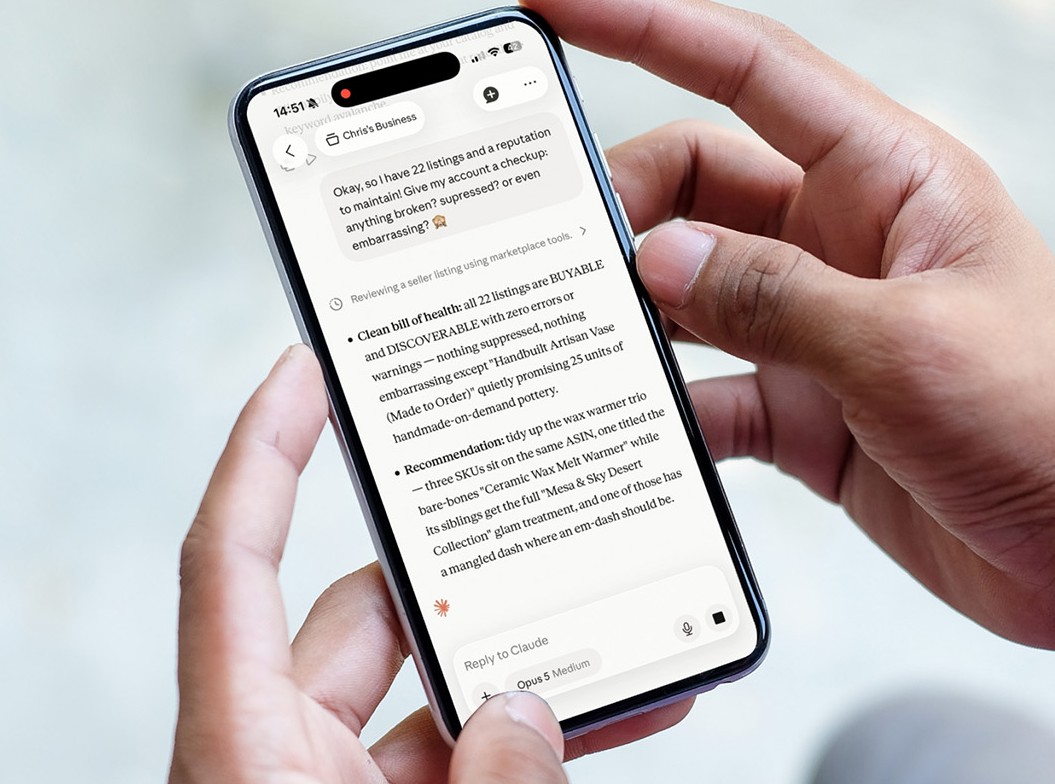
The beta plugin takes about a minute to connect and gives Claude the same power over a seller's account that Amazon's own assistant has inside the console, with Amazon deciding which outside assistants get one.
The Product Desk · Product desk
What happened
- Amazon used its Accelerate seller conference in Seattle to launch a plugin that lets independent sellers check inventory, adjust prices and update listings from Anthropic's Claude or Amazon's Quick assistant.
- Sellers pick which types of data the plugin can reach and approve every action before it runs, and Amazon says it does not see the other business data sitting in a seller's assistant.
- Amazon also shipped background automations that act on a seller's business with the seller's approval, plus a Seller Assistant that remembers pricing patterns, inventory cycles and growth goals between sessions.
- Independent sellers move more than 60% of the units sold on Amazon worldwide, and the fees they pay brought in $46.8 billion in the second quarter, more revenue than AWS.
Compiled by The Product DeskSomething wrong?How this is made
Why it matters
- capability A seller can now hold Amazon listings, inventory and sales analytics in the same assistant session as the rest of the business, so cross-channel questions stop requiring a console tab.
- decision Whoever runs a seller's operations has to decide who watches approval prompts once they arrive in a chat thread instead of a console queue, and how those approvals get logged for a Friday post-mortem.
- precedent Outside agents now reach seller accounts on Amazon's say-so: it publishes the plugins, and days earlier it barred Meta's Muse consumer shopping agent from the store.
- cost The interface gets cheaper to use while the fee load the FTC complains about stays where it is, so a friendlier front end does nothing for the seller's cost line.
Amazon's stated reason for building this is that about 90% of sellers already use some form of outside AI to run parts of their operations [3]. That is Amazon's own figure, and what it describes is copy and paste: pull numbers out of the console, ask an assistant what to do, type the change back in. The plugin removes the retyping. It pulls a seller's listings, inventory levels, sales analytics and performance metrics into the outside assistant, which can then act on the account the way Seller Assistant does inside Seller Central [20].
The pitch is larger than the feature. "Our vision was that they would never have to log into Seller Central," said Mary Beth Westmoreland, Amazon's vice president of Worldwide Selling Partner Experience. "We would just bring it to them where they work." [4] The plugin is in beta in Amazon's U.S. stores, with international expansion to follow [22].
Advertising is where that vision gets tested. Amazon's ad business, which includes the sponsored listings sellers buy to promote products, brought in $19.8 billion in the second quarter, up 26% from a year earlier [12]. Add the seller fees and Amazon took about $66.6 billion off the seller side of the store in three months [1], roughly 30% of it from advertising [2]. When it sued, the Federal Trade Commission said advertising had become "virtually necessary for sellers to do business" and that Amazon's combined fees take close to half of many sellers' revenue [13]. Amazon has denied the allegations and called the suit "wrong on the facts and the law" [10]. Trial is set for March 2027 in federal court in Seattle [11]. The ad tooling Amazon described this week is a canvas that compares pricing strategies and diagnoses ad campaigns from live data, and it lives inside Seller Assistant [23].
The first outside assistant through the door is one Amazon helps pay for. Amazon is a major investor in Anthropic, and Claude models already power Seller Assistant in the console [17]. Westmoreland said the work is "modular enough for us to continue to publish plugins" [18]. Every primary selling account holder worldwide also gets a free 12-month Amazon Quick Plus subscription, available through Dec. 31, 2026, with two additional co-workers covered at no cost [24].
This is for the seller with enough SKUs that price checks are a daily chore and one person doing them. That person has heard interface promises before. The loudest ovation at last year's Accelerate went to a housekeeping fix, when Amazon ended commingling, the practice of mixing identical inventory from different sellers in its warehouses [14].
A month of use will settle the question. Connecting takes about 60 seconds and no coding [19], so the setup is not the variable. What decides it is how many of the five console tasks that eat the most time in a normal week the plugin finishes end to end, without handing the account back to Seller Central. If restocking and reprice-to-Buy-Box close in the assistant, the console has genuinely become optional for daily work. If the tasks that move money still route through Seller Central, what shipped is a faster way to read the business, and the console is still where the business gets run.
What to watch
- Which assistants get the second and third plugins, and whether any of them is a platform Amazon has no stake in.
- Whether ad campaign buying reaches the plugin as the beta expands beyond U.S. stores.
- Whether sellers running the plugin report that per-action approvals cost them more time than console work did.