Product1 publisher3 min readPublished
Apple gates its rebuilt Siri behind a waitlist in iOS 27
Siri AI shipped on 14 September as an opt-in beta in English on a short list of recent hardware. It does not run on iPhone, iPad or Watch in the EU, or anywhere in China, and Apple has set daily limits it has not published.
The Product Desk · Product desk
What happened
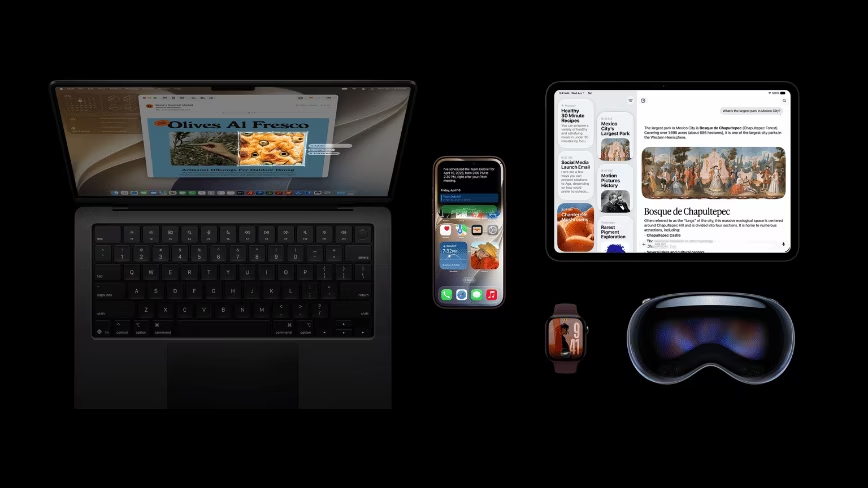
- Apple shipped the first public version of Siri AI as a beta rolling out in English from 14 September, alongside iPadOS 27, macOS 27, watchOS 27, visionOS 27 and tvOS 27.
- Apple says the assistant can draw on personal context from messages and notes, answer questions about what is on the screen, and answer general questions from world knowledge.
- On iPhone it requires a 15 Pro or Pro Max, a 16-range handset or later, an iPhone Air or an iPhone Duo, with parallel floors on iPad, Mac and Apple Watch.
- It does not run on iPhone, iPad or Apple Watch in the European Union, where Apple blamed the Digital Markets Act in June, and it is unavailable in China pending regulatory review.
- A day after the OS launch, Apple added Apple TV and Apple Arcade to iCloud+ in more than 100 countries and regions, a change announced by services chief Eddy Cue.
Compiled by The Product DeskSomething wrong?How this is made
Why it matters
- constraint Version detection no longer tells a support team what a device can do, because a phone on iOS 27 may or may not have the new assistant, so scripts and training have to branch on an opt-in state that only shows up in Settings.
- decision Multinational rollout owners now choose between documenting an assistant most of their EU handsets will not offer, or holding the whole programme for a date Apple says it does not have.
- cost Anyone designing work around Siri AI is budgeting against an unpublished daily cap and a fee Apple has already said is coming, so the running cost of the design arrives after the design is committed.
- exposure Schools and non-English workforces are outside the launch entirely and stay on the old assistant until at least October, which pushes any accessibility or support case built on the new Siri into next quarter.
Settings, then Siri, then Try Siri AI (Beta). That tap puts the user in a queue, and the download starts on its own once the wait is over; Apple says wait times can vary [6][7]. Installing iOS 27 leaves the old assistant in place [6].
Count what has to be true before one person can use the new one. The hardware has to be on Apple's list [11][12][13]. iOS 27 has to be installed, and the user has to opt in and clear the queue [6][7]. Device language and Siri language both have to be English until French, Japanese, Korean, Portuguese and Spanish arrive in October [8][9]. Users under 13 are excluded [10]. And the user has to be outside China, and outside the European Union if they are on iPhone, iPad or Watch [14][16]. That is six conditions [23]. Two of them, the hardware and the OS build, are the only ones a rollout owner can do anything about.
At WWDC in June, Craig Federighi, Apple's senior vice president of software engineering, said the company was "delivering the next generation of Apple Intelligence across our platforms" [4][5]. In the EU, those platforms are the Mac and Vision Pro: of the five device families Apple lists for Siri AI, three do not get it there [14][24]. Federighi said at the time that Apple was "deeply disappointed" that EU users would not get Siri AI on iPhone or iPad, and that Apple did "not currently have a timeline" [15].
The usage cap has a hardware reason behind it. Requests that need more computing power than the device has go to Private Cloud Compute, Apple's own server system, and the assistant runs on Apple Foundation Models the company says it built in collaboration with Google and its Gemini models [18]. Apple has set daily limits on the features that lean on those servers, Siri AI included, and says "expanded access" to them "will be available for a fee in the future" [17]. It has not published the limits or a price [17].
A workable test for a rollout plan has two axes. The first is whether the thing you are planning needs the assistant present on every device, or only on the devices that happen to have it. The second is whether it needs a known cost per user per month. Uniform and cost-sensitive is the quadrant to refuse in September, because the cap and the future fee are both unpriced [17]. Opportunistic and cost-insensitive is where a pilot fits, staffed by people who have already cleared the queue [7].
Opt-in counts will look healthy, because opting in is one tap [6]. What tells you whether it works is how many of those people are still opening the Siri app a month later, and whether they use it for in-app actions; today that means WhatsApp and Audible, with Microsoft Outlook, Notability and Tripsy to follow [20][21].
What to watch
- Whether French, Japanese, Korean, Portuguese and Spanish support lands in October as Apple said it would.
- Publication of the daily caps on server-based features and the price for the promised expanded access.
- Any EU date for Siri AI on iPhone, iPad and Watch, which Federighi said in June Apple did not have.