Science1 distinct publisher2 min readPublished
During a rare 24.4-day outage with both Chooz B cores off, Double Chooz pulled more than 100 residual antineutrino events out of the plant's burnt fuel, giving a safeguards idea from the 1970s its first measured spectrum.
The Scientist · Science desk

Compiled by The ScientistSomething wrong?How this is made
The signal exists because a shut-down core stays radioactive in a specific way: long-lived fission products keep beta-decaying after the chain reaction ends, both in the burnt assemblies still sitting in the core and in the ones already moved to the cooling pools [6]. Those two populations produce one combined flux, and that combined flux is what the collaboration measured [3].
The 1% figure [5] does most of the work in deciding what an operational monitor would look like. Hold the detector and its efficiency fixed, and a hundredth of the rate needs a hundred times the looking: the more than 100 events collected across 24.4 days [10][9] are roughly what a running reactor would have delivered in six hours (24.4 days x 0.01 = 0.244 days, or 5.9 hours) [1]. The binding constraint here is statistics rather than particle physics, and there is headroom left inside the outage itself, since 24.4 days is about 58% of the six-week end of a standard refuelling window and 44% of the eight-week end [4][16].
The enabling condition deserves attention. Both Chooz B cores were down together, 8.5 GWth of thermal power idle at once [3][11], and physicsworld describes that double shutdown as unusual as well as necessary for the low backgrounds the extraction required [9]. A site where one unit keeps running while its neighbour refuels is a harder problem by construction, because the residual you want sits under a source about a hundred times brighter [5]. That inference is mine, not the paper's, and it is the first question I would put to the authors.
Geometry matters here as much as shielding. The near detector sits about 400 m from the cores, the far one at 1.05 km [12], and inverse-square alone leaves the far detector with about a seventh of the near flux per unit volume, since (1050/400)^2 is 6.9 [2]. For residual-flux work, close beats clever. The analysis also had to pay for dead time induced by the muon veto [19], overhead that scales badly when the signal is already thin.
Location is the open question here. What was measured is a combined residual flux from core and pool [6], not a per-assembly reading, and each core holds 205 assemblies [14] over which a safeguards dispute usually turns. The work as described also stops short of showing sensitivity to a single missing assembly. What it does establish is that the weeks after a reactor goes quiet are not radiometrically quiet, which is a real thing to have measured after the proposal sat unrealised for this phase since the 1970s [8].
Ranked by verification strength, evidence, and original report placement.
Scientists have measured antineutrino emissions from spent nuclear fuel for the first time, demonstrating that monitoring efforts need not stop when the reactors do.
Independent nuclear safeguarding agencies have long used antineutrino emissions to glean information on reactor operations, but previous detection schemes only worked while the reactors were running.
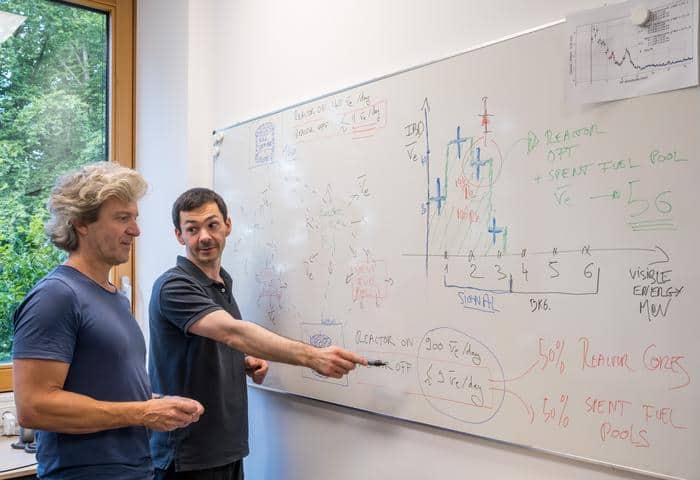
Members of the Double Chooz collaboration have shown that it is possible to detect residual antineutrino emissions during a complete reactor shutdown, including from spent fuel stored in cooling pools.
The work is detailed in Physical Review Letters, by a team led by Thierry Lasserre and Anthony Onillon of the Max Planck Institute for Nuclear Physics (MPIK) in Heidelberg, Germany.
The residual antineutrino signal from a shut-down reactor is only around 1% as strong as the signal from an operating reactor, and it lies in a region of the energy spectrum strongly affected by background activities.
When a reactor is shut down, long-lived fission products in burnt fuel assemblies remaining in the core, and in assemblies previously removed to nearby cooling pools, continue to decay and produce a residual neutrino flux.
Distinct publishers with included, body-backed reporting in this cluster.
1 article · September 3, 2026
Follow any of these and your For You feed starts watching them — no settings page required.
science
A shut-down reactor still glows, and Double Chooz has now counted the photons1 distinct publisher
science
A centuries-old Coulomb's law test could out-search accelerators for millicharged particles1 distinct publisher
invest
Seoul's freeze-first turn, and the 30 warheads it would leave on the table1 distinct publisher
science
GlueX turns up two unexplained structures while hunting a 20-year-old strangeonium candidate1 distinct publisher
Evidence-backed comparisons of source perspectives and observed adoption signals. Read the methodology
Which Builder, Operator, and Investor concerns the observed source mix emphasized—not a truth score.
Evidence, demonstrated adoption, hype gap, incentives, and confidence are assessed independently, each on its own current evidence. How these are measured.
Hard numbers, single narrator
The quantities are unusually specific for a one-outlet story: 106 ±18 events in the 1–3 MeV band, a 5.9σ excess, a simulation that called 88 ±7 in advance, and exposures stated after dead time rather than before it. What is absent is anyone outside the collaboration. Physics World reads the Physical Review Letters paper and quotes its authors; no second detector, site or outage exists in this reporting to test the result against.
A measurement, not a monitoring programme
Nothing is deployed and nothing is being procured. A detector built to chase the θ13 mixing angle happened to sit 400 m from two cores that went dark together for 24.4 days in 2017, and the collaboration mined the gap. The safeguards use exists only as the authors' stated hope that their spectrum becomes a benchmark others design against — a long way from an agency running this on a plant.
Headline outruns the outage
Physics World's title promises a detector that could monitor spent fuel for clandestine activity. The body delivers something narrower and more interesting: about a hundred events coaxed out of background over three and a half weeks, at a site where the rare alignment of two dark cores did much of the work, from a detector 400 m away. The gap is not fabrication — it is the distance between 'residual flux is measurable' and 'diversion is detectable', and only the first has been demonstrated.
The team names its own next customer
The only interested party visible in this reporting is the collaboration, quoted hoping the result becomes a robust benchmark for agencies and experimenters designing spent-fuel detectors — precisely the constituency that would fund the follow-on instruments. That is normal for a physics result, and Physics World neither flags it nor balances it: no funder is named, and no safeguards official is asked whether the benchmark is one they want.
Tight physics, thin sourcing
Internally this holds together well — peer-reviewed, quantified, and specific down to which detector was used and why. Externally it rests on a single outlet reading a single paper, with no replication and no independent voice, and the sharper comparisons here (roughly 6.9 times less flux at the far detector, under six hours of running-reactor-equivalent exposure, half a typical outage covered) are our arithmetic on Physics World's numbers rather than measured results.