Science1 publisher3 min readPublished
Two posthole rows at Old Uppsala anchor one researcher's eight-year sacrifice calendar
Goran Henriksson says the Great Midwinter Sacrifice began on the full moon falling between Jan. 28 and Feb. 26. The evidence is two excavated rows of posts and a shoreline 19.5 meters higher than today, set out in a paper he presented at a 2014 conference.
The Scientist · Science desk
What happened
- The sacrifices ran for nine days, usually beginning at the height of winter between Feb. 6 and 8, and ended with 72 bodies hanging upside down in a holy tree.
- The cycle repeated every eighth year, and the Goths apparently believed that skipping it risked catastrophe over the following eight years.
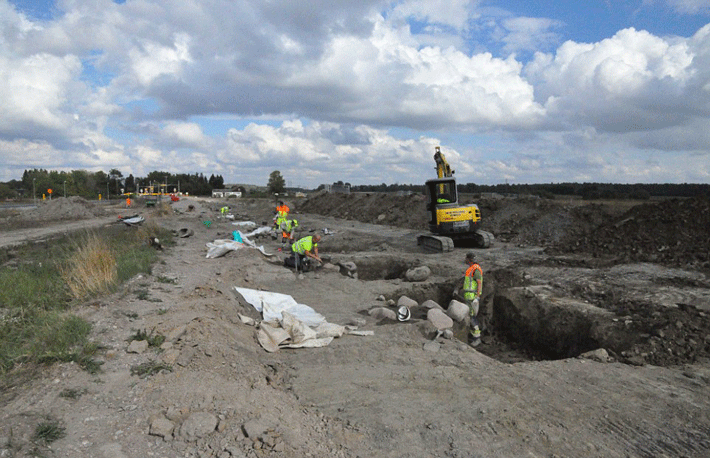
- Excavators found two long rows of postholes at the site: one 850 meters long, aligned on the northern limit of the rising midwinter full moon, and one about 600 meters long, aligned on the February sunrise.
- Three "royal" mounds dated to AD 450-550 are oriented so that they could have been used to regulate the sacrificial calendar, Henriksson writes.
Compiled by The ScientistSomething wrong?How this is made
Why it matters
- constraint Every downstream conclusion, including which years were sacrifice years and what the royal mounds were for, inherits the confidence of a single conference paper by a single author.
- capability The shoreline part of the argument can be tested on its own: land-uplift curves for Uppland will either put the AD 500 waterline beside the posts or too far away for sunlight to reflect off it.
- contradiction Anyone tracing the field evidence has to choose a season first, because the same account puts the posthole discovery in 2014 in one passage and in a 2013 excavation in another.
The posts stood close to water. The mounds now sit inside at least 260 square kilometers of flat plain, but Henriksson puts local sea level 19.5 meters higher at the time, with the shore less than 0.8 kilometer from the mounds [13]. "The rays of the sun were reflected in the sea on both sides of the posts, and the shadows from the posts were aligned with the row," he wrote [14]. He called it "a magnificent and very precise way to determine the correct date for the great midwinter sacrifice" [15].
His rule for the start date is a full moon inside a fixed window. "The sacrifice at Old Uppsala took place every eighth year; the starting date was defined by the full moon that occurred between Jan. 28 and Feb. 26 in the Gregorian calendar," Henriksson wrote in the conference paper [4]. Jan. 28 to Feb. 26 inclusive is 30 days [2]. A window that wide always catches a full moon, and except at its edges it catches only one, so the rule needs no arbitration in a year when the moon runs early or late.
Computing when a full moon fell in AD 852 is a solved problem. Henriksson says he combined historical data with such computations to fix the exact years of the cycle, one of which began in AD 852 [5]. The computation only shows that a date was available; the claim that the Goths chose it has to come from the historical material.
The orientations deserve more scrutiny than the article gives them. Two long rows define two directions across a horizon that offers many risings over a year, and the odds that two directions on a flat horizon would line up with something by chance depend on how many candidate targets were considered before these two were matched. The article does not report that count.
The precision claims are where I would push hardest. The article says the eight-year cycle was set by lunar phases the Goths "could measure to six digits of accuracy" [12], and that their calendar was more precise than the Catholic Church's hundreds of years later [17]. A row of posts fixes a direction to within the width of a post and the flatness of the horizon.
The tally of victims is at least internally consistent: one man and seven male domestic animals on each of the nine days [11] gives the 72 bodies the article describes [1]. Henriksson, an astrophysicist and former lecturer at Uppsala University [2], set out the calendar in a paper presented at the 2014 meeting of the European Society for Astronomy in Culture [4]. "I have discovered the calendar that regulates the dates for the Great Midwinter Sacrifice that took place every eight years," he told phys.org in Uppsala [3].
What to watch
- A peer-reviewed publication of the posthole orientations, with a stated count of candidate sky targets, would let others test the alignment against chance.
- An independent land-uplift reconstruction of the Old Uppsala shoreline for AD 450-550 would settle whether the water came within 0.8 kilometer of the posts.
- Excavation reports naming the season the two posthole rows were found would fix which field record the calendar rests on.