Product1 publisher3 min readPublished
Connecting Walmart and Shopify stores to Seller Central rests on an Amazon executive's word
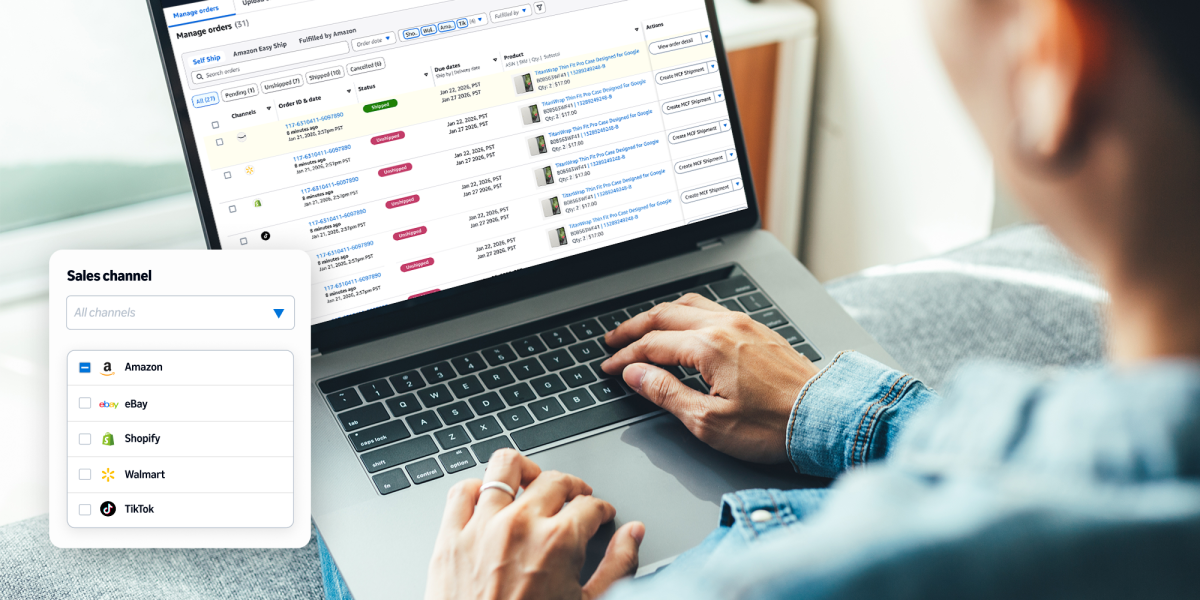
Amazon is putting eBay, Shopify, TikTok and Walmart orders inside Seller Central for US sellers at no extra cost. Sellers who price lower elsewhere would be relying on an executive's spoken data pledge while an FTC case alleging Amazon punishes such sellers heads to trial in March 2027.
The Product Desk · Product desk
What happened
- Amazon said at its Accelerate conference in Seattle that US sellers will get Seller Central tools for eBay, Shopify, TikTok and Walmart sales, rolling out over coming months at no extra cost.
- At launch, sellers can connect their other accounts, import and link listings, see all orders in one place, and fulfill orders across channels.
- Amazon vice president Mary Beth Westmoreland said a seller's multichannel data is never used for anything except showing it to that same seller.
- Amazon also offered US Multi-Channel Fulfillment users free Prime delivery on their own sites, plus a pricing program it says cuts fulfillment fees 15% to 25% for six months.
Compiled by The Product DeskSomething wrong?How this is made
Why it matters
- cost The order screen is free, but anything a seller pushes from it into Amazon's warehouses is billed, so budgets should be built on fulfillment rates from after the six-month discount lapses.
- constraint The one written data commitment in this record is a European deal covering Amazon's own retail arm. On US search ranking, a seller has an executive's spoken word.
- exposure A seller who prices lower on Walmart or its own Shopify site would be showing that gap to the company the FTC accuses of penalising it. Amazon denies the charge.
The Shopify order shows up in the same unshipped list as the Amazon orders on Seller Central's Manage Orders page [4]. The seller selects it and sends it to Amazon for fulfillment, and tracking flows back to Shopify automatically, according to Amazon [5]. Mary Beth Westmoreland, Amazon's vice president of Worldwide Selling Partner Experience, said sellers had told the company that managing sales across so many platforms took too much time [13]. "They said we would love it if we could use some of the cool tools in Seller Central everywhere we sell, and so that's what we did," she said [14].
The tool also builds a route from a rival's checkout into Amazon's warehouses. Shipping other sites' orders out of those warehouses is already a paid Amazon service, Multi-Channel Fulfillment, and it added Walmart, Shopify and SHEIN integrations last year [16]. The dashboard costs nothing [2]. Seller fees brought Amazon $46.8 billion in the second quarter, more revenue than AWS [18].
By Amazon's count, more than 95% of its independent sellers already sell through multiple channels [15]. What Amazon tells itself they will do next, in Westmoreland's account, is succeed on those channels and bring a wider range of products back to Amazon's store [20]. She said the connections mostly use the other platforms' standard APIs [19].
Pressed on whether the data could push a seller lower in Amazon's search results for charging less elsewhere, Westmoreland said: "We never, ever, will touch this data or use it for any other reason other than to show it to you" [8]. GeekWire's report does not quote a contract term or policy page carrying that promise. In 2020 The Wall Street Journal reported that Amazon employees had used independent-seller data to develop competing house-brand products [9]. Two years later Amazon agreed with European regulators not to use sellers' non-public data in its own retail business, while saying it still disagreed with "several of the preliminary conclusions" [10][11]. The Federal Trade Commission's pending antitrust case accuses Amazon of punishing sellers who offer lower prices on other sites. Amazon denies it, and the trial is set for March 2027 [12].
Sort each channel you might connect by two facts: whether its orders already ship through Multi-Channel Fulfillment, and whether its prices sit below your Amazon prices.
- On MCF, prices level with Amazon: Amazon already ships these orders [16]. Connecting mostly removes retyping. - On MCF, cheaper elsewhere: Amazon already handles the orders. The new exposure is the imported, linked listings [3]. - Off MCF, prices level: this is a shipping-cost decision, weighed against whatever setup you use now. - Off MCF, cheaper elsewhere: the pledge matters most here.
For all four, connect a channel only if you would still connect it with Westmoreland's pledge struck out. On that test I'd connect the first three cells and hold the fourth until the promise appears in Amazon's seller terms or the FTC trial tests the pricing allegation. The cost of holding is that the cheapest channel stays in its own tab, with the time burden Westmoreland said sellers wanted gone [13].
What to watch
- Whether Amazon writes Westmoreland's no-other-use pledge into its seller agreement or the policies for multichannel connections.
- The FTC trial set for March 2027, where the allegation that Amazon punishes sellers with lower prices elsewhere gets tested.
- Whether Amazon adds functions beyond the launch set of connecting accounts, linking listings, viewing orders and fulfilling them.