Product1 publisher2 min readPublished
A chatbot and a few hours of unscrewing replaced a $500 dishwasher call
Consumer chatbots are now walking people through repairs their manufacturers never documented. Two law professors told Fast Company that makers will respond by locking repair information down harder.
The Product Desk · Product desk
What happened
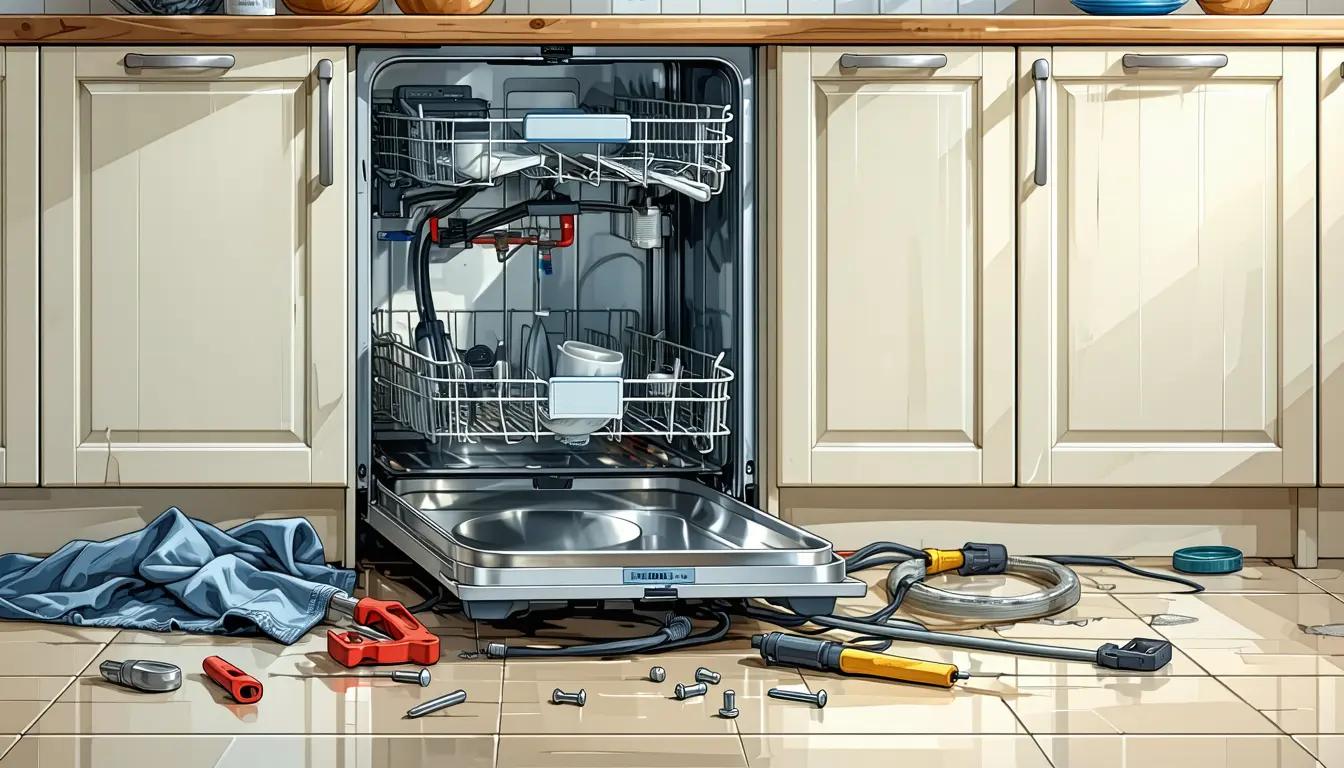
- A Fast Company writer canceled his appointment with a professional repair person and replaced the faulty logic board in his out-of-warranty dishwasher himself, with ChatGPT as the guide.
- No manual for his model had ever been uploaded to the internet, and no official manufacturer document said where the control board he needed to replace was located.
- He unscrewed sections of the machine one at a time and sent photographs to the bot, and after a few hours found the internal box holding the logic board and swapped the part.
- iFixit, which has assembled tens of thousands of repair guides, has launched an AI tool of its own to walk people through do-it-yourself repairs.
- New York, Oregon and Colorado now have laws guaranteeing a right to repair, and companies have lobbied heavily against progress in states where the right is not yet protected.
Compiled by The Product DeskSomething wrong?How this is made
Why it matters
- cost Out-of-warranty service revenue is priced on diagnosis and labor. A customer with a phone camera and a spare afternoon can now bid against that portion of the invoice.
- constraint Keeping board locations out of the published documentation buys a manufacturer hours of customer trial and error instead of a booked service call.
- exposure Households are opening live appliances on advice from a system that admits its errors only after the fact. The shock and flood risks the industry cites land on them.
- decision Any maker weighing tighter restrictions on repair information has to test that choice against three state statutes and whatever the next legislature passes.
The diagnostic assessment put the dishwasher repair at as much as $500; the board itself cost about $100 [1][2]. So $400 separated the two prices [14]. The part came to roughly a fifth of the professional quote [15]. An out-of-warranty service business sells that gap, and the people who have to answer for it own service margin on machines past their warranty.
The bot made real mistakes along the way. It answered from manuals for other models, apologized when it turned out to be wrong, and several times tried to give up and send the writer back to the manufacturer [5]. Fast Company notes that the technology makes mistakes and still struggles with understanding the physical world, appliances included [7].
It works often enough that people post it. Fast Company reports the internet is filled with posts and videos of people documenting AI-assisted repair attempts on phones, ovens and refrigerators [17].
Manufacturers have reasons to dislike this, and the piece names two: safety, including electric shock and flood risk, and money, since an owner who cannot fix a device pays for a repair or buys a replacement [13]. Apple and the tractor firm John Deere are among the companies determined to keep repairs of their products in-house [8].
Leah Chan Grinvald, a University of Nevada, Las Vegas law professor who works on intellectual property and right-to-repair law, said "Given that many large manufacturers were already anti-repair, I would think that this will incentivize these manufacturers to try to further lock down repair information" [9]. Aaron Perzanowski, a University of Michigan law professor, predicted that "If device makers try to lock down repair information even further, they are going to have to contend with state right-to-repair laws" [10].
The Fast Company account does not get into parts pairing or firmware authentication; it describes documentation, lobbying and safety [16]. That makes the working question for a hardware team narrower than the movement's usual framing. Every repairable assembly raises two questions: can a consumer buy the part, and can a consumer identify it once the case is open. Where both answers are yes, the repair happens without the maker and without the maker's labor revenue. When identification is the only gap, a chatbot will get there eventually and badly, with wrong turns lifted from other models' manuals [5]. And if the part cannot be bought at all, none of the AI guidance matters, because the maker still sets the price and availability of the board. Fast Company's writer found his for about $100 [2].
What to watch
- Whether appliance makers thin out board-level service documentation in New York, Oregon and Colorado. And whether those statutes reach it.
- Whether iFixit publishes error rates for its AI tool on machines it has never written a guide for.
- Whether control board prices at the parts counter move once photo-guided diagnosis becomes routine.