Science1 publisher2 min readPublished
An AI-fabricated monument is circulating as a record of Australian heritage, researchers say
Researchers writing at phys.org report an AI-generated image of carved stone heads near the top of Google Images results for Australian cultural heritage, and describe models taking in Indigenous knowledge without consent.
The Scientist · Science desk
What happened
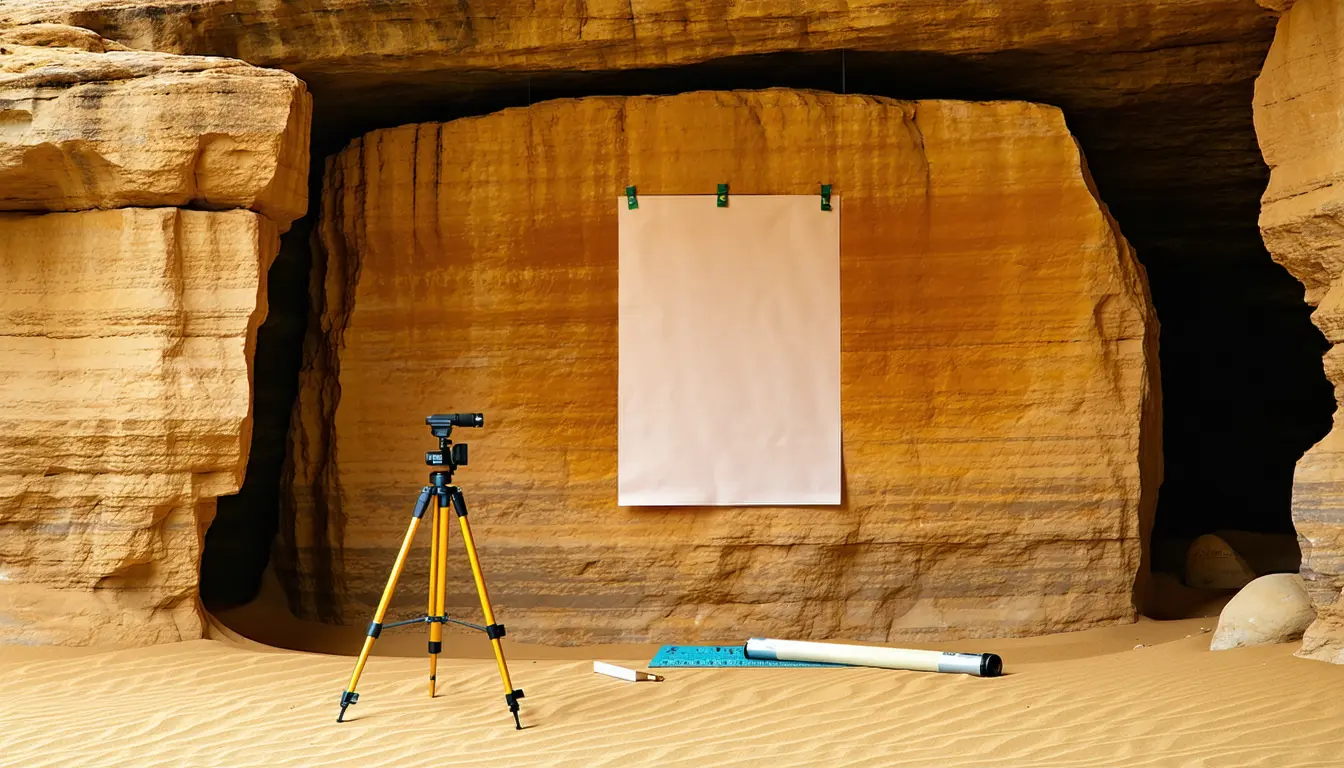
- Researchers report that a Google Images search for "cultural heritage Australia" returns, near the top, a photograph of giant carved stone heads in a red desert that is a generative AI fabrication.
- The article names four Indigenous-built places long credited to outsiders: the moai of Rapa Nui, Nan Madol in Micronesia, the Gwion Gwion paintings in the Kimberley and New Caledonia's petroglyphs.
- They ask how to combat misinformation while keeping genuine scientific knowledge publicly accessible, and what is given up by sharing it openly if AI appropriates it.
Compiled by The ScientistSomething wrong?How this is made
Why it matters
- constraint One search result is an existence proof, so any custodian weighing open against restricted publication is choosing without an estimate of how much fabricated heritage imagery is already in circulation.
- decision Scraped material cannot be pulled back, so the live decision for an institution sits at the point of publication: what licence terms, provenance labels and community sign-off attach to a file before it goes up.
- exposure Knowledge that already sits on the open web is reachable by every future training run, and control over its reuse rests with whoever collects the data.
- contradiction The same piece holds that these systems confidently reproduce untrue claims and that AI can often separate consensus from fringe; the difference between prompted classification and unprompted generation decides which one you meet.
The stone heads are a single observation. The researchers report a single fabricated image sitting near the top of the results for one query, "cultural heritage Australia" [1]. They do not give a date for the search or a count of how many of the returned images were synthetic, and image search results differ between users anyway. The example shows the failure exists. A museum or a land council still has no way to know what share of its own subject matter has already been displaced by inventions.
The authors say a model can take in Indigenous Knowledge as training data with no consent, no acknowledgment, no compensation and no community control over how it is used next [4]. A system that correctly credits the Gwion Gwion paintings to the Aboriginal ancestors whose descendants still care for them [10] has still done that. A lower fabrication rate would not touch it.
The authors also cite a recent study of their own, which found that AI can often tell scientific and Indigenous consensus apart from well-worn fringe narratives [6]. There is a gap between that test and the failure they open the piece with. Asking a model to sort a claim measures judgement under prompting. A consensus-versus-fringe score is silent on what an image generator emits unasked, or on what a ranking system puts first, and the desert stone heads surfaced in an image search [5].
On open access, the authors only ask the question: how to counter misinformation while keeping genuine scientific knowledge publicly accessible, and what is given up by sharing it openly if AI appropriates it [13]. Restricting culturally sensitive collections would cut one exposure and widen another. These systems learn mostly from the open web, where fringe material circulates freely [5]. Take the documented record out of that pool and the fringe version becomes a larger share of what remains. In my view a custodian gets more from consent terms and provenance labelling than from withdrawal, and that holds only while scraped material stays effectively unrecoverable [4].
In the same piece the authors place much of today's pseudoarchaeology in the intellectual tradition of eugenics and Social Darwinism, doctrines that claimed scientific legitimacy while justifying systematic dehumanization [14]. Each false history, they write, severs living communities from their ancestral heritage and props up racist assumptions about Indigenous peoples' capabilities [15].
What to watch
- Publication of the authors' study with the models tested, the number of items and an accuracy figure, which would put a number on "often".
- A named museum, university or land council changing access terms for culturally sensitive collections.
- Whether image search providers start labelling or demoting synthetic heritage photographs in results for queries like this one.