Science1 publisher2 min readPublished
A graph-based equation search recovers readable constitutive laws for steel, lithium and rubber
Researchers at the Eastern Institute of Technology in Ningbo encoded candidate equations as directed graphs so that form and parameters could be searched at the same time. They report better fits than Johnson-Cook and an explicit formula at the end of it.
The Scientist · Science desk
What happened
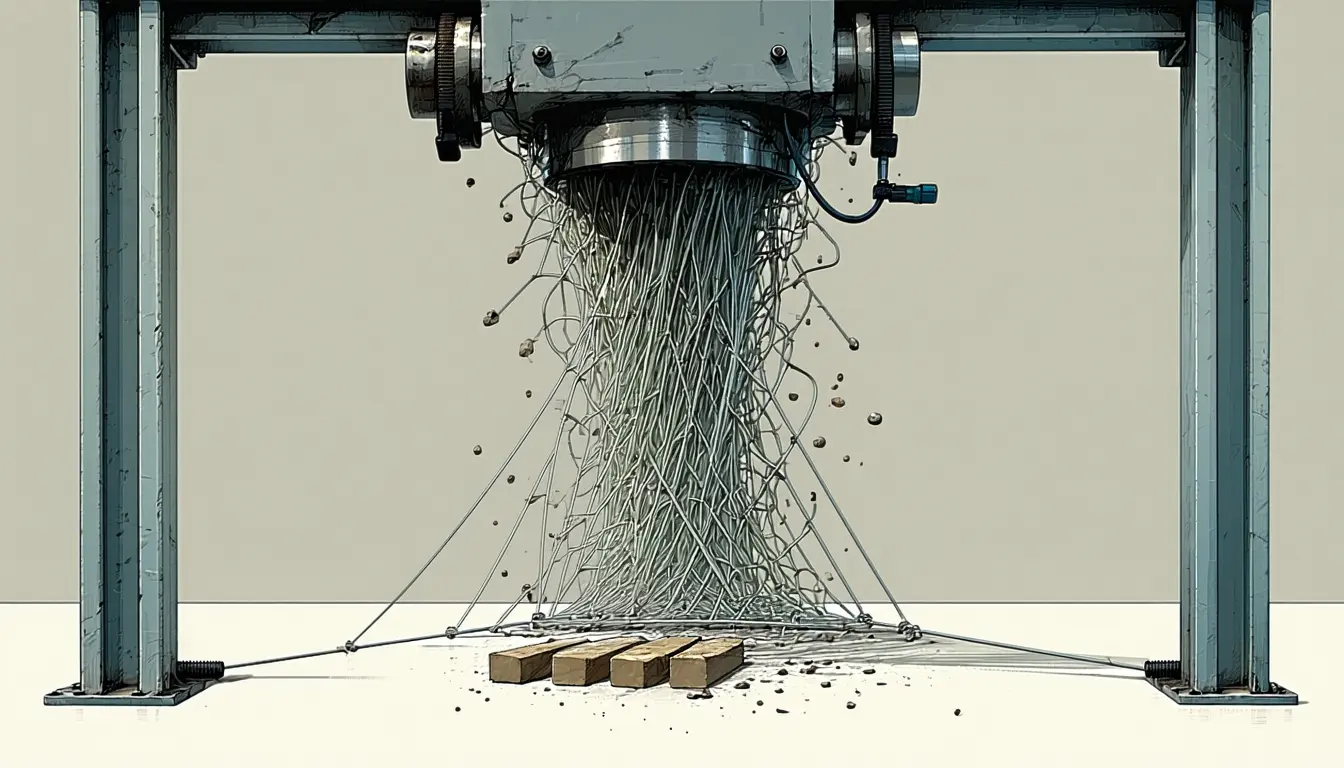
- Researchers at the Eastern Institute of Technology in Ningbo report in Science Advances a framework that searches experimental data for constitutive models of alloy steels, lithium metal and filled rubbers.
- For alloy steels the search produced explicit strain-rate and strain-hardening equations that the authors say predict more precisely than the widely adopted Johnson-Cook model.
- The framework also produced concise plastic-flow equations for lithium metal and a compact hyperelastic equation for filled rubbers that stayed accurate across compositions and temperatures.
Compiled by The ScientistSomething wrong?How this is made
Why it matters
- capability A formula that can be printed, differentiated and checked at its limits can be reviewed by an engineer who never ran the search, which a set of trained network weights does not allow.
- decision The advantage over Johnson-Cook is on the record as a direction, so any materials group weighing a recalibration of its model library has to wait for the paper's numbers before costing the work.
- constraint Use inside a solver depends on the discovered forms holding at temperatures and strain rates the search never saw, and lithium metal is where that demand bites hardest.
- precedent If topology and parameters can be searched in one pass, the same encoding becomes an option for other fields that want a readable law instead of a fitted surface.
The usual way to encode a candidate equation for a machine search is a tree, and the Ningbo team dropped it for a directed graph [4]. Nodes carry the operators and the physical variables. Edges carry the computational connections, and the edges can also hold fixed physical constants and tunable material-dependent parameters [5]. Putting the parameters on the edges is what lets one search do both jobs at once: it looks for a functional form while fitting the numbers inside that form, so a structure found once can be reused across materials that need different parameter values [6].
Yuntian Chen, an EIT associate professor and co-corresponding author, said the encoding was the bottleneck. "By representing mathematical equations as graph structures, we enable simultaneous optimization of equation topology and material parameterization, which resolves this key bottleneck," he said [13].
Across the three material systems, the published account does not include error figures for any of the comparisons [19]. An engineer would want those, because the question about a discovered law is how it behaves at temperatures and strain rates outside the ones that were fitted. Lithium metal is the hard case there. The release describes its mechanical behaviour as highly sensitive to temperature and strain-rate variation, and difficult to model with traditional methods [9].
The interpretability claim is the substantive one [3]. An explicit formula can be differentiated, inspected at its limits and implemented by someone who never saw the experimental data; the weights of a fitted network cannot be read that way. The authors describe the output as physically consistent, compact and human-interpretable [7]. Hao Xu, the study's lead author, said the older route has a ceiling built into it: "Although this paradigm has achieved great success in mechanics research, predetermined equation structures inherently restrict the model's descriptive and predictive capability" [12].
I would expect an established model such as Johnson-Cook to hold its place in production work until other groups recalibrate the discovered equations on their own specimens and report where they fail. Dongxiao Zhang, a chair professor at EIT and corresponding author of the study, said existing forms leave a gap: "Many complex material mechanical behaviors cannot be well described by existing empirical constitutive models" [15].
The team says the framework has potential beyond computational mechanics and material modelling, in disciplines that want interpretable physics [17].
What to watch
- Per-material error metrics in the Science Advances paper, against Johnson-Cook for steels and against the hyperelastic baselines for filled rubbers.
- Whether an independent group recalibrates the discovered steel equations on its own specimens and reproduces the advantage.
- Whether the discovered forms are implemented as user material routines inside finite-element codes engineers already run.