Product1 distinct publisher3 min readPublished
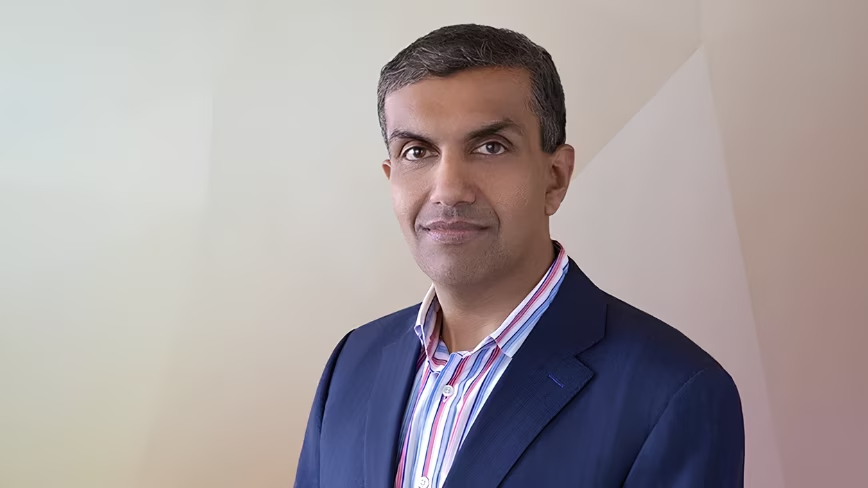
Anil Chakravarthy takes over on 1 December with a record built on Adobe Experience Platform, Workfront and Semrush, so the case that the board is ranking enterprise plumbing over creative tools rests on that CV rather than on anything it said.
The Product Desk · Product desk

product
Adobe puts the same 70-plus tools in Slack that it already gave ChatGPT1 distinct publisher
product
Software spend is weakening for three reasons, and the cycle is only the fourth1 distinct publisher
product
Adobe ships Firefly's audio tools with a licensing claim attached, not just better output3 distinct publishers
leadership
Google prices a 40-second AI video sequence at four dollars1 distinct publisher
Compiled by The Product DeskSomething wrong?How this is made
A good deal of image work now begins in a chat window, and Adobe has put more than 70 of its tools inside ChatGPT [13]. That is extra reach. It is also an admission that the first step of a creative job may no longer happen in an Adobe application [13]. The Firefly assistant runs the same architecture from the other side, wrapping Creative Cloud in a conversational layer sitting over the individual apps [15].
Teams assume users open Photoshop because that is what the assigned seat count implies, but users actually start wherever the prompt box already is and move the file into whatever can finish the job. Seat counts cannot tell those two behaviours apart. The numbers that can are where files originate, how many round trips a job takes, and whether a licence still gets opened in month four of the term.
On that question the incoming chief executive's record is legible. It took 23 months from his January 2020 arrival to running Digital Experience and worldwide field operations as president [19], and the work he is credited with inside Adobe sits entirely on the enterprise side [6]. TNW's version is blunter: Chakravarthy has never run Photoshop, the product now under his authority [7]. Its reading is that the board deliberately chose from the part of Adobe that generative models do not directly threaten [8].
Adobe's own quotes stop short of ranking the two businesses. Creativity appears first in Chakravarthy's own three-item description of "the next era of agentic software for creativity, productivity and customer experience" [11], and neither his statement nor Narayen's mentions a specific creative product [12]. That is the whole textual case for the ranking, and it is thin. TNW concedes the counter itself: Adobe has pushed AI into its creative products aggressively rather than defensively, and the Firefly audio, video and assistant work looks like a company competing on model integration [18]. The competitive pressure is not in dispute either way. Freepik, rebranded as Magnific, is a bootstrapped and profitable AI creative platform on $230m of annual recurring revenue [10].
For the person who owns the Adobe relationship, the useful split is a 2x2. One axis: would a materially better model let you do this line item somewhere cheaper. The other: how much of your own data, taxonomy and approval workflow lives inside it. Production retouching seats land high on substitution and shallow on data. Adobe Experience Platform, Workfront and GenStudio land the other way round, because the campaign metadata and routing rules are yours and they are in there [6]. Sorting Adobe SKUs into those four boxes before the next renewal usually produces a lopsided picture that the total contract value hides.
That sort tells you where your leverage is and where your dependency is, and they are rarely the same box. The buyer holding both has one line they can renegotiate this year and one they will still be inside in three, and the incoming chief executive spent his entire Adobe career building the second one [6].
Ranked by verification strength, evidence, and original report placement.
TNW writes that the person now running Photoshop's owner has never run Photoshop.
Adobe's board said in a statement on Wednesday that Anil Chakravarthy will become president and chief executive on 1 December and join the board, with Shantanu Narayen moving to executive chair.
Frank Calderoni, the lead independent director who chaired the selection committee, said the board decided unanimously after a rigorous process.
Chakravarthy joined Adobe in January 2020 to run Digital Experience, added worldwide field operations that September, and became president of both in December 2021.
Before Adobe, Chakravarthy spent four years as chief executive of Informatica, an enterprise cloud data management company he joined in 2013, with earlier roles at Symantec, VeriSign and McKinsey, and he holds a master's and a PhD from MIT.
Inside Adobe, Chakravarthy led CX Enterprise, GenStudio and Brand Visibility, scaled Adobe Experience Platform, and championed the acquisitions of Workfront and Semrush.
Distinct publishers with included, body-backed reporting in this cluster.
thenextweb.com
1 article · September 4, 2026
Follow any of these and your For You feed starts watching them — no settings page required.
Evidence-backed comparisons of source perspectives and observed adoption signals. Read the methodology
Which Builder, Operator, and Investor concerns the observed source mix emphasized—not a truth score.
Evidence, demonstrated adoption, hype gap, incentives, and confidence are assessed independently, each on its own current evidence. How these are measured.
Firm CV, single-voiced thesis
The checkable spine of this story is one Adobe board statement: the 1 December start date, the titles, the Informatica years, the Workfront and Semrush credits, Calderoni's account of a unanimous vote. Those are the kind of details a press release settles, and they hold. What does not have a second voice is the reading placed on them, that a marketing-data executive was chosen because generative models cannot easily attack that half of Adobe. The mechanism offered for it, integration depth and switching costs, arrives without a churn number, a renewal rate or a segment figure anywhere in the piece.
Product moves counted, strategic thesis left unproven
Shipping evidence exists, but it belongs to Adobe's AI strategy rather than to the succession argument. Over 70 tools are exposed inside ChatGPT and the Firefly assistant already sits above Creative Cloud as a conversational layer. Add the June Topaz Labs agreement and the Semrush purchase, credited to Chakravarthy, and you have four datable moves on both sides of the creative/enterprise line. None of them tells you which side the board favours, and the metric The Next Web says would settle it, growth in Digital Media against the experience business, is discussed without a single figure.
Headline runs ahead of the announcement
Adobe announced that a sitting president was promoted and a long-serving chief executive became executive chair. The Next Web's framing, that Photoshop has been handed to someone who never ran it, is a sharper claim than the board's language will carry, and the sharpest supporting number in the piece, Magnific's $230m of annual recurring revenue, has nothing behind it here. The overstatement is bounded, though: the piece publishes the counter-case, notes the Topaz Labs spending and records that Chakravarthy's field-operations remit covered the creative portfolio too.
Issuer supplies the facts, publisher supplies the meaning
Every quote in this story was written to reassure. The board explains why the vote was unanimous. Narayen endorses his successor. Chakravarthy talks up agentic software without naming a single product anyone buys. None of that is independent of Adobe. Around it sits a publisher whose contribution is a reading Adobe would never volunteer, and that reading happens to make the most quotable version of an internal promotion.
Confident on who, unsettled on why
The start date, the title change, and Chakravarthy's track record all trace back to Adobe's own statement and hold up. The board's underlying reasoning is a different matter: it is The Next Web's own reading of his resume, and the piece itself argues against that reading in its final third. Until the Digital Media and experience growth lines are on the table, or someone at Adobe answers the question directly, that reading stays a hypothesis with a good story attached.