Science1 publisher2 min readPublished
Pose tracking scores the moment a temperature-stressed medaka loses its balance
A Nagoya-led group checked its system against expert scorers on 50 fish and got an identical call on repeat runs of the same video, which fixes reproducibility without settling what the endpoint predicts in the wild.
The Scientist · Science desk
What happened
- A Nagoya and Fukui team reported in Scientific Reports on September 10 a system pairing DeepLabCut pose tracking with a ResNet34 image classifier to detect when a temperature-stressed fish loses equilibrium.
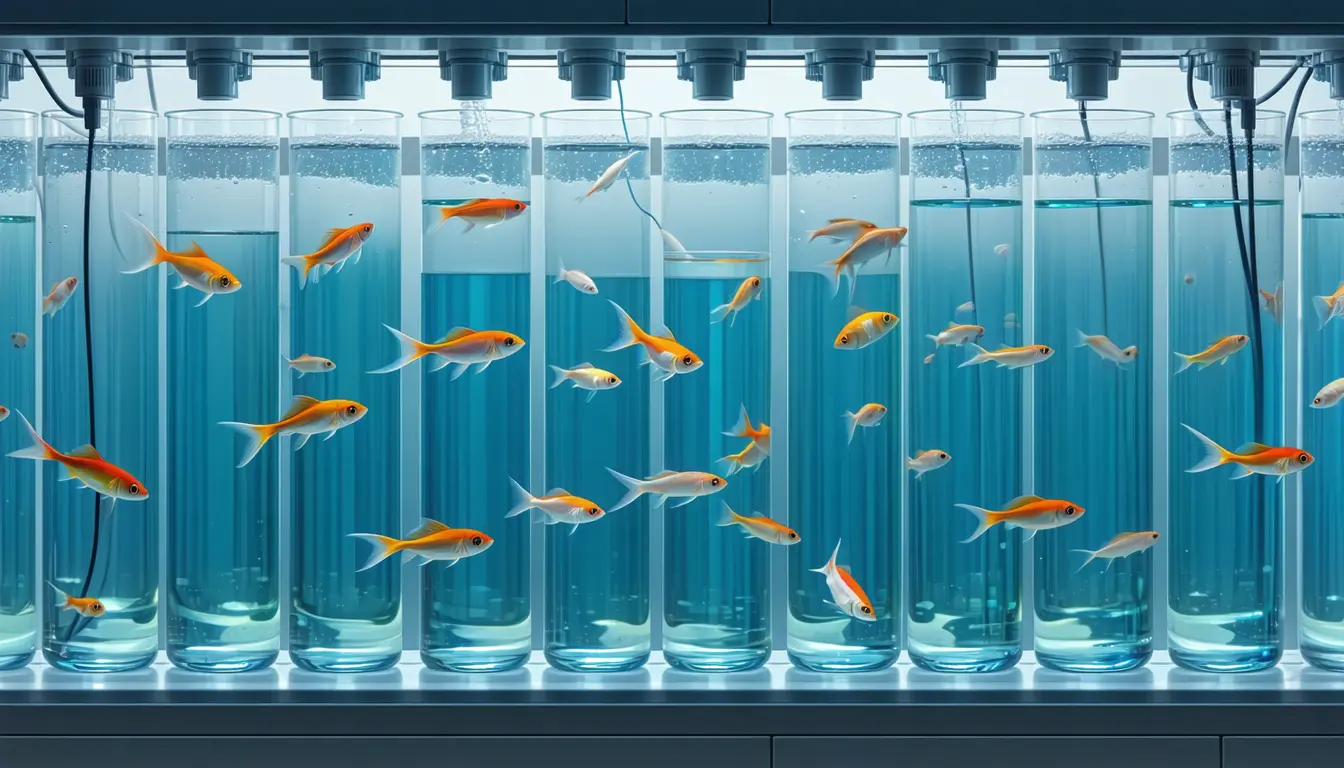
- DeepLabCut tracks seven points on each fish, among them the nose tip, both fins, the body centre and the tail, while the rig photographs individuals in separate compartments and identifies which fish is which.
- Across 50 individuals, the system's calls were about as accurate as the variation among experienced human scorers, the comparison the team used to argue that the method is reliable.
- Applied to medaka strains and related Oryzias species, tolerance differed by strain, higher-latitude species tended to be more cold-tolerant, and Japanese medaka showed the highest cold tolerance.
- Oryzias cabaranensis, a Taiwanese relative described as a new species in 2025, tolerated cold better than the latitude of its habitat would predict.
Compiled by The ScientistSomething wrong?How this is made
Why it matters
- capability With identical answers on repeat runs and automatic per-compartment identity, thermal screening across many strains becomes a video-throughput problem rather than a person-hours problem.
- constraint Benchmarking against expert scorers means the method can remove drift between viewings but cannot demonstrate that the scored moment is closer to the biological transition.
- decision Labs sitting on archives of thermal-ramp video now face a choice between rescoring them under one model and leaving visually scored results in the literature that cannot be pooled.
- precedent If more species break the latitude pattern, assigning thermal limits from a range map gets harder to defend and measured per-strain values become the expected input.
Loss of equilibrium is a judgment about a transition, not a reading off a gauge. A fish on a slow temperature ramp does not stop swimming upright at a particular frame; it tilts and rights itself, then tilts for longer. That is what the two-model pairing is for: DeepLabCut supplies per-frame coordinates for the seven landmarks, and the ResNet34 classifier reads those movement traces together with the video before calling the state [1][5]. The older protocol was the same ramp with a person watching the tape, and the authors are direct about what that cost: results varied with the viewer, and screening large numbers took considerable time and effort [9].
Reliability here is defined against people. The system's calls across 50 individuals sat within roughly the spread of determinations made by experienced researchers [7]. That is the honest comparison to run, and it also caps what the study can claim, because with human judgment as the reference, model error and ambiguity in the endpoint itself cannot be separated [15]. The gain that does not depend on the reference is repeatability: re-analysing the same video returned the same answer [8]. Manual scoring cannot promise that, and within-lab drift is one reason two labs' numbers for the same species are hard to set side by side.
The phys.org account does not carry the figures a comparative physiologist would want, with no critical temperature values and no ramp rate reported [16]. The number of strains and species tested is not given either [16]. So the latitude pattern arrives as a direction with one named exception rather than as an effect size, and the authors read that exception as evidence that something besides latitude shapes thermal adaptation [13].
The climate application is stated as expectation, and reads best that way: the group expects the method to enable larger comparisons among strains and species, and suggests such work may contribute to predicting climate impacts and to conservation [4][14]. Fish are ectotherms, so ambient water temperature acts directly on their bodily functions, which is a good reason to want tolerance limits measured carefully [10]. What this work establishes is a more reproducible way to score one laboratory endpoint. Nothing in it ties the moment a fish loses balance in a compartment to whether a population persists in a warming river, and the source claims no such link. A reproducible input beats a subjectively scored one, which is a real gain and a narrower one than the framing around it.
What to watch
- The Scientific Reports paper's reported critical temperatures and ramp protocol, which would let other labs test their legacy numbers against these.
- Whether an independent group reproduces the Oryzias cabaranensis cold-tolerance result on separately sourced fish.
- Whether the trained models and labelled video are released, so other labs can rescore their own archives instead of training from scratch.