Science1 publisher3 min readPublished
A briefcase of filters put smoke-metal estimates on a Colorado fire crew's phone
Stanford's SmokeCast prototype rode a fire truck 300 miles in July 2026 and fed soil-metal likelihoods to the crew's app, while the smoke samples that could test those estimates stayed in a cartridge for 14 days.
The Scientist · Science desk
What happened
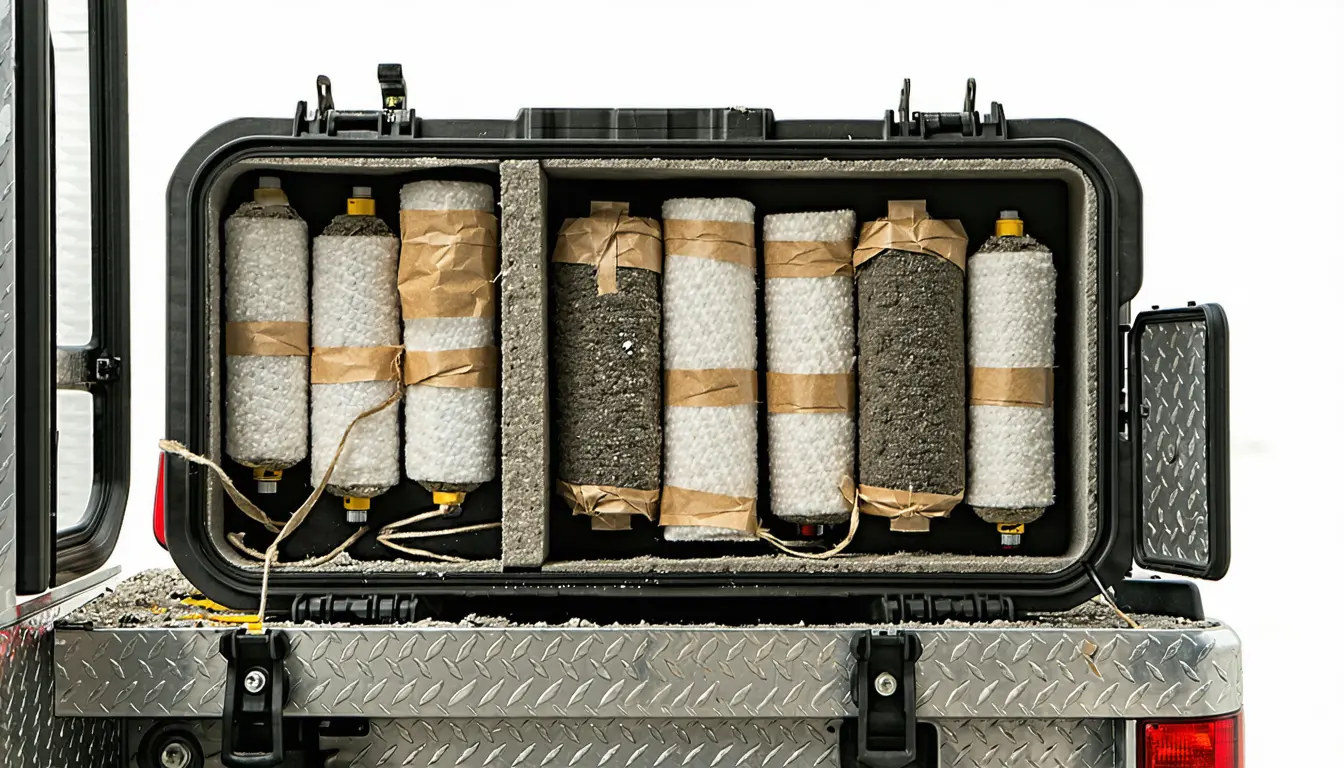
- In early July 2026, Stanford's Alex Honeyman and Mark Leone strapped a briefcase-sized box to a Colorado fire truck about to be dispatched to a wildfire 300 miles away.
- The box held prototype air filters and satellite-linked sensors that sampled smoke and measured temperature, humidity and toxic gases such as carbon monoxide around the truck.
- A smartphone app fed the crew real-time readings, helped them decide what gear to wear at the scene, and calculated the probability that sparks could ignite another blaze.
- The same app, part of a Stanford project called SmokeCast, estimated the likelihood that soils within 10 miles of the fire would release toxic metals when heated.
- The crew pulled the sample cartridge only when the truck came back to its station 14 days later, and sent it to Scott Fendorf's Stanford lab for analysis.
Compiled by The ScientistSomething wrong?How this is made
Why it matters
- capability A hazard number reaching a crew's phone during the shift changes when protective-gear choices can be made, from after a fire when lab work is done to while the truck is still staging.
- decision Any agency that wants to use this has to decide how much a protective-gear call can depend on a probability when the accuracy of that probability has not been published.
- constraint Calibrating a nationwide forecast against EPA particle records collected only occasionally caps how tightly the model can be tuned, so the team needs a sampling stream of its own.
Whether a wildfire puts metals into the air depends on what is in the ground where it burns, and that evidence is recent [6]. After the 2019 Kincade Fire in Sonoma County, Scott Fendorf's group at Stanford looked at how fires convert naturally occurring metals, harmless while locked in soil, into airborne particles linked to cancer and other health problems when people breathe them in [7].
The app's metals output therefore describes the ground. It gives the likelihood that soils within 10 miles of the fire will release metals under extreme heat [4], an area of roughly 314 square miles [18]. The estimate is defined across that whole radius, so it does not separate one staging point inside the circle from another [4].
The chemistry that could check the estimate rode along with it. The cartridge stayed in the box until the truck reached its station 14 days later, and only then went to Fendorf's lab [5]. The confirming measurement trails the field number by at least two weeks [19]. The phys.org account carries no comparison between what the app told the Colorado crew and what the filters held [20]. The trial covered one truck on one dispatch [1].
Widely used air quality ratings, including the EPA's Air Quality Index, are typically based on the concentration of the fine particles known as PM2.5 [9]. "It doesn't tell you anything about the chemistry, and that is a huge gap," Honeyman said [10]. Fendorf described the timing problem in similar terms: current smoke and air quality forecasts say when the main plume is coming, "but the toxic metals are out front, or maybe already hitting you, before you're taking any precautions," he said [16]. Fendorf also said there is no way at present to monitor the metal content of smoke in real time or to forecast where it will go as a plume travels [8].
SmokeCast is one of more than 110 active projects supported by the Stanford Sustainability Accelerator [12]. Gemma Guilera Ferre, a managing director there, pushed the team to consider immediate use to first responders, which prompted Honeyman, a volunteer firefighter for 10 years, to build hardware [14]. "What are my firefighter friends actually going to do differently on a daily basis based on what we find?" Honeyman said [15]. The sampling devices were designed first for drones that could be flown into plumes [17].
The model behind the estimates combines data on how local geology and fire temperature affect metal release, how smoke spreads and how fast it travels in different wind and weather, and historical measurements of smoke particle density that the EPA takes only occasionally [11]. The team applied to the accelerator for support in turning Fendorf's lab science into a model that could someday give a nationwide forecast of toxic metals in smoke [13].
What to watch
- A published comparison of the app's soil-metal likelihoods against the filter chemistry from the same fire would show whether the estimate is calibrated.
- Whether the model can be fitted on EPA smoke particle density records taken only occasionally, or needs a denser sampling network built from truck-mounted boxes.
- A fire agency writing the metal likelihood into PPE or staging protocol. That step would make an unvalidated number operational.