Science1 publisher2 min readPublished
Oyster mushroom mycelium fermented tofu's leftover pulp to 30% protein in 11 days
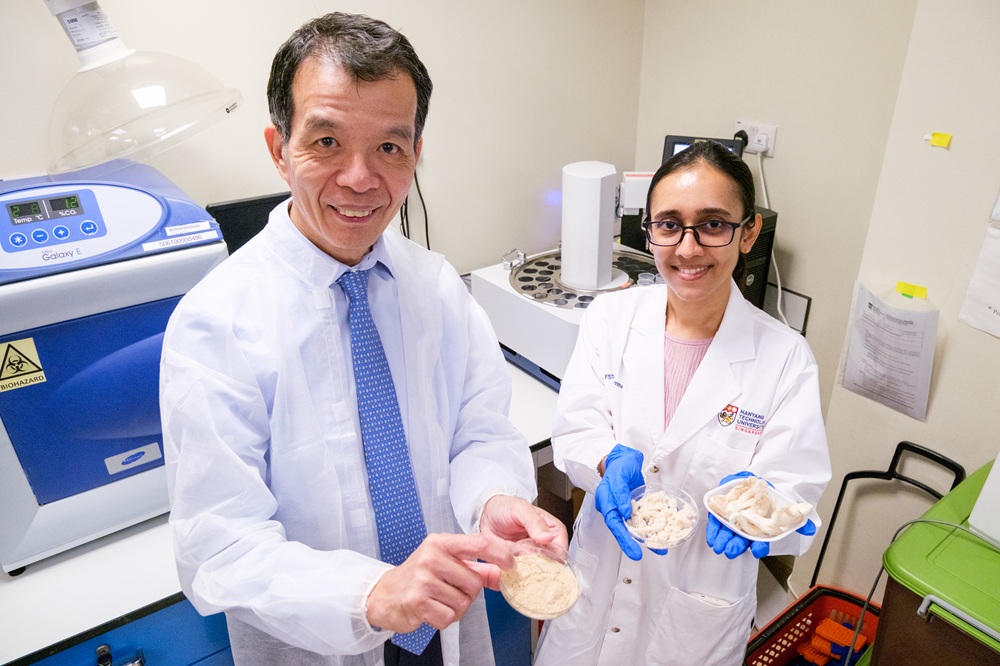
In a lab-scale run at NTU Singapore, oyster mushroom mycelium grew through the pulp left over from tofu and soymilk, cutting its sourness and raising its umami compounds. The open questions are energy and scale-up.
The Scientist · Science desk
What happened
- NTU Singapore grew oyster mushroom mycelium directly on moist okara in solid-state fermentation, and on fresh okara the fungus covered the material completely over an 11-day laboratory incubation.
- Protein content of the fermented material measured between 27.7% and 30.2% by dry weight, with nitrogen level used as the indicator.
- An electronic tongue fitted with chemical sensors recorded lower sourness and significantly higher umami and overall taste richness in the fermented okara.
- Free amino acids came out 2.2 to 6.6 times higher than in unfermented okara, and the 5'-nucleotides that intensify umami rose 3.2 to 6.3 times.
- The work was done with the Japanese food manufacturer Ichimasa Kamaboko and the team describes the results as proof of concept, subject to further process optimization.
Compiled by The ScientistSomething wrong?How this is made
Why it matters
- constraint Fresh okara gave the densest growth and the highest savory amino acids, and fresh okara spoils fast, so the fermenter belongs next to the tofu line unless someone pays to dry the feedstock first.
- cost Eleven days of vessel occupancy per batch limits a single fermenter to roughly 33 runs a year, so capital and floor space per tonne of ingredient set the price this material has to beat. The biology is not the constraint.
- decision A tofu or soymilk plant already gets something for okara as animal feed, so the investment case is measured against that revenue plus the disposal cost avoided. The report does not give those figures.
- capability Chen points to a companion study in which mushrooms fruited on okara-containing substrate were more nutritious. That would let one waste stream support a fermented ingredient and a mushroom crop from the same plant.
Oyster mushroom mycelium secretes enzymes that break okara's complex plant fibers into simpler, more digestible nutrients, releasing sugars and amino acids as it grows [8]. Glucose rose 2.8 to 6.4 times [10]. That gain and the amino acid gains both started from low baseline levels, and the report gives fold changes and a final protein percentage without the absolute concentrations underneath them [10][12][22].
The protein figure comes from nitrogen [9]. NTU calls nitrogen one indicator of protein content, and a nitrogen-based estimate is a narrower claim than a direct measure of digestible protein [9].
Taste was scored with an electronic tongue, an array of chemical sensors [11]. The paper, in Food Chemistry: X, reports glutamic and aspartic acid, the two amino acids behind umami, up to 4.1 times higher after fermentation [4][13]. William Chen, who directs NTU's Food Science and Technology Program and its Future Ready Food Safety Hub, said: "Our findings show that oyster mushroom mycelium can naturally improve okara by changing its composition and producing compounds that give it a savory, umami taste." [18][16] A sensor array measures chemistry. Whether a shopper would buy the product is a separate question, and Chen lists consumer acceptance among the items still to be evaluated [11][17].
Chen said: "This proof-of-concept approach offers a promising way to turn okara into more valuable food ingredients instead of discarding it, though further research is needed to evaluate pretreatment requirements, energy efficiency, scale-up feasibility and production economics alongside food safety and consumer acceptance." [17] The fermentation ran 11 days before the mycelium had fully covered the fresh okara [7]. Dividing 365 by 11 gives about 33 batches a year in a single vessel, before any cleaning or turnaround time [20].
Okara is often discarded as food waste or used as low-value animal feed [3]. A fermentation step has to earn back more than the feed revenue it displaces and the disposal it avoids. Chen also said that a separate study by his team showed "oyster mushrooms grown on a substrate containing okara have enhanced nutritional value" [19].
What to watch
- Whether a follow-up publishes results for dried okara alongside the energy cost of drying it, since drying is what would let the material be shipped.
- A human sensory panel run against the electronic tongue scores. Consumer acceptance turns on that test.
- Whether Ichimasa Kamaboko takes the process to pilot scale and reports yield and cost per tonne of finished ingredient.